Weird Medical History · Engineering
The Mechanical Horse That Trotted So You Didn't Have To — and the Doctor Who Invented the Gym Machine
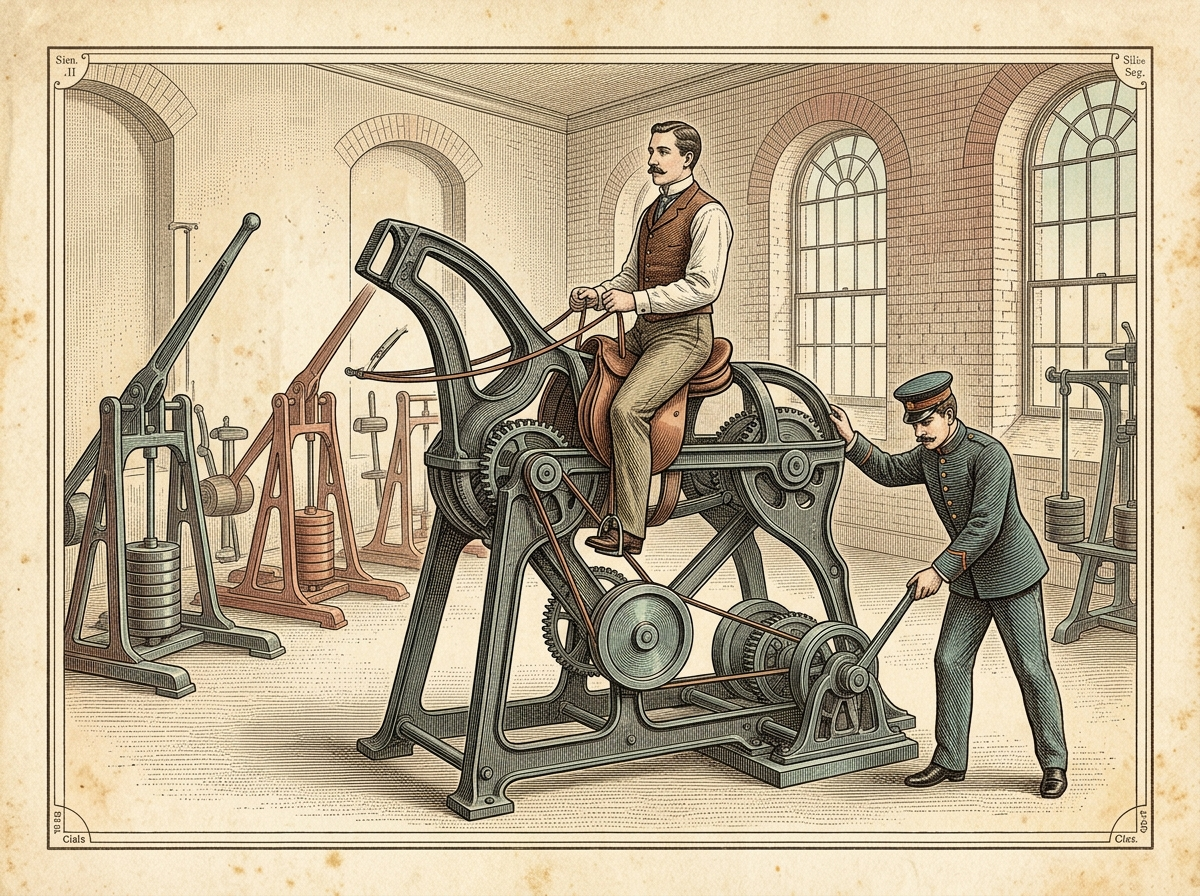
Around 1915, a bathhouse in Hot Springs, Arkansas, took delivery of a horse with no head, no legs, and no appetite. It was a saddle on a machine, driven by an electric motor, and it existed so that guests could go for a brisk ride without ever going anywhere. Its designer, the Swedish physician Gustav Zander, had spent decades building machines like it — and in the process helped invent the modern gym machine.
By the Curiosities Desk · · 5 min read · Filed under Engineering · Today’s round
What happened?
Gustav Zander was born in Stockholm on March 29, 1835. His work grew out of Swedish gymnastics, the “movement cure” developed by Pehr Henrik Ling, in which patients exercised specific muscles while a trained assistant pushed back against them by hand. The method was popular and respected, but it had a built-in weakness: human assistants get tired, and their resistance wobbles from one push to the next.
In the late 1850s, Zander started experimenting with a fix. He attached a weight to a lever. Slide the weight farther out, and the exercise got harder; slide it closer, and it got easier. A machine, he realized, could supply the same steady resistance all day long. He qualified as a physician in 1864, and in 1865 opened his Medico-Mechanical Institute in Stockholm, stocked with 27 of his machines. It was state-supported and open to patients regardless of what they could pay.
The machines came in three families. “Active” machines made you work against the adjustable weight. “Passive” machines, driven by motors, moved your limbs for you — useful for people too weak or paralyzed to move on their own. And a third family delivered what Zander’s colleague Alfred Levertin called “mechanical influences”: shaking, vibration, percussion, kneading, rolling, and friction. Zander gave each model a letter-and-number code, and the Swedish names in the archives of Stockholm’s Tekniska museet read like a spa menu written by a blacksmith: A8a armvridning (arm twisting) and G3 lårhackning — roughly, “thigh chopping.”
Then the machines went international. At the 1876 Centennial Exposition in Philadelphia, Zander won an award for mechanical design, and he pitched his apparatus to a new class of desk-bound businessmen as “a preventative against the evils engendered by a sedentary life and the seclusion of the office.” By the 1880s he had opened an institute near Central Park in New York, and by 1904 a fully equipped Zander institute boasted 74 different implements.
Some of the most popular asked almost nothing of the user. One abdominal machine pressed rhythmic, oscillating leather pads against the stomach, and a brochure promised that “sunken vital energy is raised.” The motor-driven mechanical horse was even more relaxing. An early American guide, quoted by historian Carolyn de la Peña, told riders: “All you need to do is sit down in the saddle.”
In 1911, 36 Zander machines were installed at The Homestead, a resort in Hot Springs, Virginia. In December 1914, Samuel Fordyce, owner of the Fordyce Bathhouse in Hot Springs, Arkansas, ordered his own set from a New York supplier. Among the first arrivals were the F-1 “universal vibratory,” the F-2 “mechanical horse,” and an upper-body combination machine.
Why was it strange?
We picture the early gym as a place of sweat and iron. The first machine gym was, in large part, a place where machines moved people. Zander’s equipment was enormous and gleaming, packed with cranks and flywheels, and much of it was built to apply force to the body rather than draw force from it. De la Peña argues that a big part of the appeal was the experience itself: in an age dazzled by engines, being shaken, kneaded, and trotted by one felt modern and powerful.
That doesn’t make Zander a crank. His central idea, precise and adjustable resistance, was sound, and his passive machines served patients who could not exercise any other way. The strange part is how quickly a carefully measured medical tool became a fashionable way for the healthy to be exercised without exerting themselves. For an earlier fitness machine with an even stranger first job, see From the Everlasting Staircase to the Home Gym: A Short History of the Treadmill.
What did scientists learn?
Zander’s lasting insight is what he called “progressive exertion”: strength builds best when resistance is controlled and increased step by step. Because his lever-and-weight system made resistance measurable, each machine doubled as a dynamometer, a device that measures force. Levertin noted that when the weight was set too high, the movement became “tremulous and irregular,” a visible sign the muscle had reached its limit. That’s essentially the logic of every weight stack in a modern gym.
The vibrating, kneading, and trotting machines are harder to evaluate. Claims that they raised “vital energy” were never tested in anything like a modern trial, and much of their reported benefit may have come from relaxation and expectation rather than mechanics. Another treatment that leaned on the dazzle of new technology: The Box of Light Bulbs the Corn Flakes Doctor Said Cured a King.
How does it affect us today?
Zander’s machines found serious work during World War I, when hospitals used mechanotherapy to rehabilitate wounded soldiers’ stiff joints and weakened limbs. A 1916 report in the journal The Hospital described large installations in French hospitals and argued for more in Britain. That mission lives on in physical therapy, where carefully graded, measurable resistance is still a core tool.
The bulky machines themselves faded by the 1930s, crowded out by smaller equipment and by the costs of war and the Depression. The idea came roaring back in the 1970s with Arthur Jones’s Nautilus machines, which also varied resistance through a movement. Jones later said he developed them without knowing Zander’s work. Every row of cable stations and leg-press machines at your local gym is, in a sense, a Zander institute. For another machine that promised health through sheer gadgetry, see The Electric Celestial Bed That Promised Couples a Baby.
Fun fact
You can still see a Zander F-1 “universal vibratory” machine on display inside the Fordyce Bathhouse at Hot Springs National Park, part of a collection the National Park Service describes as the largest known in the United States.
Sources
- National Park Service, Hot Springs National Park, “The Therapy Machines of Dr. Gustav Zander”: https://www.nps.gov/hosp/learn/historyculture/the-therapy-machines-of-dr-gustav-zander.htm
- Alfred Levertin, “Zander’s Medico-mechanical System of Gymnastics,” in G. Sundbärg (ed.), Sweden: Its People and Its Industry (Stockholm, 1904), via Project Runeberg: https://runeberg.org/sverig01en/0379.html
- Tekniska museet (Swedish National Museum of Science and Technology), archive photograph “Gustaf Zanders mediko-mekaniska gymnastik. G3 Lårhackning,” via DigitaltMuseum: https://digitaltmuseum.se/0210113978062/g3-larhackning
- Carolyn de la Peña, “The Origins of Cybex Space,” Cabinet, Issue 29 (Spring 2008): https://www.cabinetmagazine.org/issues/29/pena.php
- Gust. Hamel, “Physical Treatment of War Injuries: Zander Mechanotherapy,” The Hospital, November 25, 1916 (via PubMed Central): https://pmc.ncbi.nlm.nih.gov/articles/PMC5230905/
Related stories
- From the Everlasting Staircase to the Home Gym: A Short History of the Treadmill — The exercise machine that started out as a punishment
- The Box of Light Bulbs the Corn Flakes Doctor Said Cured a King — Another dazzling machine from the age of the health spa