Weird Medical History · Archaeology
The Ancient Egyptian Pregnancy Test That Asked Women to Pee on Grain — and Sort of Worked
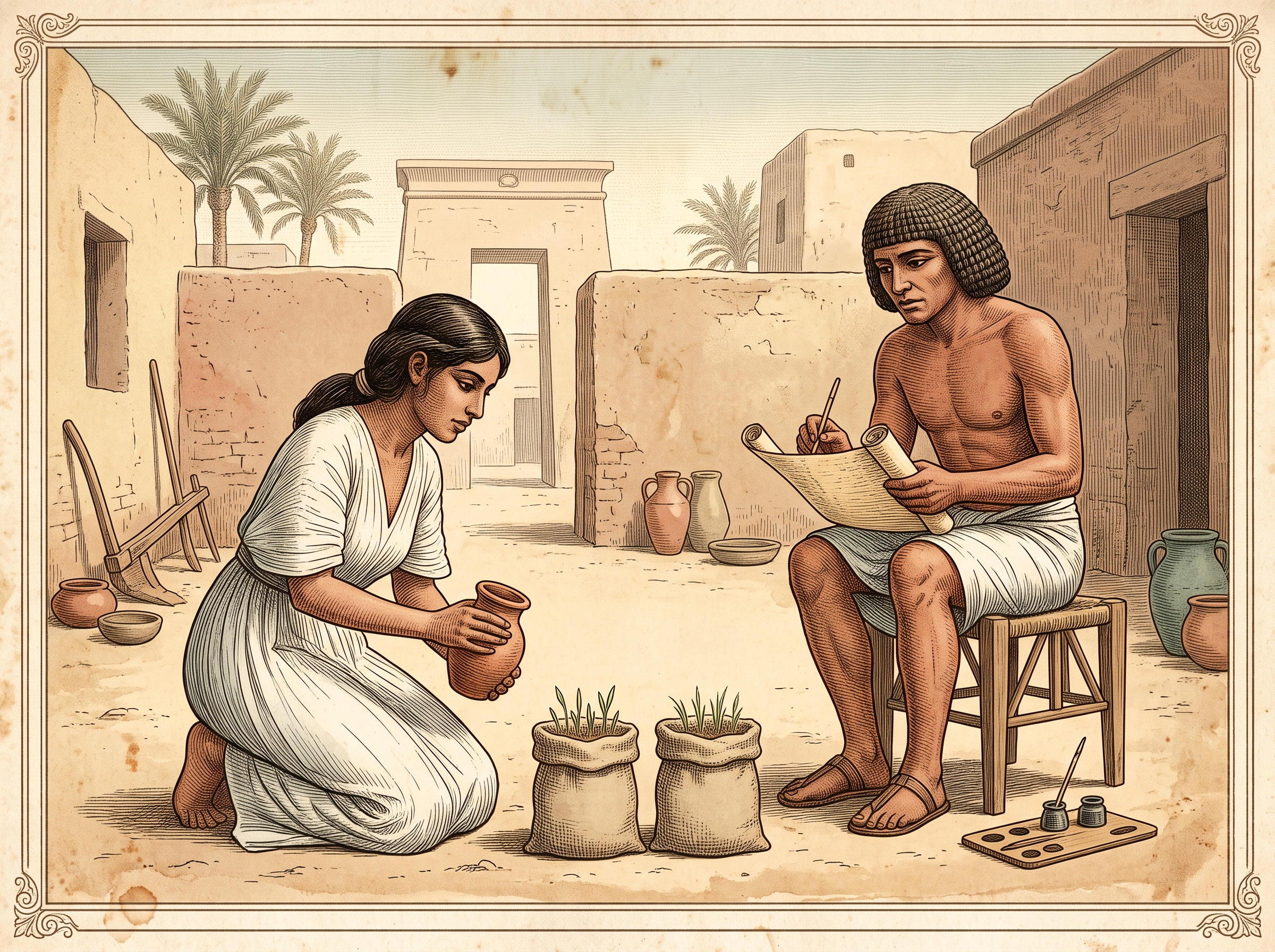
Picture two small cloth bags, one of wheat and one of barley, and a woman who has been asked to water them every day — not with water. If the seeds sprout, the papyrus promises, she is going to have a baby. If only the barley comes up, it's a boy; only the wheat, a girl. If nothing grows at all, she will not bear. More than three thousand years later, a team of scientists in Cairo set out Petri dishes to find out whether any of it was true.
By the Curiosities Desk · · 5 read · Filed under Archaeology · Today’s round
What happened?
The instructions survive in the Berlin Medical Papyrus (catalogued as P. Berlin 3038), a New Kingdom Egyptian medical text usually dated to around 1300 BCE, and in a closely related passage in the Carlsberg Papyrus VIII, held at the University of Copenhagen. Egyptologists think both are copies of even older originals. In the translation by the historian Warren Dawson, the woman is told to water wheat and a second grain “daily with her urine,” packed in two bags. Both grains growing means she will give birth; which grain grows decides the sex; neither growing means no baby.
There’s a catch that scholars still argue about: nobody is completely sure which grains the Egyptian words mean. Different translators have rendered them as wheat and spelt, wheat and barley, or barley and emmer, and they don’t agree on which one stood for boys.
The test was remarkably durable. Greek medical writers repeated versions of it, Arabic physicians described a variant in the tenth century, and University of Copenhagen Egyptologist Sofie Schiødt, who translated the Carlsberg passage, has pointed out that it turns up in a German folk-medicine book as late as 1699. By one account, people in parts of Asia Minor were still using it in the twentieth century.
In 1963, three Egyptian researchers — the physician and medical historian Paul Ghalioungui, with Sh. Khalil and A. R. Ammar — decided to test it properly. The obstetrics department at Ain Shams University Hospital in Cairo sent 48 numbered urine samples to the plant physiology department of Egypt’s National Research Centre: 40 from pregnant women, 6 from women who weren’t pregnant, and 2 from men. The plant scientists didn’t know which was which.
For each sample they laid out 12 Petri dishes of 50 seeds each, using two local varieties of wheat and two of barley. Some dishes got undiluted urine, some got urine diluted half-and-half with distilled water, and some got plain distilled water as a control. After three to five days at about 25°C, they counted what had sprouted. Then they waited for the babies to be born and checked the predictions against reality.
The results, published in the journal Medical History, were surprising. Urine from men and from non-pregnant women stopped the seeds cold: no growth at all, in every case. (A follow-up with 20 more non-pregnant samples in pots of real soil also produced nothing.) Urine from pregnant women let the seeds sprout in 28 of 40 cases — 23 with growth close to the water controls and 5 with weaker growth.
The sex prediction was another story. In only 7 of the 40 pregnancies did one grain sprout while the other stayed completely dormant and correctly called the baby’s sex. Even counting generously, the authors found 19 correct calls out of 40 — worse than flipping a coin. Their verdict was blunt: the sex of an unborn child “cannot be predicted” this way.
Why was it strange?
We tend to file ancient medicine under charms and guesswork, and plenty of it deserves that label. But half of this test held up in a modern lab. When grain sprouted, the urine really did come from a pregnant woman; the 1963 team never got a false positive. The ancient physicians had seemingly stumbled onto a real biological signal thousands of years before anyone knew what a hormone was.
The test wasn’t a reliable way to rule pregnancy out, though. In 12 of the 40 pregnant women, nothing grew — a negative result for a woman who was, in fact, pregnant. So it worked like a smoke alarm that never goes off by mistake but sometimes stays silent during a fire.
The same thread — Egyptology — continues in The 3,000-Year-Old Wooden Toe Scientists Test-Drove in Replica Egyptian Sandals.
What did scientists learn?
The Cairo study showed the effect ran backward from what you might expect. Ordinary urine seems to contain something that stops germination, and in many pregnant women that brake is weakened or cancelled out. The researchers found that bubbling air through the urine also lifted the brake, which hinted the inhibiting substance could be broken down by oxidation.
What exactly the pregnancy factor is remains unsettled. It probably isn’t hCG, the hormone modern pregnancy tests detect: earlier German experiments had found that boiling or dialyzing the urine didn’t change the result, which ruled out large protein hormones in the authors’ view. Later writers have suggested the higher levels of estrogen during pregnancy might play a role, but that is an educated guess rather than an established finding.
The sex half had a humbler origin. The German philologist Hermann Grapow argued that the pairing of grain and gender probably came from grammar, not observation: in Egyptian, barley was a masculine noun and wheat a feminine one.
Another treatment that history kept the receipt for: The 5,300-Year-Old Iceman Whose Tattoos May Have Been Medicine.
How does it affect us today?
The idea at the heart of the test — that urine carries chemical news about a pregnancy — is exactly how modern tests work. The line from the papyrus runs through medieval urine-gazing doctors, the rabbit and frog tests of the twentieth century, and finally the home pregnancy test, which the NIH’s history office traces back to this Egyptian recipe.
The papyri themselves are also still yielding surprises. Many texts in the Carlsberg collection, bought in the 1930s, were only being translated and published in recent years, and they keep adjusting our picture of what Egyptian doctors knew.
Elsewhere in archaeology: The Circus Strongman Who Found Egypt’s Greatest Tomb.
Fun fact
Grapow noticed that when the test resurfaced in a medieval German book, the sexes had been swapped — wheat for boys, barley for girls. In German, the grammar runs the other way: der Weizen (wheat) is masculine and die Gerste (barley) is feminine. The prediction apparently followed the language, not the baby.
Sources
- Ghalioungui, P., Khalil, Sh., and Ammar, A. R. “On an Ancient Egyptian Method of Diagnosing Pregnancy and Determining Foetal Sex.” Medical History 7, no. 3 (1963): 241–246: https://doi.org/10.1017/S0025727300028386
- Smithsonian Magazine, “Egyptian Papyrus Reveals This Old Wives’ Tale Is Very Old Indeed” (2018), on the Carlsberg Papyrus translation: https://www.smithsonianmag.com/smart-news/egyptian-papyrus-reveals-old-wives-tale-very-very-old-indeed-180970066/
- The Papyrus Carlsberg Collection, University of Copenhagen: https://pcarlsberg.ku.dk/
- The Embryo Project Encyclopedia (Arizona State University), “Pregnancy Tests”: https://embryo.asu.edu/pages/pregnancy-tests