Accidental Discoveries · Archaeology
The Runaway Goat That Led to the Dead Sea Scrolls
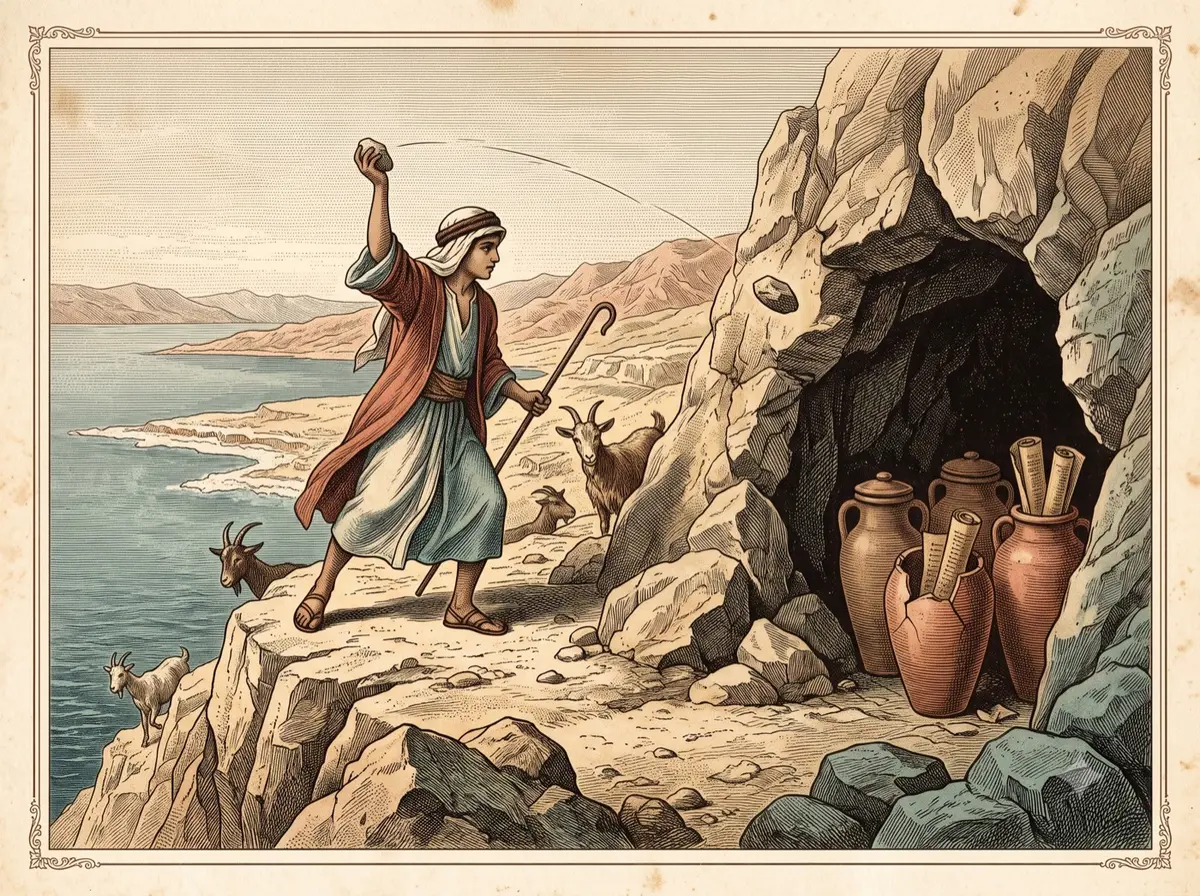
Sometime in the winter of 1946–47, a Bedouin teenager climbing the limestone cliffs above the Dead Sea threw a rock into a dark opening in the rock face, hoping to chase a stray goat back into view. Instead of a bleat, he heard something shatter. Inside the cave sat a row of tall clay jars, and inside the jars, wrapped in linen that crumbled at a touch, lay leather scrolls that no human eye had read in two thousand years.
By the Curiosities Desk · · 6 min read · Filed under Archaeology · Today’s round
What happened: The Dead Sea Scrolls
The story, as it’s usually told by the family and later retold by scholars, centers on a young shepherd of the Ta’amireh Bedouin tribe named Muhammed edh-Dhib (“the wolf”). Exactly when it happened is genuinely uncertain — accounts place it anywhere from late 1946 to early 1947, and even edh-Dhib gave differing versions of the date over the years. What’s well documented is that he was searching for an animal near the ruins of Qumran, on the northwestern shore of the Dead Sea, when he found the cave opening, tossed in a stone, and heard pottery break. He didn’t go in that day. He and two companions, his cousin Jum’a Muhammed and a third herder named Khalil Musa, returned to explore it, and found several intact jars holding seven leather and papyrus scrolls, some wrapped in linen, one written on copper.
The Bedouin didn’t report the find. They carried the scrolls to Bethlehem and sold them to a cobbler and antiquities dealer named Khalil Iskander Shahin, known as Kando, for a sum sources describe only as strikingly small — a tiny fraction of the scrolls’ eventual worth. From Kando, some scrolls reached an archbishop at Jerusalem’s St. Mark’s Syrian Orthodox Monastery, Metropolitan Athanasius Yeshue Samuel; others reached Hebrew University archaeologist Eleazar Sukenik, who bought three scrolls in November 1947, days before the UN vote to partition Palestine.
Samuel’s scrolls eventually left the country. On June 1, 1954, an ad in The Wall Street Journal’s classified section read: “The Four Dead Sea Scrolls. Biblical Manuscripts dating back to at least 200 B.C. are for sale.” Sukenik’s son, Yigael Yadin — an archaeologist and former Israeli military chief of staff — arranged to buy them for $250,000 and bring them home, reuniting them with the scrolls his father had bought seven years before.
Once scholars grasped what the Bedouin had stumbled onto, archaeologists led by Roland de Vaux and G. Lankester Harding began systematically searching the Qumran cliffs. Between 1949 and 1956 they identified eleven caves holding scroll material, including Cave 4 alone, which held fragments of roughly 400 manuscripts. In total, the caves yielded somewhere around 900 to 980 distinct manuscripts, represented today by an estimated 15,000 fragments, most no larger than a postage stamp, written mainly in Hebrew and Aramaic and dating from roughly the third century BCE to the first century CE.
Why it was strange: The Dead Sea Scrolls
Before Qumran, the oldest known complete Hebrew Bible manuscripts were medieval — copied around the 9th and 10th centuries CE by scribes working from a standardized text known as the Masoretic tradition. The Dead Sea Scrolls pushed that timeline back more than a thousand years in a single discovery, and included fragments or complete copies of nearly every book of the Hebrew Bible, most strikingly a nearly intact scroll of the entire Book of Isaiah.
What surprised scholars wasn’t just the age, but the mix of consistency and diversity in the text. Some passages matched the much later Masoretic version astonishingly closely, suggesting centuries of careful copying. Others diverged meaningfully — different wording, different verse order, even different endings — showing that “the Bible” wasn’t yet a single fixed text in this period, but a living tradition still being copied in variant forms. That a stray goat led to evidence upending assumptions about how sacred texts were transmitted is itself part of the strangeness: one of the twentieth century’s most consequential archival discoveries began with no funding, no expedition, and no archaeologist anywhere nearby.
It shares a shelf with The Teenagers Who Found a 20,000-Year-Old Art Gallery, in The Finds That Started on the Wrong Errand.
What scientists learned: The Dead Sea Scrolls
Dating fragile material this old pushed dating science forward. Early radiocarbon tests in the 1950s used pieces of the linen wrappings, since sampling the scrolls themselves destructively wasn’t yet feasible. Later, accelerator mass spectrometry (AMS) — a technique that counts individual carbon-14 atoms rather than waiting for them to decay — let labs date the scrolls directly using samples of just a few milligrams. Results from independent labs in Zurich and Tucson, run on the Great Isaiah Scroll, came back nearly identical, reinforcing confidence in the method, though researchers also had to account for contamination from castor oil that early conservators applied to soften the parchment.
In 2020, a team including researchers at Tel Aviv University sequenced ancient DNA extracted from scroll fragments — sometimes from nothing more than dust on old preservation tape — to identify which animal skins the parchment came from. The genetic differences let researchers match fragments that belonged to the same original scroll and separate ones that had been wrongly grouped together, and revealed that some manuscripts sharing the same text were written on skins from genetically distinct flocks, implying that copies of these texts circulated among Judean communities beyond Qumran itself, not just within one isolated group.
More recently, in 2025, a research team built an AI model called Enoch, trained on radiocarbon-dated samples to recognize handwriting style patterns, then used it to estimate dates for scrolls that had never been directly tested. The model dated some manuscripts — including fragments of the biblical books of Daniel and Ecclesiastes — decades earlier than traditional handwriting analysis alone had suggested, in some cases placing them closer to the lifetimes of the texts’ presumed authors.
Also in The Finds That Started on the Wrong Errand: The Basement Wall That Opened Onto a City for 20,000 People.
How it reaches us today: The Dead Sea Scrolls
The scrolls reshaped biblical scholarship and the study of how religious texts were transmitted, and the techniques developed to study them — trace-sample radiocarbon dating, ancient DNA fragment-matching, multispectral imaging that reveals faded text — are now standard tools across manuscript archaeology and museum conservation. The Israel Antiquities Authority’s Leon Levy Dead Sea Scrolls Digital Library has photographed nearly all known fragments at high resolution and put them online free, turning a discovery once guarded by a handful of institutions into a public research resource. The search continues: in 2021, archaeologists rappelling into Judean Desert cliff caves recovered new biblical fragments, proof the desert may still be holding pieces of the story.
Another from The Finds That Started on the Wrong Errand: The Lost Hammer That Led to 14,865 Roman Coins — and Got Its Own Museum Number.
Fun fact: The Dead Sea Scrolls
The scrolls Yadin purchased are now displayed at the Shrine of the Book in Jerusalem, a museum wing whose white, dome-shaped roof was deliberately designed to resemble the lids of the very clay jars the scrolls were found in — with a curved black basalt wall built opposite it, evoking the scrolls’ own “Sons of Light against Sons of Darkness” imagery.
Sources: The Dead Sea Scrolls
- Ballin Smith, B., et al., “Radiocarbon Dating of Scrolls and Linen Fragments from the Judean Desert,” Radiocarbon (University of Arizona AMS lab): https://journals.uair.arizona.edu/index.php/radiocarbon/article/viewFile/1642/1646
- Carmi, S., et al., “Dating ancient manuscripts using radiocarbon and AI-based writing style analysis” (the “Enoch” model), PLOS ONE, 2025: https://journals.plos.org/plosone/article?id=10.1371%2Fjournal.pone.0323185
- Tel Aviv University press release, “Dead Sea Scrolls ‘Puzzle’ Solved With DNA From Ancient Animal Skins”: https://english.tau.ac.il/news/puzzle_scrolls
- The Israel Museum, Jerusalem / Shrine of the Book, “Discovery and Publication” of the Dead Sea Scrolls: https://www.deadseascrolls.org.il/learn-about-the-scrolls/discovery-and-publication
- Wikipedia, “Dead Sea Scrolls” — overview cross-referenced against the primary sources above: https://en.wikipedia.org/wiki/Dead_Sea_Scrolls
Related stories: The Dead Sea Scrolls
- Part of The Finds That Started on the Wrong Errand
- The Library Burned by Vesuvius That AI Is Finally Reading — Carbonized scrolls from Vesuvius, now being read by AI
- The Teenagers Who Found a 20,000-Year-Old Art Gallery — Four teenagers and a dog found a 20,000-year-old painted cave
- The Buried Army Found by Farmers Digging a Well — Farmers digging a well hit an 8,000-strong clay army