Accidental Discoveries · Archaeology
The Basement Wall That Opened Onto a City for 20,000 People
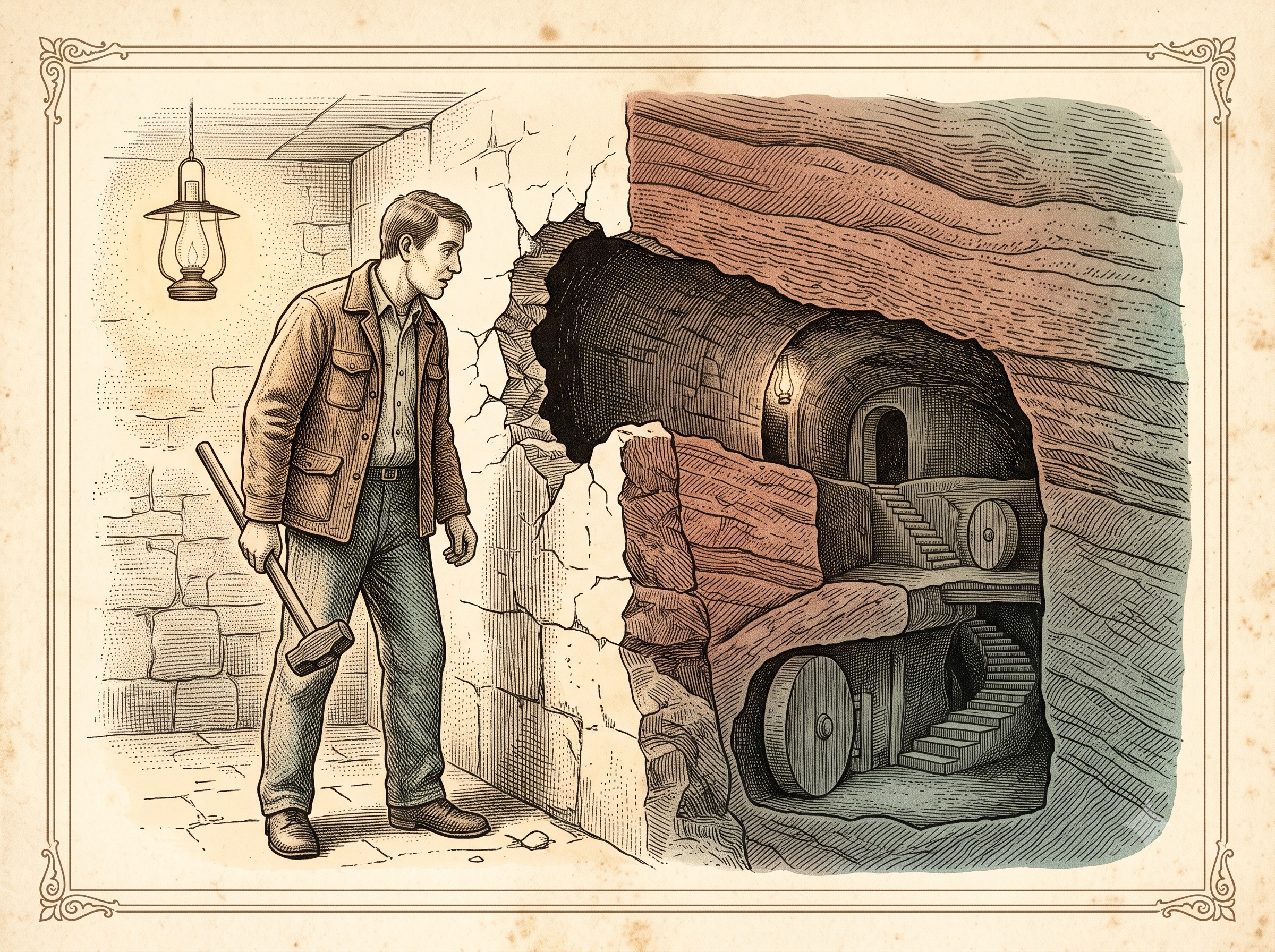
In 1963, a man in the Turkish town of Derinkuyu decided to knock down a wall in his house. The wall came down. Behind it was a room he had never seen. Behind that room was a passage, and behind the passage were more passages, and stairs, and stables, and wine presses, and chapels, dropping level after level into the rock beneath his floor. He had swung a hammer at his own basement and opened a hole into a city that could hold twenty thousand people.
By the Curiosities Desk · · 5 min read · Filed under Archaeology · Today’s round
What happened?
Nobody wrote down his name. Every account of the discovery calls him a resident, an inhabitant, an anonymous local. What the accounts agree on is the wall, the hammer, and the room behind it. (The version that travels fastest online adds that he had been losing chickens into a crack in his cellar and went looking for them. That detail shows up mostly in later retellings, so treat it as the story the town tells rather than the record of what happened. It is a much better story, which is exactly why it deserves the caveat.)
The town sits in Cappadocia, in central Turkey, a landscape built almost entirely out of old volcanic ash. Eruptions from the region’s now-extinct volcanoes laid down thick beds of tuff — rock formed from compacted ash. Tuff is soft enough to carve with hand tools and hard enough, once exposed to air, to hold a ceiling up. Wind and rain have spent millennia sculpting it into the spindly “fairy chimneys” that put Cappadocia on postcards. People spent those same millennia carving into it from the inside.
What lay under the man’s house was the largest of those carvings. Derinkuyu descends roughly 85 metres — about 280 feet — through a honeycomb of chambers usually described as eighteen levels, though the count depends on who is measuring and which passages they include. Living quarters and sleeping rooms sit near the top, where the air is best. Below them are storerooms, stables, kitchens, wine and oil presses, a room with a barrel-vaulted ceiling that has been interpreted as a religious school, a cruciform church far down, and a dungeon lower still. Circular stone doors, some weighing several hundred kilograms, could be rolled across the corridors from the inside — and only from the inside. Each floor could be sealed off on its own.
Nobody is certain who started digging. Proposals range from the Hittites around 2000 BC to the Phrygians in the 8th–7th centuries BC to Christian communities in the early centuries AD. What is better established is who finished it. The final layers of carving are unmistakably Byzantine Christian, roughly the 6th to 10th centuries, when Arab raids made the Anatolian plateau a dangerous place to sleep above ground.
And the cities were not a relic even then. The Cambridge linguist Richard MacGillivray Dawkins, working in Cappadocia between 1909 and 1911, recorded the local Greek-speaking population using the tunnels in his own lifetime: when news of the 1909 massacres at Adana reached the village of Axo, he wrote, “a great part of the population… took refuge in these underground chambers, and for some nights did not venture to sleep above ground.” The Cappadocian Greek word for the places was kataphygia — refuges.
In 1923, the Christian population of Cappadocia was moved to Greece in the population exchange that followed the Greco-Turkish war. They took the knowledge of the tunnels with them. Forty years later, a sledgehammer found them again.
Why was it strange?
The strangeness is not that a lost city existed. It is that it was directly, continuously underfoot.
The town’s own name gives it away: derin kuyu is Turkish for “deep well.” The wells the townspeople drew water from every day were shafts sunk straight through the hidden city. For decades, buckets went down past chapels and stables and came back up with drinking water, and nobody upstairs knew what the rope was passing through.
There is also the matter of scale versus obscurity. This is not a buried temple that erosion covered over. It is a piece of infrastructure large enough to shelter a small town’s worth of people and livestock, deliberately built to be invisible from the surface, and it succeeded at that so thoroughly that it stayed invisible for forty years after the last people who knew about it left.
It shares a shelf with The Teenagers Who Found a 20,000-Year-Old Art Gallery, in The Finds That Started on the Wrong Errand.
What did scientists learn?
The engineering is the real payoff, and most of it is about air.
Digging down is easy. Breathing down is not. Derinkuyu is threaded with ventilation shafts — reportedly more than 15,000 of them, most only about 10 centimetres across — bored from the surface into the upper levels, with larger shafts running much deeper and doubling as wells. Because rock holds a steady temperature while surface air swings between Cappadocian summer heat and winter cold, the temperature difference drives a constant draft down the shafts. The city ventilated itself, no machinery required, and the airflow appears to have reached down to roughly the eighth level.
The structural engineering was equally careful. Soft tuff carves beautifully and collapses readily, which is why the complex is full of thick load-bearing pillars of uncut rock left deliberately in place. No floor at Derinkuyu is known to have caved in. A 2016 engineering study of the site’s pyroclastic rock treated it as a case study in exactly this: how ancient builders read the mechanical limits of their material and stopped short of them.
Also in The Finds That Started on the Wrong Errand: The Buried Army Found by Farmers Digging a Well.
How does it affect us today?
Derinkuyu opened to visitors in the late 1960s and is now part of the UNESCO World Heritage property “Göreme National Park and the Rock Sites of Cappadocia,” inscribed in 1985, which explicitly names Derinkuyu and neighbouring Kaymaklı. Hundreds of underground settlements are known across the region, and more keep surfacing — often, still, by accident, during construction.
The passive-ventilation principle the diggers relied on has a modern name, the stack effect, and it is standard practice in low-energy architecture: buildings designed so that warm air rising out the top pulls cool air in at the bottom, no fans involved. Earth-sheltered construction leans on the same steady underground temperature that made these cities livable. The Cappadocian tuff-carvers were not doing thermodynamics. They were doing something harder to teach — noticing precisely what their rock and their climate would do for free.
Another from The Finds That Started on the Wrong Errand: The Lost Hammer That Led to 14,865 Roman Coins — and Got Its Own Museum Number.
Fun fact
Derinkuyu is connected to the underground city of Kaymaklı, several kilometres away, by a tunnel. You can, in principle, commute between two ancient towns without ever coming up for air.
Sources
- UNESCO World Heritage Centre, “Göreme National Park and the Rock Sites of Cappadocia” — official inscription (1985), naming Derinkuyu and Kaymaklı.
- Dawkins, R. M. (1916). Modern Greek in Asia Minor, Cambridge University Press, pp. 16–17. — first-hand record of the tunnels in use as refuges in 1909.
- Nývlt, V., Musílek, J., Čejka, J., & Stopka, O. (2016). “The Study of Derinkuyu Underground City in Cappadocia Located in Pyroclastic Rock Materials.” Procedia Engineering 161, 2253–2258.
- Jacobs, F. (2023). “Derinkuyu: Mysterious underground city in Turkey found in man’s basement.” Big Think — ventilation shafts, layout, and the wells detail.
- Snopes (2024). “Massive Underground City in Turkey Rediscovered During Home Renovations?” — assessment of the 1963 discovery story, including the chicken version.