Accidental Discoveries · Archaeology
The Buried Army Found by Farmers Digging a Well
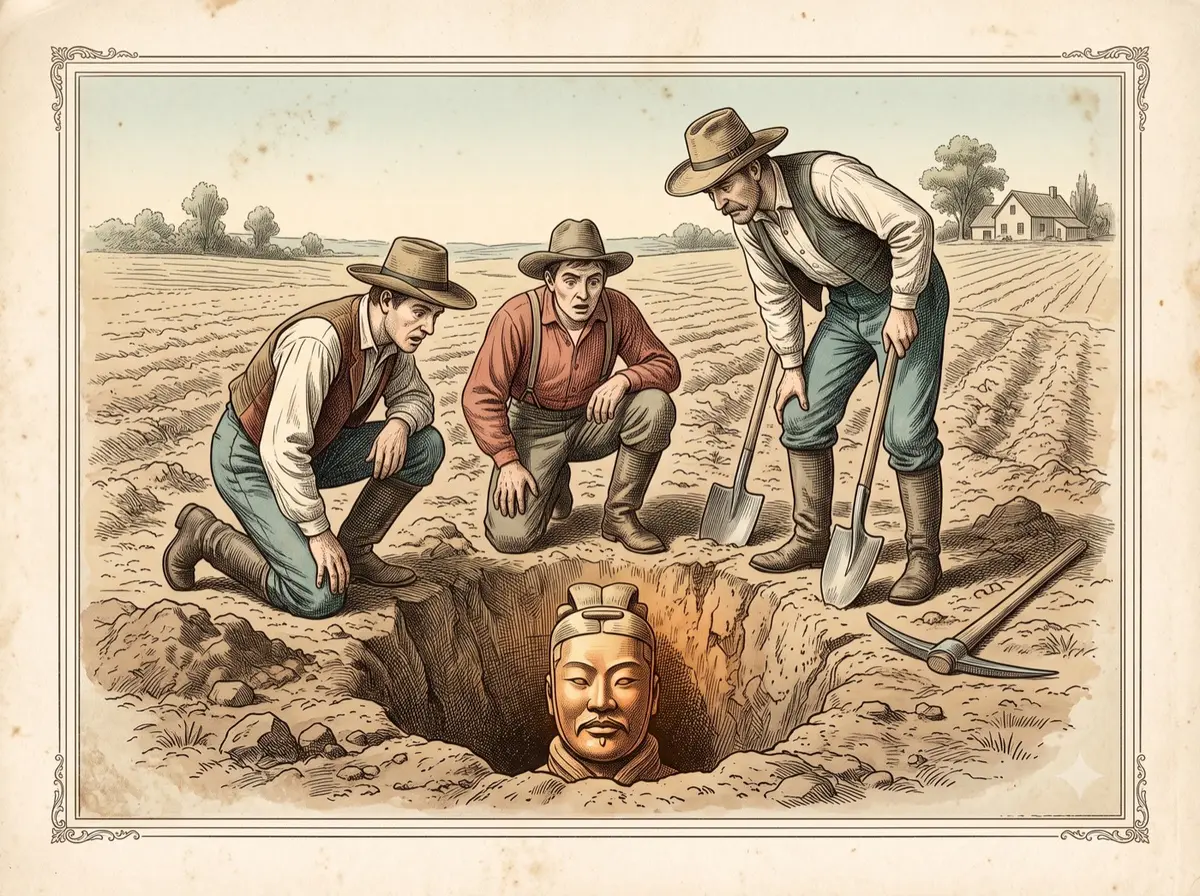
In the spring of 1974, a few farmers near Xi'an, in central China, were digging a well to reach water during a drought. A meter or two down, their shovels struck something that wasn't a rock and wasn't a root. It was a human face, made of hard-baked clay, staring up out of the dirt. They had no way of knowing it, but they had just punched a hole into the roof of a buried hall holding thousands of life-sized clay soldiers — an entire army, standing in formation, that had been waiting underground in silence for more than two thousand years.
By the Curiosities Desk · · 6 min read · Filed under Archaeology · Today’s round
What happened: The Terracotta Army
The discovery is dated to 29 March 1974. A farmer named Yang Zhifa, several of his brothers, and a neighbor were sinking a well about a kilometer and a half east of a large, grassy mound near Mount Li (Lishan). The mound had been there forever, treated by locals as just a hill. Over the centuries people had occasionally turned up odd shards of pottery and stray bricks in the area, so broken clay wasn’t unheard of. But this was different: large fragments of figures, arrowheads, and pieces of a brick floor.
Chinese archaeologists, among them Zhao Kangmin, came to investigate, and the scale of what they uncovered grew with every season of digging. The well-diggers had stumbled onto a corner of the funerary complex of Qin Shi Huang — the king of Qin who, in 221 BCE, conquered the warring states and made himself the first emperor of a unified China. Construction of his tomb complex had begun around 246 BCE, when he was a boy of about thirteen newly seated as king. According to the ancient historian Sima Qian, the project eventually consumed the labor of some 700,000 conscripted workers.
What lay underground was not the emperor’s tomb itself but its guard. Estimates published in 2007 put the buried force at more than 8,000 soldiers, 130 chariots with 520 horses, and another 150 cavalry horses, arranged across several enormous pits. The infantry, archers, charioteers, and generals stand roughly between 1.8 and 2 meters tall, the officers tallest of all, each in armor and uniform appropriate to rank.
Why it was strange: The Terracotta Army
The strangest thing about the army isn’t that it exists — it’s that every soldier is an individual. Mass-produced clay figures from the ancient world are usually stamped from the same mold, identical and interchangeable. These are not. Scholars have identified about ten base facial forms that were then altered by hand — different noses, ears, expressions, hairstyles, mustaches — so that no two faces in the ranks are quite the same. An assembly line, run twenty-two centuries ago, that still managed to give thousands of statues distinct faces.
And the soldiers were only ever the outer layer. Sima Qian, writing roughly a century after the emperor’s death, described the actual tomb beneath the great mound as a buried model of the empire itself: palaces and towers, a ceiling painted with the heavens, and the rivers and seas of China recreated in flowing mercury, kept circulating by some mechanism. For centuries this read like pure myth — the kind of flourish a historian adds for color.
It shares a shelf with The Basement Wall That Opened Onto a City for 20,000 People, in The Finds That Started on the Wrong Errand.
What scientists learned: The Terracotta Army
Then the soil started talking. When researchers sampled the earth covering the central tomb mound, they found mercury concentrations far higher than the surrounding countryside — exactly the strange detail that earlier readers had dismissed as legend. The chemistry doesn’t prove there are literal silver rivers down there, but it gives Sima Qian’s account real credibility, and it’s one reason the central tomb has deliberately not been excavated. A sealed chamber that may be laced with toxic mercury vapor, holding fragile painted artifacts that could degrade the moment air and light reach them, is not something archaeologists open in a hurry.
The science has also corrected itself in public. For years a favorite “lost technology” claim held that the bronze weapons buried with the army — over 40,000 arrowheads, swords, spears, and crossbow triggers — had been deliberately coated with a thin layer of chromium to keep them sharp and rust-free for millennia, supposedly anticipating modern anti-corrosion plating by two thousand years. It made a great story. But a 2019 study found the chromium was almost certainly contamination that leached from nearby lacquer, not an intentional coating. The weapons’ remarkable preservation owes more to the particular chemistry of the surrounding soil. It’s a tidy reminder that “the ancients knew a secret we lost” is often less true than “we measured more carefully the second time.”
Also in The Finds That Started on the Wrong Errand: The Lost Hammer That Led to 14,865 Roman Coins — and Got Its Own Museum Number.
How it reaches us today: The Terracotta Army
The site near Xi’an became a museum, with the largest pit roofed over and left in place, and in 1987 the wider mausoleum was named a UNESCO World Heritage Site. It now draws millions of visitors a year and ranks among the most famous archaeological finds anywhere. The whole necropolis, mapped with ground-penetrating radar and core sampling, covers something like 98 square kilometers — most of it still underground, still unexcavated.
The Terracotta Army also reshaped how we think about early Chinese manufacturing. The way the figures and weapons were produced — standardized parts, batch marks, semi-independent workshops feeding a single huge project — looks startlingly like a blueprint for industrial mass production, executed by hand long before factories existed. And it stands as the headline argument for not digging: some of the best preservation science we have is aimed at leaving the emperor’s tomb sealed until we’re sure we won’t destroy it by looking.
Another from The Finds That Started on the Wrong Errand: The Runaway Goat That Led to the Dead Sea Scrolls.
Fun fact: The Terracotta Army
The painted colors on the warriors didn’t survive contact with our world. Many figures were originally vivid — reds, greens, and a striking purple — but the lacquer underneath the paint curls and flakes within minutes of being exposed to dry air. Some excavated soldiers visibly lost their color shortly after being unearthed. The famous “stone-gray” army is really an army that faded in front of the archaeologists who found it.
Sources: The Terracotta Army
- Wikipedia, “Terracotta Army” — overview, discovery date, figure counts, and the chromium and mercury findings (cross-referenced against its cited sources): https://en.wikipedia.org/wiki/Terracotta_Army
- UNESCO World Heritage Centre, “Mausoleum of the First Qin Emperor”: https://whc.unesco.org/en/list/441/
- Sima Qian, Records of the Grand Historian (Shiji) — the ancient account of the mausoleum, including the mercury rivers and 700,000 workers.
- Emperor Qin Shihuang’s Mausoleum Site Museum (official site): http://www.bmy.com.cn/
- Smithsonian Magazine, “Terra Cotta Soldiers on the March” (Arthur Lubow): https://www.smithsonianmag.com/history/terra-cotta-soldiers-on-the-march-30942673/
Related stories: The Terracotta Army
- Part of The Finds That Started on the Wrong Errand
- The Teenagers Who Found a 20,000-Year-Old Art Gallery — Four teenagers and a dog found a 20,000-year-old painted cave
- The Runaway Goat That Led to the Dead Sea Scrolls — A goat wandered into a cave and led to the Dead Sea Scrolls
- The Man Who Found Troy — and Dug Straight Through It — The man who found Troy dug straight through it