Science Through Time · Archaeology
The Library Burned by Vesuvius That AI Is Finally Reading
For nearly 2,000 years they looked like nothing at all — lumps of charcoal, so unremarkable that 18th-century workmen burned some of them for warmth and tossed others on the rubbish heap. They were, in fact, books: hundreds of scrolls from the only library to survive intact from the ancient world, carbonized in an instant by Mount Vesuvius. To open one was to destroy it. So they sat, unreadable, for two and a half centuries — until a 21-year-old student, a particle accelerator, and a piece of AI coaxed the first word out of a scroll no human hand had ever unrolled.
By the Curiosities Desk · · 5 min read · Filed under Archaeology · Today’s round
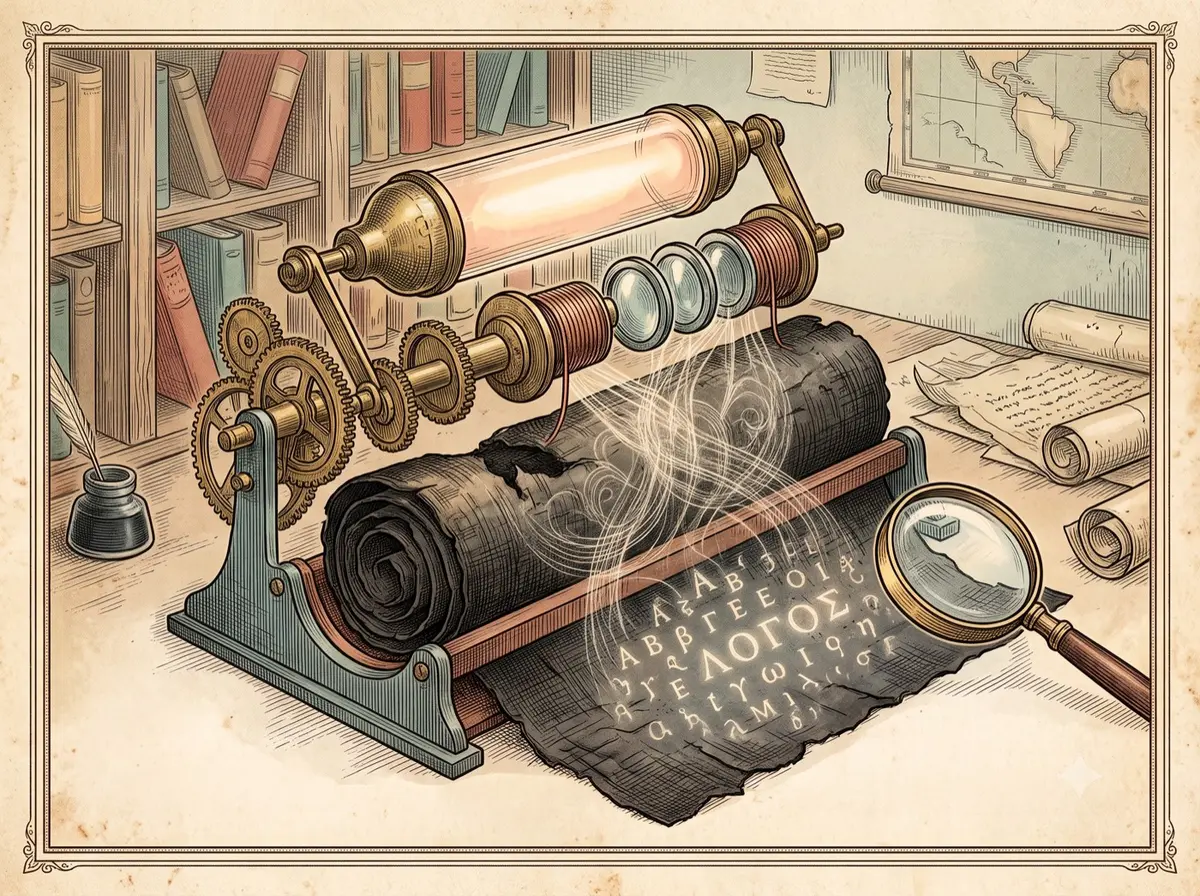
What happened: The Library Burned by Vesuvius That AI Is Finally Reading
When Vesuvius erupted in 79 AD, it buried the seaside town of Herculaneum under a surge of superheated volcanic material. Inside a lavish villa — now called the Villa of the Papyri — stood a working library. The blast didn’t burn the scrolls to ash the way an open fire would. Instead, the intense heat, in a room starved of oxygen, parched them into compact, brittle blocks of carbon, which the cooling rock then sealed and preserved.
In 1752, workmen digging for the Bourbon royal family stumbled onto the villa and its more than 1,800 scrolls. At first nobody recognized them as books. Once they did, the trouble began: the scrolls were too fragile to unroll. An ingenious monk, Father Antonio Piaggio, built a machine in 1756 that used silk threads to peel a scroll open at a rate of millimeters per day — the first one took roughly four years, and the method routinely shredded the beginnings and ends of texts. Later attempts were worse. Humphry Davy, the famous chemist, tried chlorine gas around 1819 and partly opened 23 manuscripts. Other efforts used mercury, rose water, and assorted solvents. Many scrolls were simply lost to the experiments meant to read them.
The breakthrough was to stop opening them at all. Computer scientist Brent Seales of the University of Kentucky spent years developing “virtual unrolling” — scanning a closed scroll with X-rays to build a 3D model, then digitally flattening the layers to read them without touching the original. In 2016 he proved it worked on the badly charred En-Gedi scroll from Israel. Herculaneum, though, posed a nastier problem (more on that below). To crack it, in 2023 tech entrepreneurs Nat Friedman and Daniel Gross teamed with Seales to launch the Vesuvius Challenge, a public competition with a $700,000 grand prize for the first team to read substantial text from scans of two intact scrolls.
It worked faster than almost anyone expected. On October 12, 2023, Luke Farritor, a 21-year-old computer science student at the University of Nebraska, trained a machine-learning model to spot the faint texture of ink in the scans and pulled out the first whole word from an unopened scroll: porphyras — ancient Greek for “purple.” Then, on February 5, 2024, the challenge awarded its grand prize to a team that had recovered roughly 5% of one scroll — column after column of philosophy that no one had read since the eruption.
Why it was strange: The Library Burned by Vesuvius That AI Is Finally Reading
The cruel twist is why these scrolls resisted for so long. The ancient scribes wrote with carbon-based ink — essentially soot — on papyrus. When Vesuvius carbonized the papyrus, the page itself turned to carbon too. So the writing and the surface it sat on became chemically almost identical. A standard X-ray or CT scan distinguishes materials by density, and here the ink and the page have nearly the same density. The text was, in effect, written in invisible ink made of the same stuff as the paper.
Stranger still is what survived. Mediterranean climate destroys papyrus; ancient libraries rotted away everywhere else. The one library that lasted did so precisely because it was incinerated and entombed. The disaster that should have erased these books is the only reason we still have them.
Another idea followed the long way: From a Sponge on a Stick to the Flush Toilet: A Short History of the Toilet.
What scientists learned: The Library Burned by Vesuvius That AI Is Finally Reading
The solution combined big-machine physics with pattern-hungry AI. Researchers took intact scrolls to the Diamond Light Source, a synchrotron particle accelerator in England, and scanned them at extremely high resolution. Even though the ink barely differs in density from the page, its presence makes the papyrus very slightly thicker — and a subtle technique helps resolve that difference. The result is a stack of cross-sectional images so detailed that you can trace the scroll’s wound-up layers.
That’s where machine learning comes in. The contest competitors trained models to recognize the almost imperceptible “crackle” texture that ink leaves in the 3D scan, then map it back onto the digitally unrolled surface so human scholars can read it. The text from the prize-winning scroll appears to be a previously unknown work by Philodemus, an Epicurean philosopher who lived in Herculaneum — a meditation on pleasure, touching on music and food and how the senses respond to them. It is, fittingly, a brand-new ancient book.
Another thread pulled across centuries: From Baltimore Sewer Gas to the Shroud of Turin: A Short History of Radiocarbon Dating.
How it reaches us today: The Library Burned by Vesuvius That AI Is Finally Reading
Most of the literature of the ancient world is gone — lost works by famous authors known only because someone else mentioned them. The Herculaneum library may hold copies of some of them, which means the techniques proven here could genuinely expand the canon of antiquity, not just reread what we already have. And hundreds of scrolls in the villa remain unopened, with possibly another whole level of the library still buried underground.
The bigger legacy is the method. Non-destructive imaging plus machine learning lets us read objects too fragile to open — and the same toolkit now applies far beyond one Roman villa, to sealed documents, delicate manuscripts, and artifacts that any physical touch would ruin. It’s a quietly radical idea: that the past can be recovered without being disturbed.
A close cousin: The 3,900-Year-Old Fart Joke Scribes Copied in School.
Fun fact: The Library Burned by Vesuvius That AI Is Finally Reading
The very first piece of writing pulled from an unopened scroll wasn’t a grand philosophical sentence — it was a single word for the color purple, porphyras. After nearly two millennia of silence, the ancient library’s reopening began with one word about a dye once worth more than gold.
Sources: The Library Burned by Vesuvius That AI Is Finally Reading
- “Herculaneum papyri,” Wikipedia — https://en.wikipedia.org/wiki/Herculaneum_papyri
- Jo Marchant, “First passages of rolled-up Herculaneum scroll revealed,” Nature 626 (2024) — https://www.nature.com/articles/d41586-024-00346-8
- Vesuvius Challenge official site — https://scrollprize.org
- W. B. Seales et al., “From damage to discovery via virtual unwrapping: Reading the scroll from En-Gedi,” Science Advances 2 (2016) — https://www.science.org/doi/10.1126/sciadv.1601247
- Ian Sample, “Researchers use AI to read word on ancient scroll burned by Vesuvius,” The Guardian, Oct 12, 2023 — https://www.theguardian.com/science/2023/oct/12/researchers-use-ai-to-read-word-on-ancient-scroll-burned-by-vesuvius
Related stories: The Library Burned by Vesuvius That AI Is Finally Reading
- The 2,000-Year-Old Computer Found in a Shipwreck — A corroded bronze lump that turned out to be an ancient computer
- The Runaway Goat That Led to the Dead Sea Scrolls — A goat wandered into a cave and led to the Dead Sea Scrolls
- The Angry Customer Complaint That Survived 3,750 Years — A furious complaint about bad copper, baked into clay in 1750 BC