Weird Medical History · Biology
The Zoologist Who Said Cotton Was Poisoning You — and Dressed George Bernard Shaw in Wool Down to the Bedsheets
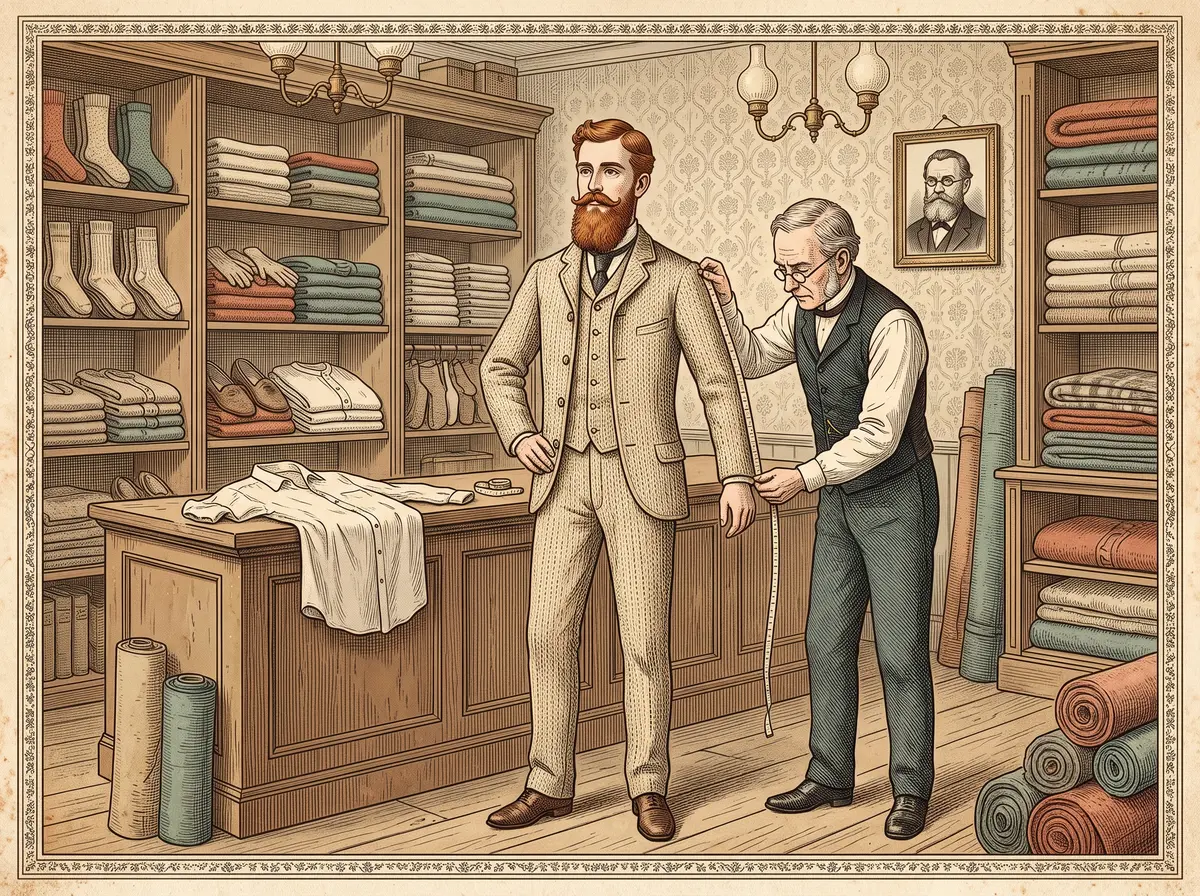
In June 1885, a 28-year-old Irish writer named George Bernard Shaw took some of the money from his late father's insurance payout and spent it on a suit. Not a fashionable suit. A suit made entirely of knitted animal wool, because a German zoology professor had warned that cotton and linen next to the skin were trapping the body's poisons. Shaw never looked back. He went on to buy the wool socks, the wool gloves, the wool shoes, the wool underwear, and eventually the wool bedding.
By the Curiosities Desk · · 5 min read · Filed under Biology · Today’s round
What happened: The Zoologist Who Said Cotton Was Poisoning You — and Dressed George
The professor was Gustav Jäger (usually spelled Jaeger in English), born in Württemberg in 1832. He was a serious scientist by the standards of his day. He ran a zoological garden in Vienna, became a professor of zoology at the Hohenheim academy in the late 1860s, and from 1870 taught zoology and anthropology at the Stuttgart Polytechnic and physiology at the city’s veterinary school. He was an early German champion of Charles Darwin, co-wrote a popular book on beetles, and in 1876 floated an idea about heredity that resembled the “germ plasm” theory August Weismann would make famous later.
He was also, by his own account, not a well man. In essays written around 1878 and 1879, Jaeger described years of trying to fix a “debilitated bodily condition” with Turkish baths, exercise, fresh air, and diet, “but with only limited success.” Then he changed his clothes. He started with a strip of flannel for people prone to colds, moved on to woollen undervests and shirts, and finally a woollen coat. His waist measurement, he reported, shrank by several inches and stayed that way. He credited the wool.
In 1880 he set out the whole system in a book called Die Normalkleidung als Gesundheitsschutz — roughly, “Normal Clothing as Health Protection.” The rule was simple: wear animal fibre, ideally undyed knitted wool, against the skin, and banish plant fibre entirely. Jaeger was thorough about it. In his view, “all linen and cotton material in the clothing, not excepting that used for lining and stiffening coats,” was “pernicious to health.” Cotton pockets were suspect. So was the padding hidden inside an old coat lining, which he said became “saturated with the mal-odorous ‘noxious’ emanations of the body.”
The idea crossed the Channel fast. In 1884 a London businessman named Lewis Tomalin translated Jaeger’s writings and opened the first shop for what became Dr Jaeger’s Sanitary Woollen System Co. By 1900 the company had twenty branches across Britain.
Shaw was one of its most devoted customers. His diaries record 68 visits to Jaeger shops in the 1880s and early 1890s. A cream wool Jaeger shirt from his wardrobe, labelled “Jaeger’s Sanitary Woollen System / Pure Wool Warranted,” is now in the Victoria and Albert Museum. Photographs show him wearing Jaeger capes into 1950, the year he died. Oscar Wilde wore Jaeger garments too, and the Norwegian explorer Fridtjof Nansen wore the clothing on his lecture tours, which helped spread the craze across Europe.
Why it was strange: The Zoologist Who Said Cotton Was Poisoning You — and Dressed George
Jaeger’s starting observation wasn’t silly. Wool really does feel different from cotton when you sweat, and a damp cotton shirt really can leave you chilled. The leap was in the explanation. Jaeger believed the body gave off invisible “noxious” vapours that he compared to fusel oil (the harsh-smelling by-product of fermentation), and that plant fibres grabbed and held on to them, while animal fibres let them pass. In an earlier book, Die Entdeckung der Seele (“The Discovery of the Soul,” 1878), he went further, arguing that a trained nose could detect a person’s state of health from their breath.
So a zoologist and beetle specialist ended up building a complete wardrobe — and a business — on a smell theory he could not measure. Jaeger even left teaching in 1884 to practise as a physician. It’s a reminder that being a careful scientist in one field doesn’t protect anyone from a confident wrong turn in another.
Another Victorian health idea that sounded scientific and was later put to a fair test: The Fake Metal Rods That Accidentally Invented the Placebo-Controlled Trial.
What scientists learned: The Zoologist Who Said Cotton Was Poisoning You — and Dressed George
The “noxious emanations” never turned up. Cotton underwear isn’t poisoning anyone, and nobody has found a toxic vapour that linen traps and wool releases.
But wool’s real properties are interesting in their own right. Wool is hygroscopic, meaning it soaks up water vapour from the air around it. According to the wool industry’s research body, Woolmark, wool can absorb up to about 35% of its own weight in moisture before it starts to feel wet, and it releases a little heat as it does so. Cotton, by contrast, feels clammy sooner and loses much of its insulation when soaked. That likely explains part of why Jaeger’s converts felt warmer and drier, even if his reason was wrong.
Jaeger also guessed at something real. He proposed that skin gave off chemical substances, which he called “anthropines,” that other people could sense by smell. The chemistry of his time couldn’t test it. In 1959 the biochemists Peter Karlson and Martin Lüscher coined the word “pheromone” for chemical signals that animals release to affect others of their own species — a crude cousin of Jaeger’s hunch, put on firm footing decades later.
Bad smells were later turned into a health scare for profit, too: The Floor Cleaner That Taught America to Fear Its Own Breath.
How it reaches us today: The Zoologist Who Said Cotton Was Poisoning You — and Dressed George
The shop outlived the theory. Jaeger’s company dropped its German associations during the First World War, kept going by supplying woollen underwear to troops, and by the 1920s had moved into fashion. It became a British high-street name for most of the 20th century. After several rounds of financial trouble, Marks & Spencer bought the Jaeger brand in January 2021.
The idea of wool against the skin came back in a new form. Hikers, runners, and skiers now buy merino wool “base layers” for many of the reasons Jaeger’s customers did: warmth when damp and less odour after a long day. The modern pitch talks about moisture and bacteria rather than poisonous vapours, but the shopper standing in the outdoor store is, in a small way, still buying into Jaeger’s wardrobe.
Fun fact: The Zoologist Who Said Cotton Was Poisoning You — and Dressed George
Shaw’s commitment to Jaeger wool went well beyond the suit. Over the decades he bought Jaeger jerseys, socks, shoes, slippers, gloves, underwear, and even bedding, and wore Jaeger capes for more than half a century.
Sources: The Zoologist Who Said Cotton Was Poisoning You — and Dressed George
- A Treatise on Health Culture — Gustav Jaeger, English translation (1886), digitized by the U.S. National Library of Medicine (primary source: his own account of the wool system, “noxious emanations,” linings and pockets)
- Bernard Shaw’s Jaeger cape — National Trust Collections, Shaw’s Corner (Shaw’s 1885 suit, 68 shop visits, bedding, capes until 1950; Tomalin’s 1884 shop)
- Shirt worn by George Bernard Shaw, Jaeger, ca. 1884–1900 — Victoria and Albert Museum (label text, twenty branches by 1900, Oscar Wilde)
- Jäger, Gustav — Neue Deutsche Biographie, via Deutsche Biographie (career and dates)
- Wool Is Breathable — Woolmark fact sheet (moisture absorption and heat of sorption; industry source)
If a product promises to fix your health through clothing, diet, or any single change, it’s worth running it past a doctor first. The real answer is often less exciting than the advertisement, and more useful.