Weird Medical History · Engineering
The Reducing Machine That Exercised You While You Lay Down — Until the FDA Told Owners to Destroy It
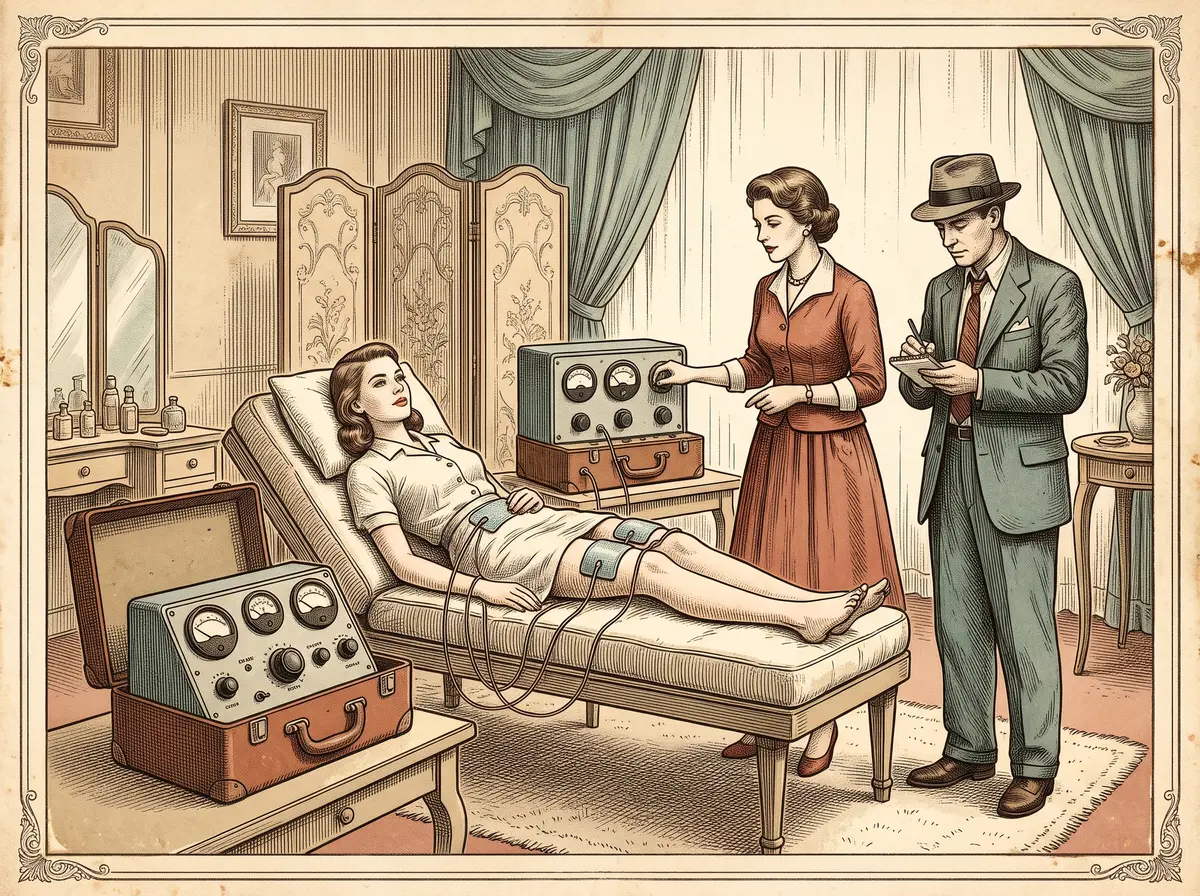
In 1952, on Fifth Avenue in New York, a young woman named Charlotte Rakay lay perfectly still while a salon owner strapped a Relaxacizor's damp pads to her body, turned a dial, and let electricity do her sit-ups for her. An Associated Press reporter stood by, taking notes on her thigh muscles. Asked how it felt, Rakay offered a two-word review: "Tingly… just tingly." The machine was called the Relaxacizor, and it promised the dream of every era: all the exercise, none of the effort.
By the Curiosities Desk · · 5 min read · Filed under Engineering · Today’s round
Part of Medicine, Before It Was Sure
What happened: The Relaxacizor
The Relaxacizor was the creation of William J. Browner, an engineer who, according to later accounts, hand-built early units and sold them around Hollywood after World War II. By around 1949 a company called Relaxacizor, Inc. was selling it to the public. The device came in a carrying case: a console with big dials for intensity, cords ending in electrode pads, and charts showing where to put them. Belly, hips, thighs, buttocks, upper arms, even the face. You plugged it into the wall, wet the pads (the manuals insisted, in capital letters, that they be saturated for every treatment), lay back, and let the current run for anywhere from 10 minutes to an hour.
The pitch was irresistible. In 1952, the salon owner Louise Simonet told the AP’s Hal Boyle that the machine “takes the place of your nerve centers and electronically flexes your muscles for you,” about 20 contractions a minute. The New Yorker that same year called it the “first portable reducing machine in the world.” (“Reducing” was the polite midcentury word for slimming.) Doris Day was among the celebrities who praised it. Units cost a few hundred dollars, a serious sum at the time, and an army of saleswomen, often called “figure consultants,” sold them in people’s homes.
It worked, commercially. More than 400,000 Relaxacizors were sold over roughly two decades.
The trouble was what users reported. Complaints described ruptured blood vessels, cramps, vomiting, fainting, and worse. A 1970 Chicago Tribune account included a young woman who said she miscarried after placing the pads across her abdomen. The U.S. government took the company to court in a case that had been grinding along since 1966. On April 14, 1970, federal judge William P. Gray in California ruled the devices dangerous to health. He found they could cause miscarriages and could worsen existing conditions, including hernias, ulcers, varicose veins, and epilepsy, and he barred their sale across state lines.
The company appealed, then dropped the appeal by agreement with the government that November. In January 1971 the Food and Drug Administration went a step further: it announced that even selling a used Relaxacizor was illegal, sent warning posters to post offices across the country, and recommended that owners destroy their machines or make them inoperable.
Why it was strange: The Relaxacizor
The Relaxacizor sold a contradiction: exercise for people lying down. Its name stitched “relax” and “exercise” together, and its ads leaned on the promise that you could get the results of a workout without doing one.
Stranger still, the company’s own fine print gradually backed away from that promise. By the mid-1950s some ads conceded the machine would not, by itself, make you lose weight, and suggested pairing it with a diet. A 1968 ad said it could improve muscles only “to the extent these muscles lack tone because of insufficient exercise.” The marketing still said “reduce”; the small print said “maybe tighten a bit.”
The deepest oddity is legal. In 1970 the FDA had no power to review a medical device before it went on sale, so it took a four-year court fight to stop a machine that had already been in hundreds of thousands of homes.
For an earlier attempt to exercise people without making them move, see The Mechanical Horse That Trotted So You Didn’t Have To.
What scientists learned: The Relaxacizor
The Relaxacizor wasn’t a total fake. It used a real principle called electrical muscle stimulation, or EMS: a small current applied through the skin triggers the nerves that tell a muscle to contract. That’s why Rakay’s muscles twitched without her deciding to move them.
The problem was the leap from contraction to slimming. A muscle twitching under your skin burns very little energy compared with real activity, and making a muscle work doesn’t melt the fat sitting on top of it. The government argued in court that the device’s involuntary contractions were abnormal and “cannot be equated with ordinary exercise.”
Modern research makes the picture clearer, and a little more generous. In a 2005 study from the University of Wisconsin–La Crosse, 24 volunteers used an abdominal stimulation belt five days a week for eight weeks. Their abdominal strength rose 58 percent and their waists shrank by a few centimeters, but their body weight and body fat didn’t change significantly. (The belts’ manufacturer funded the study.) So stimulation can strengthen and firm muscles; it just can’t do what the Relaxacizor’s name implied.
For another gadget that sold the idea of electricity more than its effects, see The ‘Electric’ Hairbrush With No Electricity in It.
How it reaches us today: The Relaxacizor
You can still buy electric ab belts, and the FDA’s advice reads like a polite echo of Judge Gray. The agency says these devices “may be able to temporarily strengthen, tone or firm a muscle,” but that none has been cleared for weight loss or “rock hard” abs, and it has received reports of shocks, burns, bruising, and interference with pacemakers.
Meanwhile, the same principle found an honorable job. Doctors and physical therapists now use prescription electrical stimulators to help people rebuild muscle after strokes, serious injuries, and surgery, and to keep muscles from wasting away. The idea was never the villain. The promise was.
Cases like this one also fed a growing sense in Washington that devices needed oversight before they reached the public. In 1976 Congress passed the Medical Device Amendments, which gave the FDA power to review many medical devices before they could be sold.
For a time an American gadget aimed X-rays at children’s feet instead, see The Shoe-Store X-Ray Machine That Kids Begged to Use.
The Relaxacizor sits with the other guesses in Medicine, Before It Was Sure.
Fun fact: The Relaxacizor
After the ban, the secondhand market didn’t go quietly. Personal ads for used Relaxacizors were common enough that a recurring phrase turned up in them, “used once and then never used again,” which may be the most honest product review the machine ever got.
If you’re thinking about weight loss or exercise devices because of a health concern, a doctor or registered dietitian can help you sort out what will actually work for your body.
Sources: The Relaxacizor
- U.S. Food and Drug Administration, Press release on the sale of used Relaxacisors, January 13, 1971 — reproduced by the Museum of Questionable Medical Devices (primary source)
- United States v. Relaxacizor, Inc., 340 F. Supp. 943 (C.D. Cal. 1970), case listing on CourtListener
- Porcari, J.P., et al., “The Effects of Neuromuscular Electrical Stimulation Training on Abdominal Strength, Endurance, and Selected Anthropometric Measures” — Journal of Sports Science & Medicine 4, no. 1 (2005)
- U.S. Food and Drug Administration, “Electronic Muscle Stimulators”
- Kate Knibbs, “The Fitness Wearable So Dangerous It Was Supposed to Be Destroyed” — Gizmodo (2015)
#FDA #medical devices #quackery #1950s #weird medical history