Weird Medical History · Engineering
The Insurance Doctor Who Had 2,130 People Blow Into an Upside-Down Bell — From Prizefighters to Princes
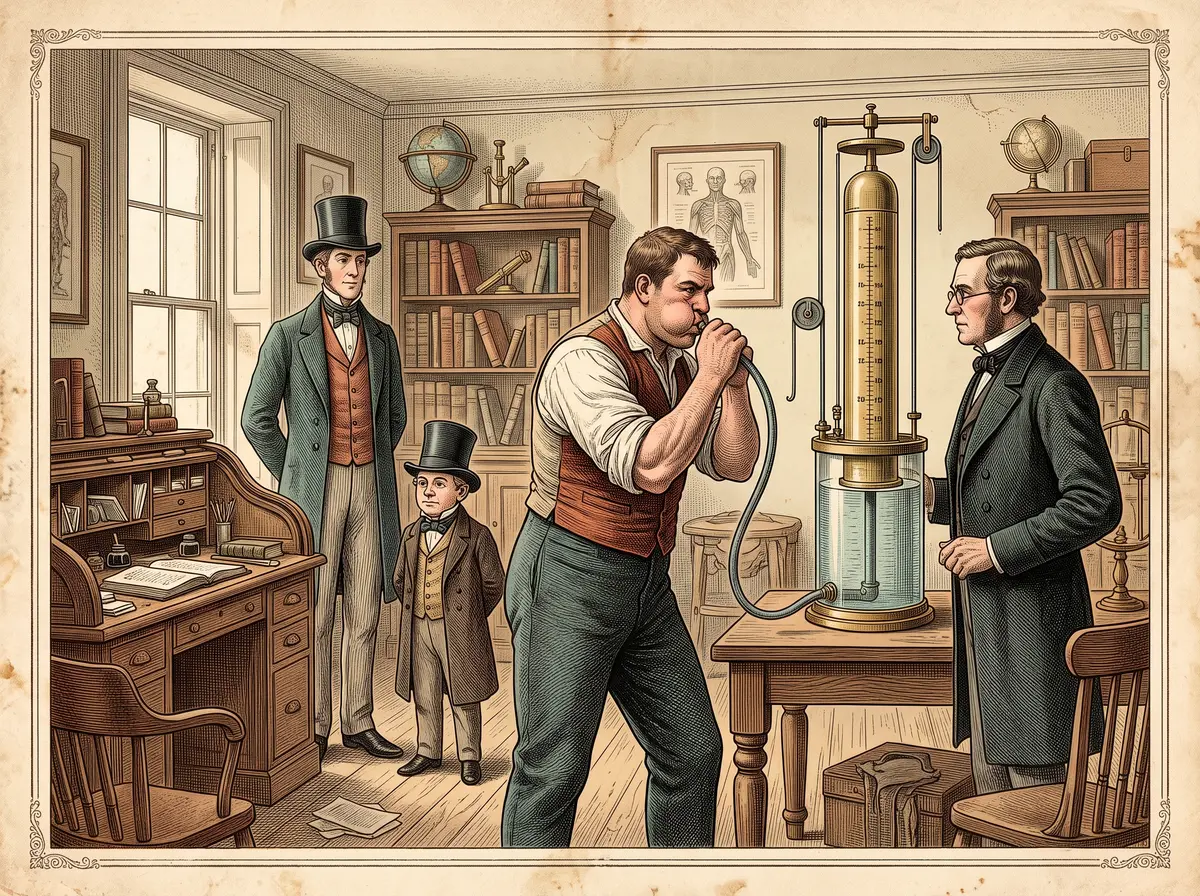
In 1840s London, a life-insurance doctor named John Hutchinson kept asking strangers to take the deepest breath of their lives and blow it into a hose. At the other end, a metal bell floating upside down in a tank of water rose by a few inches, and Hutchinson wrote down the number. Firemen did it. Wrestlers did it. A man seven feet tall did it, and so did a man under thirty inches tall. By 1846 he had 2,130 numbers, and he had found a rule hiding in them.
By the Curiosities Desk · · 5 min read · Filed under Engineering · Today’s round
Part of Medicine, Before It Was Sure
What happened: The Spirometer
John Hutchinson was born in 1811 in Ryton, a village near Newcastle upon Tyne, in the north of England. He trained as a surgeon, moved to London after his father died in 1834, and qualified in 1836. Like many doctors of the time, he took on a steady side job: examining people who wanted to buy life insurance, as physician to the Britannia Life Assurance office.
That job came with a real question. How do you tell, from the outside, whether someone’s lungs are healthy? Tuberculosis was one of the leading killers of the age, and stethoscopes and tapping on the chest could only tell a doctor so much.
Hutchinson’s answer was engineering. He took the design of a gasometer, a tank used to measure stored gas, and turned it into a precision instrument. A calibrated bell sat upside down in water. The subject breathed in as deeply as possible and then blew out everything they could through a tube. The exhaled air lifted the bell, and a scale showed the volume. He called the device a spirometer, from the Latin for “breath measurer.”
Then he started measuring everyone he could find. He reported about 1,150 people in an 1844 paper to the Statistical Society of London. By April 1846, when his long paper was read before the Royal Medical and Chirurgical Society, the count was 2,130. In his own phrase, the group ran from “dwarfs to draymen” (beer-wagon drivers) and “from princes of the blood to pugilists” (prizefighters). His subjects included fire-brigade men, wrestlers, gentlemen, a seven-foot man named Mr. Randall, a 36-year-old man three feet nine inches tall named Robinson, and a performer known as Don Francisco, who stood under thirty inches. He also spent months testing patients at the Hospital for Consumption at Brompton, which specialized in tuberculosis.
He published the work in Medico-Chirurgical Transactions in 1846, in a paper that runs more than 110 pages, and expanded it into an 1852 book called The Spirometer, the Stethoscope, and Scale-Balance.
Later that year he left London, his career, and his family behind, sailing to Australia as a ship’s surgeon during the gold rush. Historians still haven’t found a satisfying explanation for why. He worked as a doctor in the gold town of Sandhurst, now Bendigo, then sailed to Fiji in 1861. He died there that July, of dysentery, at about 50.
Why it was strange: The Spirometer
Before Hutchinson, “good lungs” was a matter of impression. A doctor looked at your chest, listened, maybe tapped it, and formed an opinion. Hutchinson’s idea was that a single number, read off a floating bell, could say more than that impression.
The strange part is how plain the rule turned out to be. Lung capacity didn’t track weight in any simple way, and it didn’t match how strong or athletic someone looked. It tracked height. According to his measurements, for every extra inch of height, a healthy adult man could blow out about eight more cubic inches of air. It also fell with age. A prizefighter and a clerk of the same height and age should land close together. If one of them fell well short, something might be wrong.
That’s why the giants and the very short men mattered. They stretched the range of heights far beyond what a crowd of ordinary Londoners would give him, so the pattern could show itself.
He is one of the medical experimenters on the shelf called Medicine, Before It Was Sure.
What scientists learned: The Spirometer
Hutchinson gave lung medicine its vocabulary. He split the air in your chest into four parts: the ordinary breath you take at rest (“tidal air”), the extra you can pull in on top of that, the extra you can push out, and the “residual air” that always stays behind. He named the biggest breath a person can move “vital capacity,” which he defined as the greatest voluntary breath out following the deepest breath in. Doctors still use the term.
More important was the method. Hutchinson’s insight was that a measurement only means something next to a normal value for someone like you, of your height and age. That idea of a “predicted” value is the backbone of lung testing today. He also saw that low vital capacity showed up in patients with tuberculosis, sometimes before other signs were obvious.
He wasn’t right about everything. He reported averages and paid less attention to how much healthy people vary. Historians judge that his hopes for the spirometer as an all-purpose screening tool went further than the evidence supported. But the basic link held up, and later research made it stronger: a 1983 report from the long-running Framingham Heart Study found that low vital capacity predicted heart disease and death.
Another doctor who turned careful measuring into an experiment is The Doctor Who Ate, Slept, and Worked on a Giant Scale for 30 Years.
How it reaches us today: The Spirometer
If you’ve been tested for asthma or COPD (chronic obstructive pulmonary disease, a long-term lung disease), you’ve used Hutchinson’s descendant. Modern spirometers are handheld and electronic, and they time the breath as well as measure it. The most-used numbers are how much you can blow out in total and how much in the first second. Your results are still compared to predicted values based on your height, age, and sex.
How those predicted values are built is still being argued over. For decades, many labs adjusted “normal” values by race. In 2023 the American Thoracic Society recommended replacing those with race-neutral reference equations, a sign that the question Hutchinson raised — what counts as normal, and for whom? — is still open.
For the stethoscope’s own odd origin story, see The Rolled-Up Paper That Became the Stethoscope.
Fun fact: The Spirometer
Hutchinson didn’t just build a breathing machine. Colleagues knew him as a violinist, an oil painter, and a sculptor in bas-relief, and he also testified to the House of Lords about air safety in coal mines.
Sources: The Spirometer
- Hutchinson, J. (1846). “On the capacity of the lungs, and on the respiratory functions, with a view of establishing a precise and easy method of detecting disease by the spirometer.” Medico-Chirurgical Transactions, 29, 137–252. https://pmc.ncbi.nlm.nih.gov/articles/PMC2116876/
- Bishop, P. J. (1977). “A bibliography of John Hutchinson.” Medical History, 21(4), 384–396. https://www.ncbi.nlm.nih.gov/pmc/articles/PMC1082083
- Spriggs, E. A., Gandevia, B., & Bishop, P. J. (1976). “John Hutchinson (1811–1861), inventor of the spirometer.” Proceedings of the Royal Society of Medicine, 69(6), 450. https://www.ncbi.nlm.nih.gov/pmc/articles/PMC1864295
- Petty, T. L. (1987). “John Hutchinson’s mysterious machine.” Transactions of the American Clinical and Climatological Association, 98, 11–20. https://pmc.ncbi.nlm.nih.gov/articles/PMC2279716/
- UCSF Health (2023). “New ATS Recommendation: Use Race-Neutral Equations for Pulmonary Function Test Interpretation.” https://medconnection.ucsfhealth.org/news/new-ats-recommendation-use-race-neutral-equations-for-pulmonary-function-test-interpretation-to-improve-patient-care
If you’re living with a lung condition or are worried about your breathing, a doctor can arrange a quick spirometry test. It’s painless, and it’s one of the oldest and best-tested tools in medicine.