Science Through Time · Medicine
From Lamb's Blood to Blood Types: A Short History of the Transfusion
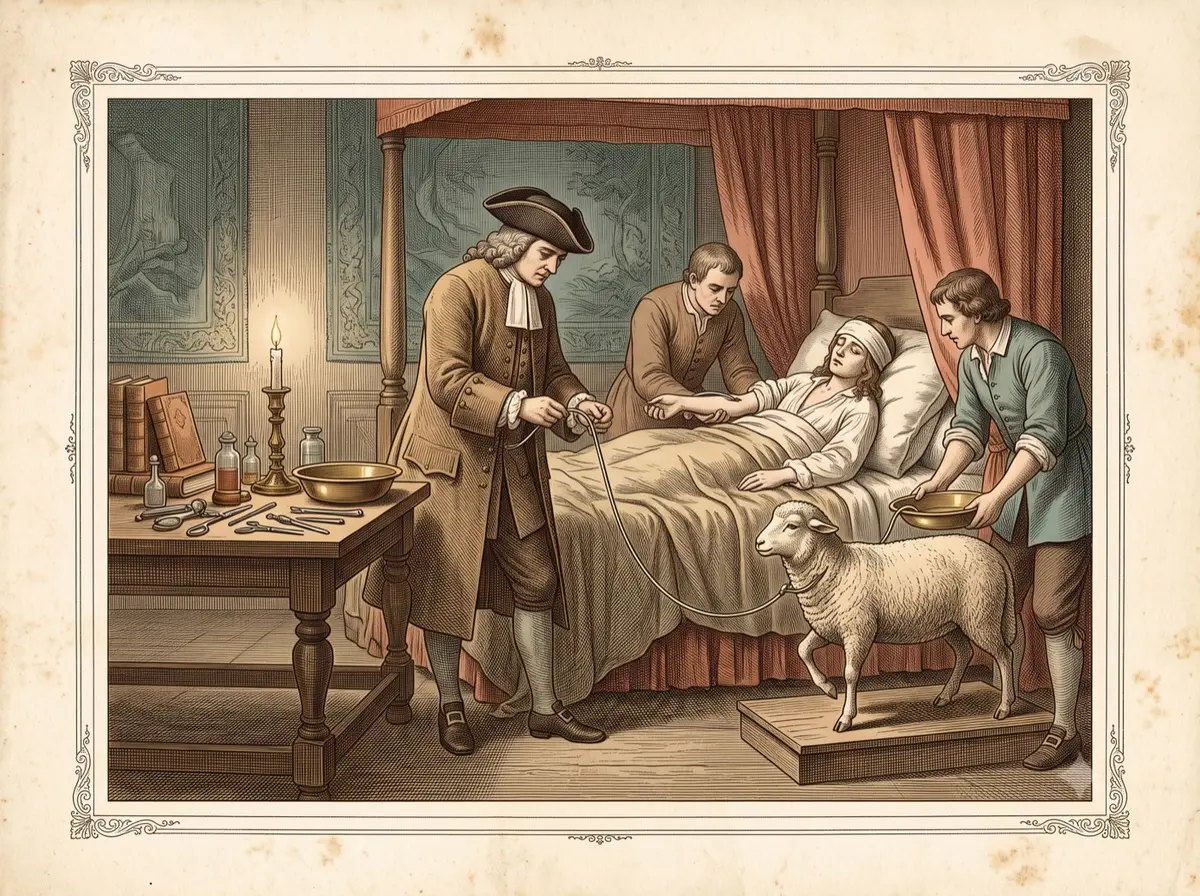
On June 15, 1667, a Paris physician named Jean-Baptiste Denys opened a vein in a feverish 15-year-old boy and let about twelve ounces of lamb's blood flow in. The boy, who had already been bled by leeches twenty times with no results, reportedly woke up the next morning feeling better. It would take more than two centuries, one death blamed on the wrong culprit, and a quiet Austrian lab experiment before anyone understood why a transfusion could just as easily kill a patient as save one.
By the Curiosities Desk · · 5 min read · Filed under Medicine · Today’s round
What happened: Blood Transfusion
Denys wasn’t guessing at random. He reasoned that since people already ate lamb and drank its milk, lamb’s blood — thought to be gentler and “purer” than human blood — ought to be safe to transfuse. Over the next several months he treated a handful of ailing patients this way, including a man named Antoine Mauroy, who suffered from violent bouts of what doctors of the time called insanity. Denys hoped the calm nature of a lamb might calm the man too.
It didn’t work out. After a series of transfusions, Mauroy died. His widow accused Denys of murder, and the case became a sensation. Denys was acquitted in 1668 — and centuries later, medical historians turned up a detail that never made it into the popular version of the story: evidence suggests Mauroy’s wife had likely been poisoning him with arsenic, and that this, not the lamb’s blood, killed him. At the time nobody made that connection. The transfusion took the blame. In 1670, the French Parliament banned the procedure outright, and blood transfusion all but disappeared from Western medicine for roughly 150 years.
It resurfaced in London in 1818, when the obstetrician James Blundell picked the idea back up for an entirely different reason. Blundell had watched too many women bleed to death after childbirth, and he believed a transfusion — this time human blood only, never animal — might save them. His first attempt, on a man dying of stomach cancer, offered only a temporary reprieve. But on December 7, 1828, Blundell transfused a young mother who had lost dangerous amounts of blood after delivering her third child, and she recovered. It was the first unambiguously successful human-to-human transfusion on record.
Even so, transfusion remained a gamble for the rest of the 19th century. Some patients thrived; others, given blood from a seemingly healthy donor, went into shock and died within minutes. Nobody could explain the difference. The turning point came in 1900 and 1901, when the Austrian physician Karl Landsteiner began mixing blood serum and red blood cells from his own colleagues in test tubes at the University of Vienna. He noticed the cells sometimes clumped together — agglutinated — and sometimes didn’t, depending on whose serum was mixed with whose cells. Sorting through the pattern, Landsteiner identified three distinct blood groups, which he called A, B, and C (C was later renamed O). A colleague of his identified the fourth, AB, the following year.
Why it was strange: Blood Transfusion
For more than 230 years, doctors had been performing what was essentially the same procedure — moving blood from one body into another — without knowing that human blood itself came in incompatible varieties. It’s a little like handing out keys for centuries without realizing they belonged to different locks, and blaming the door whenever one didn’t turn. And the Mauroy case adds an extra twist: the single event that shut down an entire field of medicine for a century and a half may not have even been caused by the thing everyone blamed.
Another idea followed the long way: From a Lion-Headed Throne to the Cochlear Implant: A Short History of the Hearing Aid.
What scientists learned: Blood Transfusion
Landsteiner’s work revealed that red blood cells carry marker molecules, called antigens, on their surface, and that a person’s immune system produces antibodies against whichever antigens their own cells lack. Mix incompatible types — giving type A blood to a type B recipient, for instance — and the recipient’s antibodies attack the donated cells, causing them to clump and rupture. That single insight explained why some 19th-century transfusions were miracle cures and others were fatal: doctors had been transfusing blind, with no way to know in advance which combinations were safe. Landsteiner received the Nobel Prize in Physiology or Medicine in 1930 for the discovery.
Another thread pulled across centuries: From Laughing Gas Parties to the Operating Room: A Short History of Anesthesia.
How it reaches us today: Blood Transfusion
Knowing blood types made transfusion reliably safe for the first time, but blood still had to be used fresh, transfused directly from a live donor. That changed during the First World War, when researchers including Albert Hustin, Luis Agote, and Richard Lewisohn showed that sodium citrate could keep blood from clotting outside the body, so it could be stored rather than piped vein-to-vein. In 1917, U.S. Army physician Oswald Robertson set up what’s considered the first blood bank near the front lines in France, keeping citrated blood in bottles packed in ice so it could be transfused into wounded soldiers days later. That basic model — type it, store it, ship it — is still how blood banks operate today, sustaining everything from routine surgeries to disaster response.
A close cousin: From a Cargo of Melting Ice to the Kitchen Fridge: A Short History of Refrigeration.
Fun fact: Blood Transfusion
Nobody is entirely sure why blood type O is called “O” rather than “zero.” Landsteiner’s original label was C, but when the naming was standardized in the 1920s, some researchers argued for “O” from the German word ohne, meaning “without” — since type O cells lack the A and B antigens found on the other types. Others insist it was meant to represent a zero all along. Both explanations point to the same fact: O really is blood without the extra markers, which is part of why it can be given to patients of nearly any blood type in an emergency.
Sources: Blood Transfusion
- Karl Landsteiner, “Über Agglutinationserscheinungen normalen menschlichen Blutes,” Wiener Klinische Wochenschrift (1901); summarized in “The Nobel Prize in Physiology or Medicine 1930,” NobelPrize.org — https://www.nobelprize.org/prizes/medicine/1930/landsteiner/facts/
- “Jean-Baptiste Denys,” Wikipedia, citing period court records and historical accounts of the Mauroy case — https://en.wikipedia.org/wiki/Jean-Baptiste_Denys
- “James Blundell (physician),” Wikipedia — https://en.wikipedia.org/wiki/James_Blundell_(physician)
- “Transfusion Medicine History,” Association for the Advancement of Blood & Biotherapies (AABB) — https://www.aabb.org/blood-biotherapies/blood/transfusion-medicine/transfusion-medicine-resources/transfusion-medicine-history
- “Blood transfusion in the trenches of World War I,” Canadian Blood Services — https://www.blood.ca/en/research/our-research-stories/research-education-discovery/dr-lawrence-bruce-robertson-and-blood
This story involves several historical deaths, including a poisoning long mistaken for a medical accident. If it leaves you thinking about the stakes behind that jar of stored blood: donated blood still saves lives every day, and most local blood banks are glad to hear from new donors.
Related stories: Blood Transfusion
- From a Milkmaid’s Blisters to mRNA: A Short History of the Vaccine — From cowpox blisters to mRNA, the long road to immunity
- The Surgeon Who Threaded a Tube Into His Own Heart — He threaded a catheter into his own heart and walked to the X-ray room
- The Baby-Blue Blood of the Horseshoe Crab That Keeps Every Vaccine Safe — The crab blood that screens nearly every vaccine for contamination