Weird Medical History · Chemistry
The Peasants Who Ate Arsenic in Front of a Room Full of Scientists — and Came Back the Next Day
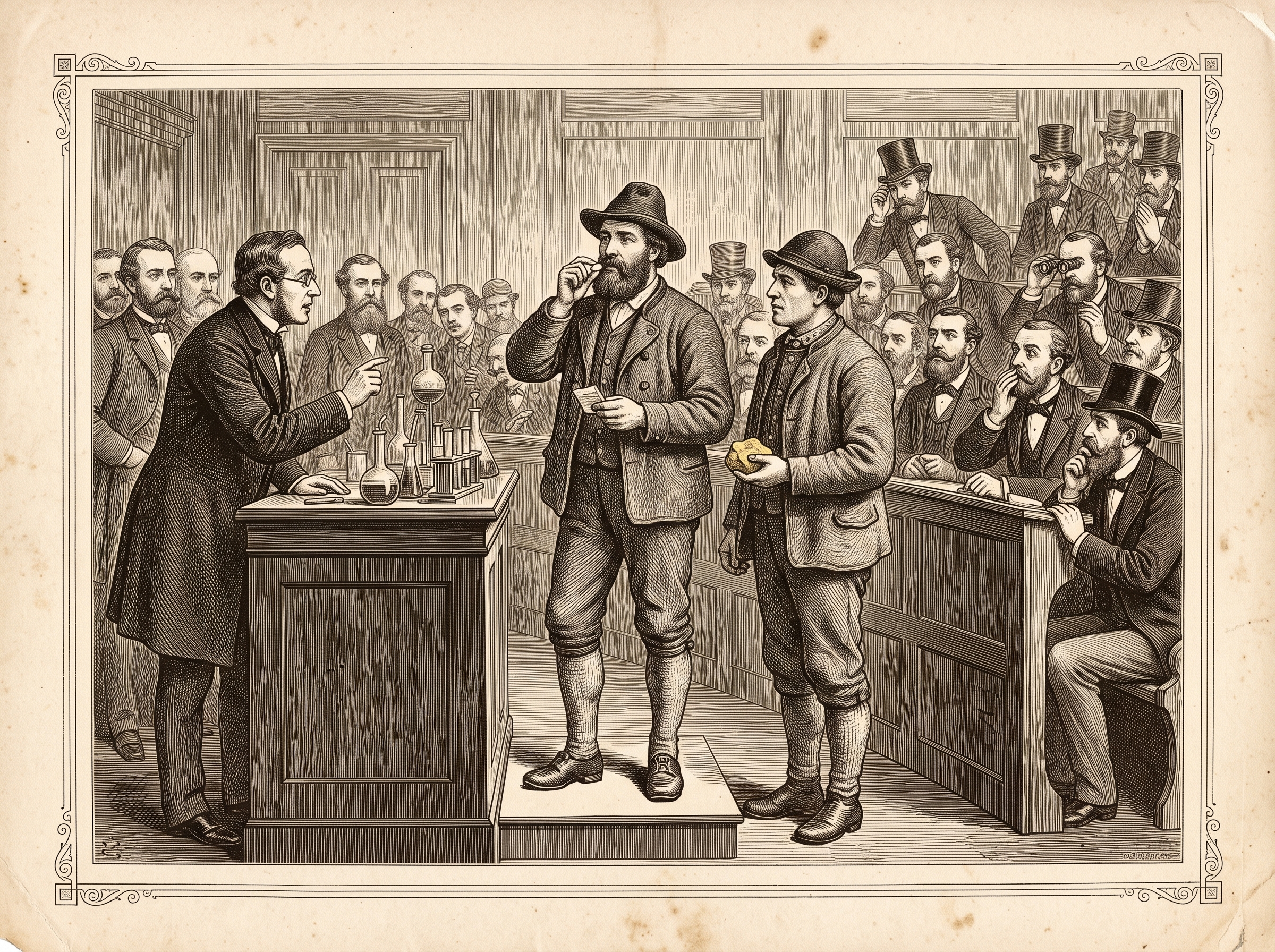
In 1875, at a scientific congress in Graz, Austria, a physician named Knapp brought two mountain farmers up in front of a room of doctors and chemists. As the audience watched, one of the men swallowed a lump of yellow arsenic and the other a lump of white arsenic, each about 4 to 6 grains, a few hundred milligrams, roughly what the textbooks of the day called a fatal dose. The next day Knapp brought them back, walking, talking, and apparently fine.
By the Curiosities Desk · · 5 min read · Filed under Chemistry · Today’s round
What happened?
The story starts in 1851, when a Swiss doctor, naturalist, and traveler named Johann Jakob von Tschudi published an article in a Viennese medical journal about the “toxicophagi,” the poison-eaters. A poisoning trial had raised the question of whether someone might have been swallowing arsenic on purpose, and von Tschudi wanted to tell doctors about a habit he said was common in the Styrian Alps, in what is now southeastern Austria.
According to his account, peasants took small pieces of white arsenic (arsenic trioxide, the same “ratsbane” sold to kill vermin) several times a week. They started with a crumb about the size of a lentil and slowly worked up to bigger ones as the small dose seemed to stop working. Young women reportedly took it for a fresh, rosy complexion and fuller figure. Men said it helped them breathe while hauling loads up steep mountain paths. Von Tschudi also noted that grooms gave arsenic to horses to make their coats glossy and their bodies round, and many writers later suspected the human habit started in the stable.
He described one man who had worked his way up to 4 grains, enough to kill most people, and said arsenic eaters felt anxious and unwell if they stopped.
Plenty of doctors, especially in Britain, thought this was nonsense. In 1856, physician W. B. Kesteven argued in a British medical journal that the evidence was hearsay, that von Tschudi was more traveler than clinician, and that nobody had actually proved the white substance was arsenic. Others suggested the “arsenic” might be chalk, sold by quack healers who wanted customers to believe they were immune to poison.
So people started checking. The chief medical officer of Styria sent a questionnaire to local physicians and got 17 reports back. One district, Hartberg, counted at least 40 arsenic eaters. Around 1860, a local doctor watched a man who said he’d eaten arsenic for 30 years swallow measured pieces on consecutive days, then sent the man’s urine to a chemist in Graz, who confirmed arsenic. In England, the chemist Henry Roscoe got a sample of what an arsenic eater actually swallowed, analyzed it, and reported in 1862 that it was white arsenic.
The public demonstration came at the 48th meeting of the Society of German Natural Scientists and Physicians in Graz in 1875. Knapp first showed urine test results proving both of his volunteers had arsenic in their bodies. Then came the part nobody in the room would forget: the two men took their doses on the spot, and came back the next day to be looked over again.
Why was it strange?
Arsenic was the classic poison of the 1800s, the one behind countless murder trials and accidental deaths. It had no taste, it was cheap, and a small amount could kill. The idea that a whole community was eating it for breakfast, on purpose, for their looks, sounded like a traveler’s tall tale.
The bigger puzzle was what it implied. If the human body could learn to shrug off a deadly poison through slow practice, then a toxic dose wasn’t a fixed number. That was a serious problem for courtrooms. In poisoning trials, defense lawyers could now argue that the victim had been a secret arsenic eater. It came up more than once, most famously in the 1889 English trial of Florence Maybrick, whose defense argued her husband had been dosing himself.
Another odd chapter in medicine: The Dinner Party Where Three Doctors Sniffed Chloroform and Woke Up Under the Table.
What did scientists learn?
The short answer: they’re still not completely sure how the Styrians did it, and it’s important not to overstate the case.
In the early 1900s, animal experiments cast doubt on the idea that a body can simply build immunity to arsenic. A leading explanation was chemistry, not toughness: the peasants often swallowed arsenic as coarse, solid lumps, which dissolve poorly. Much of a chunky dose may have passed straight through the gut without being absorbed. Nineteenth-century observers noticed a clue to this themselves: the arsenic in the eaters’ urine was far less than the amount they swallowed.
A 2001 review by chemists Gerhard Przygoda, Jörg Feldmann, and William Cullen revisited the case of people who reportedly took 300 to 400 milligrams of arsenic oxide per dose and stayed in apparently good health. Researchers have since found real evidence that some plants, animals, and human cells can adapt to arsenic, and that the body processes it partly by attaching small carbon groups (methylation) so it can be flushed out. But whether the Styrians truly developed tolerance, or were mostly saved by poor absorption, has never been definitively proven. And the early reports themselves noted that many long-term arsenic eaters eventually paid for it with their health.
Another treatment that history kept the receipt for: The Everlasting Pill That Families Fished Out of the Chamber Pot and Passed Down.
How does it affect us today?
The arsenic eaters had a surprisingly long reach. Stories of rosy-cheeked Styrian women helped launch a Victorian fashion for arsenic beauty products and gave doctors a new excuse to prescribe arsenic tonics such as Fowler’s Solution.
The question they raised, whether human bodies can adapt to arsenic, is now studied seriously. In 2015, geneticists reported that people in the Andes of Argentina, who have lived for generations with naturally arsenic-rich water, carry gene variants that help them process arsenic more efficiently. That work matters for the many millions of people worldwide whose groundwater contains dangerous levels of arsenic.
And arsenic has a genuine place in modern medicine: arsenic trioxide, the very compound the Styrians ate, was approved by the U.S. Food and Drug Administration in 2000 as a treatment for a rare blood cancer, acute promyelocytic leukemia, given under careful medical supervision.
A close cousin: The Shoe-Store X-Ray Machine That Kids Begged to Use.
Fun fact
The idea of arsenic tolerance was so irresistible that Dorothy L. Sayers built a 1930 mystery novel, Strong Poison, around it: a killer who has quietly trained his body to handle arsenic shares a poisoned meal with his victim and walks away unharmed.
A note: arsenic is highly toxic, and there is no safe way to “build up” to it. If you’re worried about a possible poisoning, contact a poison control center (in the U.S., 1-800-222-1222) or emergency services right away.
Sources
- Parascandola, John. “The Arsenic Eaters of Styria.” Hektoen International: A Journal of Medical Humanities, 2017. (By the former chief of the History of Medicine Division, U.S. National Library of Medicine.)
- Przygoda, G., Feldmann, J., & Cullen, W. R. “The arsenic eaters of Styria: a different picture of people who were chronically exposed to arsenic.” Applied Organometallic Chemistry 15 (2001): 457–462.
- “The Arsenic Eaters of Styria.” Scientific American 21, no. 14 (1869): 215. (Contemporary report of the Styrian physicians’ survey.)
- Wallau, W. M., et al. “The Phenomenon of the Styrian Arsenic Eaters from the Perspective of Literature, Chemistry, Toxicology, and History of Science.” Angewandte Chemie International Edition, 2015.
- Schlebusch, C. M., et al. “Human adaptation to arsenic-rich environments.” Molecular Biology and Evolution 32, no. 6 (2015): 1544–1555.