The Satellite NASA Flew on a 12-Mile Leash — Until the Leash Burned Through
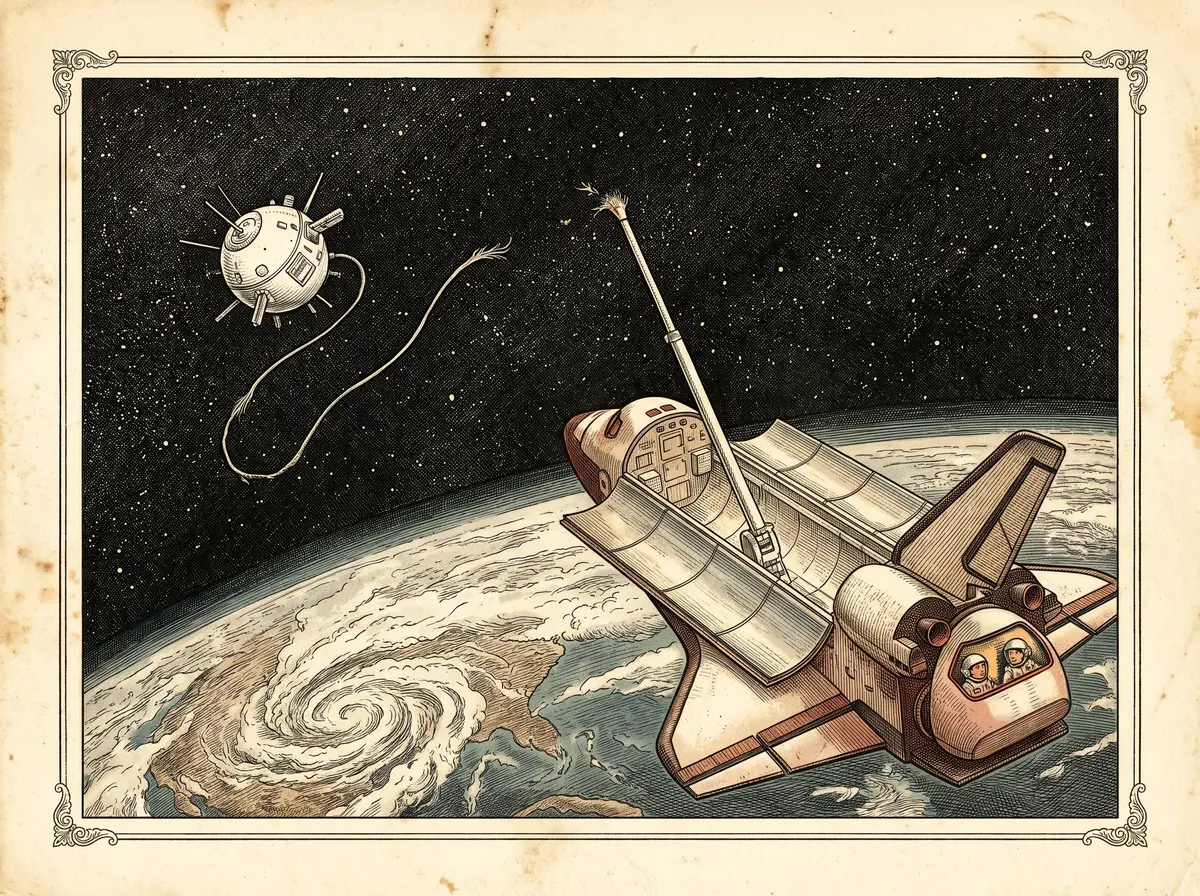
On the evening of February 25, 1996, the crew of Space Shuttle Columbia were watching a ball about five feet across float away from them on a cord thinner than a bootlace. The cord had been paying out for five hours and stretched 12 miles into space. Then the cord let go at the wrong end. "The tether has broken at the boom!" astronaut Jeff Hoffman called out — and the satellite, still trailing most of its leash behind it, sailed off on its own.
By the Curiosities Desk · · 5 min read · Filed under Space · Today’s round
What happened: NASA's Tethered Satellite
The idea came from two scientists at the Smithsonian Astrophysical Observatory, the Italian mathematician Giuseppe Colombo and the engineer Mario Grossi. In 1975 they filed a patent for a satellite “connected by means of a long tether to a powered spacecraft.” The appeal was simple to describe and hard to pull off: hang an instrument package from the Space Shuttle on a very long cord, and you can dangle it into regions of the upper atmosphere that are too low for a satellite to orbit on its own, or use the cord itself as a scientific instrument.
NASA and the Italian Space Agency (ASI) built it together as the Tethered Satellite System, or TSS. Italy supplied the satellite: a sphere 1.6 meters (about 5 feet) across, weighing roughly 518 kilograms. The United States supplied the deployer, a reel and boom mounted in the shuttle’s cargo bay. The tether was about 2.5 millimeters thick — a copper wire wrapped in insulation and wound with strands of Kevlar for strength.
The first attempt flew on Space Shuttle Atlantis in July and August 1992 (mission STS-46). The plan was to let out 20 kilometers of tether. The reel stuck at 256 meters — about 840 feet. An investigation board found the culprit in the returned hardware: a protruding bolt, part of a modification added late in the review process, that physically blocked the mechanism that guides the tether onto the reel. The satellite was reeled back in, and a 20-kilometer experiment had been undone by a single bolt.
The agencies decided to fly it again. The reflight, TSS-1R, launched on Columbia on February 22, 1996 (mission STS-75), with a crew of seven that included Italian astronauts Maurizio Cheli and Umberto Guidoni and the Swiss astronaut Claude Nicollier. This time the deployment went beautifully. Over about five hours the satellite rose to 19.7 kilometers (12.2 miles) above the orbiter, nearly the full 20.7 kilometers planned. Instruments were recording exactly the kind of electrical data the mission was designed to collect.
Then, about a kilometer short of its goal, the tether snapped — not out at the satellite, but down inside the shuttle’s own deployment boom. Freed from the orbiter, the satellite and its trailing 19.7 kilometers of cord shot into a higher orbit. It kept sending data for a few days until its batteries ran down. Commander Andy Allen later described seeing nothing but “pinpoints of light, real close together.” When the crew looked at the stub left in the boom, Hoffman said, it was “brown and charred.”
Why it was strange: NASA's Tethered Satellite
Most broken cords break because someone pulled too hard. This one was barely being pulled at all. A joint NASA–ASI investigation board, chaired by Ken Szalai of NASA’s Dryden Flight Research Center, reported in June 1996 that the tension at the moment of failure was only about 15 pounds (65 newtons) — while the tether had been designed to take about 400 pounds.
The tether had not been torn. It had been burned. The board concluded that something — either a foreign object or a defect in the tether — breached the insulation, and electricity began to arc through the gap. The arcing burned away most of the cord until the remaining Kevlar strands could not hold even that gentle load. The cause was the experiment working: the tether was generating electricity, and that electricity found a way out.
Another orbital experiment undone by a small oversight: The Docking Target That Showed Up in Orbit Looking Like an Angry Alligator.
What scientists learned: NASA's Tethered Satellite
The physics behind the tether is the same physics behind a power-plant generator. Push a conductor through a magnetic field and a voltage appears along it — an effect called motional electromotive force, or motional EMF. In orbit, the shuttle and its tether were moving at about 7.7 kilometers per second through Earth’s magnetic field, so a long copper wire became a long generator. The circuit was closed by the ionosphere, the layer of electrically charged gas in the upper atmosphere, which let current flow back between the satellite and the shuttle.
TSS-1R measured the result directly. The tether developed up to 3,500 volts, and current reached about half an amp, hundreds of times more than the stalled 1992 flight had produced. The big surprise was that the currents ran up to three times higher than theoretical models had predicted, which told physicists their picture of how charged spacecraft gather electrons from the surrounding plasma was incomplete. The investigation board wrote that the failure was “not indicative of any fundamental problem” with the idea, but that “the degree of vulnerability of the tether insulation to damage was not fully appreciated.”
One small part could end a mission in other ways, too: The Genesis Capsule That Crashed Because a Switch Was Installed Backward.
How it reaches us today: NASA's Tethered Satellite
Because TSS-1R generated more current than expected, electrodynamic tethers look more useful now than they did on paper in 1996. The same physics works in reverse: a current flowing through a tether in Earth’s magnetic field feels a push, which means a spacecraft could raise or lower its orbit with no fuel at all. The most practical near-term use is cleanup — fitting dead satellites and spent rocket stages with tethers that slowly drag them down to burn up in the atmosphere instead of drifting as debris for decades.
That idea is still being tested, and it remains hard to make work. Japan’s space agency tried a tether experiment on its HTV-6 cargo ship in 2017, and the tether failed to deploy. Each attempt is still drawing on the data from the satellite on a leash.
A more successful repair job in orbit: The Flake of Chipped Paint That Made a $1.5 Billion Telescope Nearsighted.
A 12-mile tether that failed at the reel sits with the other missions undone by one small thing in The Missions Undone by One Small Thing.
Fun fact: NASA's Tethered Satellite
The patent for the idea of hanging a satellite from the Space Shuttle on a long cord, granted in 1978, doesn’t belong to NASA or an aerospace company. It was assigned to the Smithsonian Institution.
Sources: NASA's Tethered Satellite
- NASA/ASI TSS-1R Mission Failure Investigation Board, summary of findings (June 1996), via NASA’s National Space Science Data Center — the primary source on the arcing, the tension at failure, and the voltage and current
- Tethered Satellite System Contingency Investigation Board, report on TSS-1 / STS-46 (NASA, 1993) — the bolt and the 256-meter stall
- NASA, TSS-1R Mission Report (NASA Technical Reports Server) — deployment timeline and the 19,695-meter length at the break
- G. Colombo and M. D. Grossi, US Patent 4,097,010, “Satellite connected by means of a long tether to a powered spacecraft” (1978) — the original concept, assigned to the Smithsonian Institution
- AmericaSpace, 20th-anniversary retrospective on STS-75 (2016) — crew accounts, including Hoffman’s and Allen’s words