Strange Animals Scientists Studied · Chemistry
The Beetle That Explodes Inside a Predator's Stomach — and Walks Away
In a lab at Kobe University, a Japanese toad swallowed a small ground beetle whole. Within minutes its stomach began to convulse. Then, in front of the watching researchers, the toad vomited the beetle back up — alive, undigested, and already walking away. Inside the toad's gut, the beetle had done what it always does when threatened: mixed two chemicals in its own abdomen and set off a boiling, jet-propelled explosion.
By the Curiosities Desk · · 6 min read · Filed under Chemistry · Today’s round
Part of Creatures That Changed Science
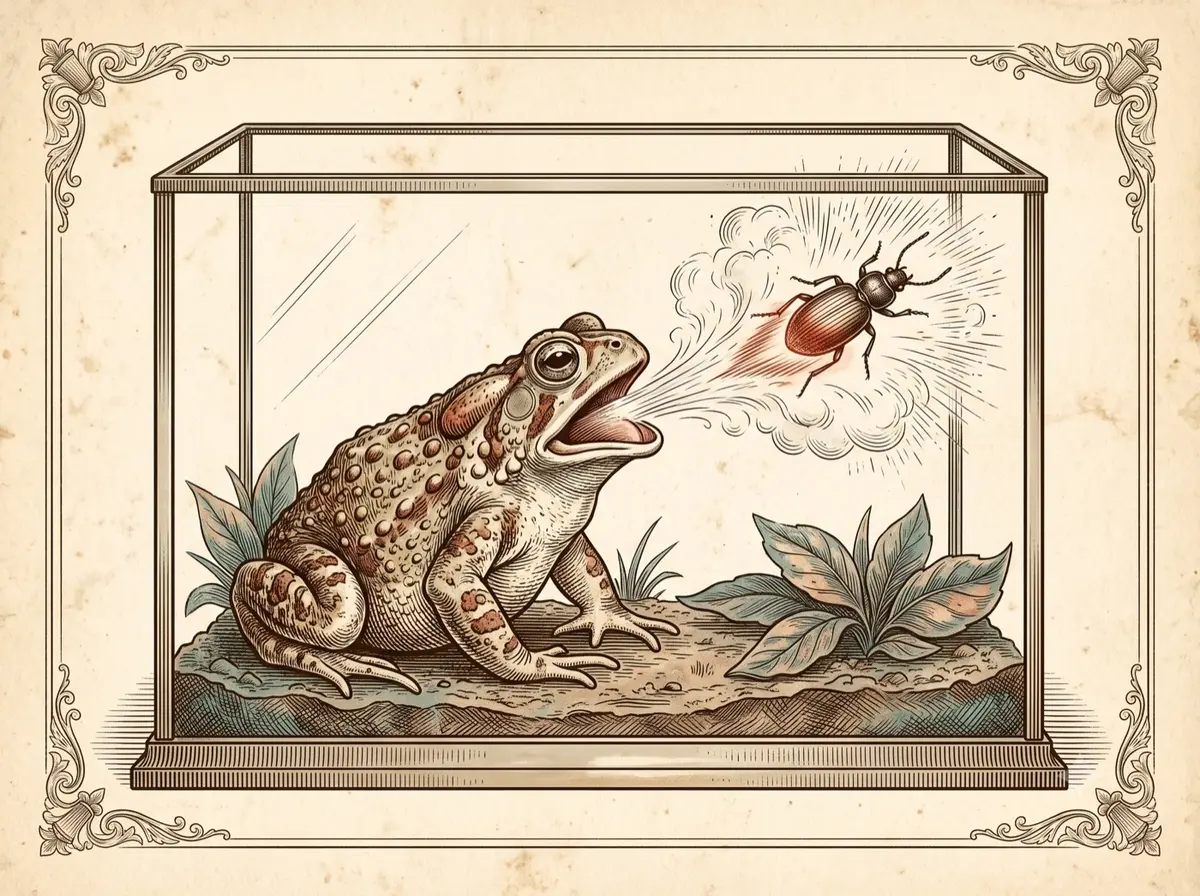
What happened: The Beetle That Explodes Inside a Predator's Stomach — and Walks Away
The bombardier beetle isn’t one species but a group of roughly 500, all in the tribe Brachinini within the ground beetle family Carabidae, found on every continent except Antarctica. What they share is a defense system unlike anything else in the animal kingdom: a pair of internal chambers at the tip of the abdomen that function, essentially, as a two-part chemical reactor. One chamber stores a solution of hydroquinones and hydrogen peroxide. A second chamber, lined with the enzymes catalase and peroxidase, sits just behind it. When a predator — an ant, a spider, a frog — disturbs the beetle, a valve opens and lets the first liquid flow into the second. The enzymes trigger an explosively fast reaction, oxidizing the hydroquinones into benzoquinones, a compound that stings and irritates on contact, while releasing a burst of oxygen gas and heat. The mixture flashes to nearly 100°C (212°F), right at the boiling point of water, and is blasted out through a steerable nozzle aimed with real precision at whatever is attacking the beetle.
The entomologist Thomas Eisner, working at Cornell University, spent decades documenting this in the 1960s and after, using high-speed photography to capture what the naked eye couldn’t: the beetle wasn’t emitting a smooth stream but a rapid series of distinct pulses, audible as an actual popping sound. Eisner’s photographs, published in Science in 1969, made the bombardier beetle a textbook example of chemical defense, but the mechanism behind the pulsing itself — how the beetle fired what amounted to a machine gun of tiny explosions without cooking its own insides — remained unexplained for another 46 years.
That answer came in 2015, when a team from MIT, the University of Arizona, and Brookhaven National Laboratory used high-speed synchrotron X-ray imaging at Argonne National Laboratory to film live beetles from the inside, at 2,000 frames per second, while they discharged. The images showed that the pulsing isn’t muscular — the beetle isn’t flexing anything to control it. It’s passive. As the reaction builds pressure in the second chamber, that pressure pushes back on a flexible membrane, which closes the valve to the first chamber and cuts off the reaction’s fuel supply. The pressure vents, the spray fires, the membrane relaxes, the valve reopens, and the cycle repeats — up to roughly 500 times per second, entirely governed by the physics of pressure and elasticity rather than any nerve signal. Researcher Eric Arndt, who led the study as an MIT graduate student, compared the resulting jet to a “biological pulse jet,” structurally similar in principle to the pulsejet engine that powered Germany’s V-1 flying bombs in World War II — except this one evolved.
Why it was strange: The Beetle That Explodes Inside a Predator's Stomach — and Walks Away
Chemical defenses are common in the insect world — plenty of beetles ooze, secrete, or smear irritating compounds on an attacker. What sets the bombardier beetle apart is that it doesn’t merely carry a toxin; it manufactures one on demand, inside its own body, through a reaction violent enough to nearly boil water, and survives doing so unharmed, over and over. And as the Kobe University toad experiments — led by biologists Shinji Sugiura and Takuya Sato and published in 2018 — demonstrated, the beetle can trigger this same reaction after already being swallowed. Of the toads in the study that ate beetles with their chemical defenses intact, 43 percent vomited the beetles back up within minutes, and every vomited beetle survived; one lived for at least 562 days afterward. Toads that ate beetles chemically disabled by the researchers digested them completely. The beetle isn’t just repelling predators before an attack — it’s negotiating its way back out of one that has already succeeded.
The same thread — Biomimicry — continues in The 7,500 Pounds of Hagfish That Slimed Five Cars and Closed a Highway.
What scientists learned: The Beetle That Explodes Inside a Predator's Stomach — and Walks Away
The core lesson is about engineering under evolutionary pressure: a passive valve-and-membrane system, with no moving parts driven by muscle or nerve, can regulate an explosive chemical reaction with split-second precision and repeatability. That’s a genuinely useful insight for anyone designing systems that need to survive their own combustion — rocket engineers, materials scientists building blast-resistant housings, anyone working with the same basic problem the beetle solved millions of years before humans existed. The 2015 study’s authors noted that the beetle’s reaction chamber has reinforced, rigid walls specifically suited to withstand repeated heat spikes, while the surrounding structures are built to flex and release pressure safely — a combination of rigidity and give that mirrors principles engineers use in blast-protection design.
Another creature that ended up in the notes: The Kingfisher That Redesigned the Bullet Train.
How it reaches us today: The Beetle That Explodes Inside a Predator's Stomach — and Walks Away
The bombardier beetle has become a genuine touchstone in biomimicry, the practice of engineering solutions modeled on biological ones. Researchers have used its two-chamber, flash-evaporation mechanism as the basis for spray systems intended for fuel injectors, firefighting mist nozzles, and inhaled drug-delivery devices, all of which need to turn a stored liquid into a fine, forceful, controllable spray using minimal added energy. The beetle’s passive pulsation system — reaction pressure regulating its own valve — is the kind of mechanically simple, failure-resistant design engineers actively look for when the alternative is a pump or motor that can break down.
Another animal the lab could not ignore: The ‘Rubbish Bird’ a Grad Student Discovered Was Poisonous by Licking His Own Scratch.
Fun fact: The Beetle That Explodes Inside a Predator's Stomach — and Walks Away
The beetle’s blast is loud enough, and hot enough, to be genuinely painful to a human finger — collectors and entomologists who handle bombardier beetles carelessly often come away with a small chemical burn and a story to tell.
Sources: The Beetle That Explodes Inside a Predator's Stomach — and Walks Away
- Arndt, E.M., Moore, W., Lee, W.K., Ortiz, C. “Mechanistic origins of bombardier beetle (Brachinini) explosion-induced defensive spray pulsation.” Science 348, no. 6234 (2015): 563–567. — primary synchrotron X-ray imaging study
- Sugiura, S. and Sato, T. “Successful escape of bombardier beetles from predator digestive systems.” Biology Letters 14, no. 2 (2018). — primary study on beetles surviving toad predation
- How some beetles produce a scalding defensive spray, MIT News — plain-language summary of the 2015 study with researcher quotes
- How Exploding Beetles Can Survive Being Eaten Alive, Smithsonian Magazine — coverage of the Sugiura and Sato toad study
- Thomas Eisner, Wikipedia — background on Eisner’s career and his foundational bombardier beetle research
Related stories: The Beetle That Explodes Inside a Predator's Stomach — and Walks Away
- The Kingfisher That Redesigned the Bullet Train — A kingfisher’s beak fixed the bullet train’s sonic boom
- The Burrs Stuck to a Dog That Became Velcro — A dog covered in burrs became the hook-and-loop fastener
- The Jellyfish That Can Reverse Its Own Aging — A jellyfish that can rewind itself back to childhood