Strange Animals Scientists Studied · Chemistry
The 'Rubbish Bird' a Grad Student Discovered Was Poisonous by Licking His Own Scratch
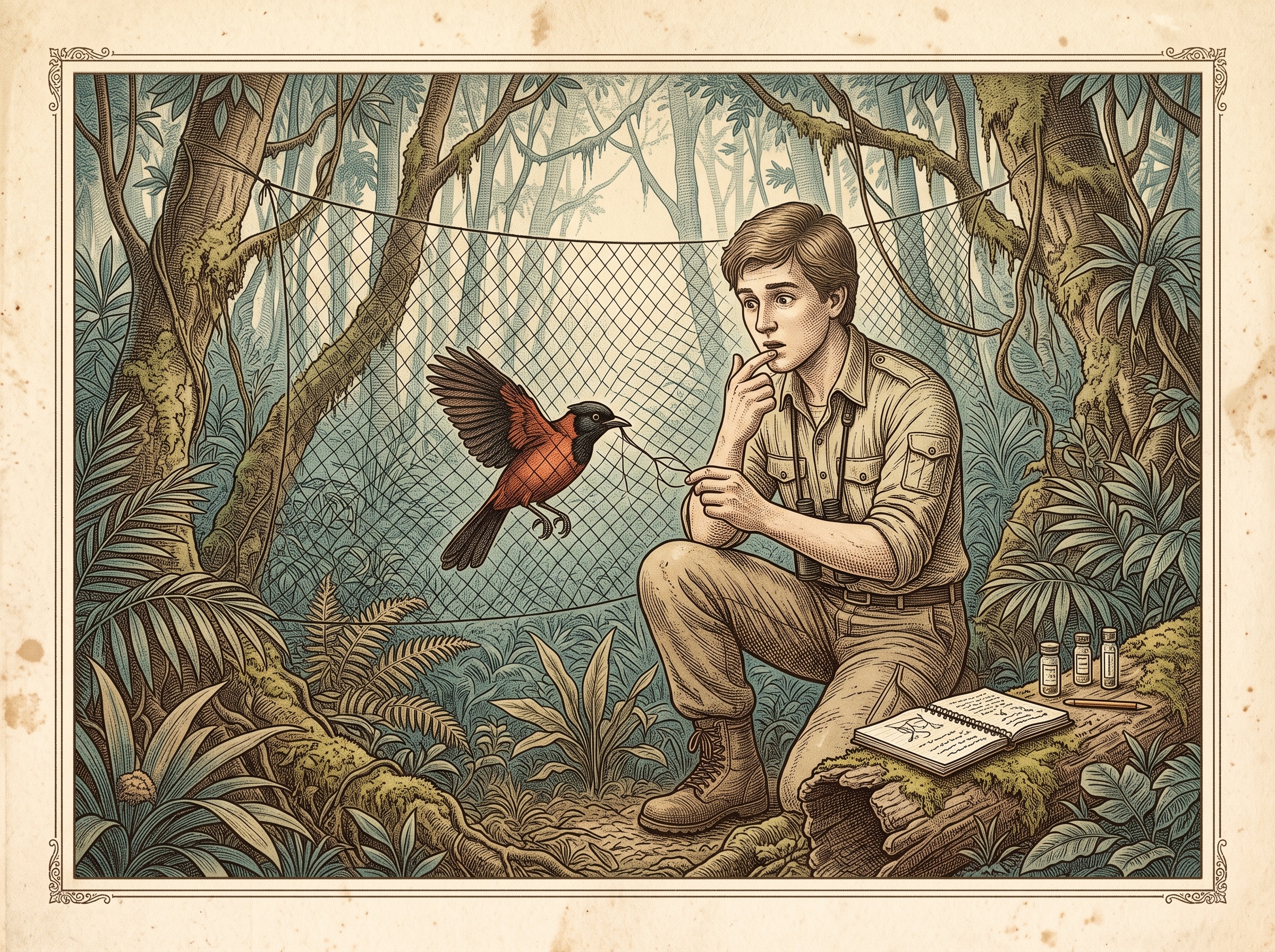
In the summer of 1989, a graduate student named Jack Dumbacher was untangling a furious black-and-orange bird from a net in a Papua New Guinea rainforest when it scratched his hand. He had 39 more nets to check, so he did what most of us would do: he stuck the cut in his mouth. His lips began to tingle. Then burn. Then go numb — and they stayed that way into the night. Dumbacher had just become the first scientist to discover a poisonous bird, by accidentally tasting one.
By the Curiosities Desk · · 5 min read · Filed under Chemistry · Today’s round
What happened?
Dumbacher, then a University of Chicago graduate student, wasn’t in New Guinea to study poison at all. He was there to study birds of paradise, and he had strung fine “mist nets” — nearly invisible mesh used to catch birds without hurting them — through the forest. Plenty of birds he didn’t want blundered in too, including the hooded pitohui (Pitohui dichrous), a jay-sized bird with, as he later told National Geographic, “needle-sharp claws and bills.”
At first he blamed the numb mouth on the mix of sweat, dirt, and mosquito repellent on his hands. Then, days later, a co-worker mentioned the same odd tingling. Dumbacher asked what he’d been doing. Handling pitohuis, the man said.
When Dumbacher returned the next year, he ran a small, very hands-on experiment: he plucked a feather from the first pitohui to hit his nets and put it in his mouth. “It definitely made my mouth tingle and burn,” he told the California Academy of Sciences’ magazine.
The people who lived in the forest were not surprised. Local guides told him villagers knew pitohuis as “rubbish birds” — not worth eating unless skinned and specially prepared. “It buggers up your mouth if you try,” one told him. People who handled the birds also tended to sneeze and get teary-eyed.
When Dumbacher mentioned all this to his advisor, Smithsonian ornithologist Bruce Beehler, while driving him from the airport, Beehler’s response (as Dumbacher recalls it) was immediate: turn the car around. He’d never heard of a poisonous bird, and he predicted it would end up in the journal Science.
With government permits, the team collected feathers and tissue from three pitohui species and brought them to the United States. Then came the hard part: finding a chemist willing to look. Most were skeptical. According to Dumbacher, the feathers finally reached John Daly, a chemist at the National Institutes of Health, after he passed some around for tasting at the end of a talk.
Daly’s lab found that extracts from the feathers sent lab mice into convulsions and killed them. When the chemists finally purified the toxin, Daly recognized it. It was batrachotoxin — a poison he himself had helped identify decades earlier in the skin of Colombian poison dart frogs, on the other side of the world.
In October 1992, Dumbacher, Beehler, Daly, and colleagues published the result in Science: the paper “Homobatrachotoxin in the Genus Pitohui: Chemical Defense in Birds?” It was Dumbacher’s first scientific paper.
Why was it strange?
Birds were not supposed to do this. Venomous snakes, stinging insects, toxic frogs — fine. But a songbird carrying a nerve poison in its feathers had never been documented by science.
Stranger still was which poison it was. Batrachotoxin had been known only from a handful of poison dart frogs in western Colombia — the frogs whose secretions some Indigenous hunters use on blow darts. Now the same rare molecule had turned up in a bird on an island on the far side of the Pacific, in an animal with no close relationship to frogs at all.
And the discovery came about in the least scientific-sounding way imaginable: a sore hand, a reflexive lick, and a mouth that wouldn’t stop tingling. The villagers had known the bird was “rubbish” for generations. Science simply caught up by tasting it.
Another creature that ended up in the notes: The 7,500 Pounds of Hagfish That Slimed Five Cars and Closed a Highway.
What did scientists learn?
Batrachotoxin is a neurotoxin — a chemical that disrupts nerves. Nerves send signals by opening and closing tiny gates in their cell walls called sodium channels. Batrachotoxin jams those gates open, so the nerve can’t reset. In small doses that means tingling and numbness; in large doses, paralysis or worse. National Geographic describes it as deadlier than cyanide.
The pitohui, though, carries far less of it than the most toxic frogs. The hooded pitohui isn’t considered lethal to handle or eat — it’s more of a very unpleasant warning. Most of the toxin sits in the skin and feathers, especially on the breast and belly, which hints at its job: defense. In tests Dumbacher described, captive green tree pythons that started swallowing chicks dabbed with a pitohui-sized dose of the toxin stopped partway, pulled the chicks back out, and rubbed their mouths on nearby objects. Feather lice also avoided toxic feathers.
The bigger puzzle was where the poison came from. Poison dart frogs raised in captivity aren’t toxic, which suggests they get it from their diet. In 2002, villagers in Herowana, in the Crater Mountain area, handed one of Dumbacher’s team vials of tiny orange beetles they called nanisani — a word for that same tingling sensation. Lab tests found batrachotoxins in the beetles, from the genus Choresine. A 2004 paper in PNAS reported high toxin levels in the beetles and found Choresine beetles in pitohui stomach contents.
That’s a strong lead, not a closed case. Dumbacher himself doubts the beetles make the toxin; he suspects they too pick it up from something else — perhaps mites or a plant. Nobody knows yet.
Another animal the lab could not ignore: The Beetle That Explodes Inside a Predator’s Stomach — and Walks Away.
How does it affect us today?
The pitohui opened a whole field. Since 1992, scientists have identified at least a dozen toxic bird species. Most carry batrachotoxin and live in New Guinea, including several more pitohuis and the blue-capped ifrit — a bird local people pointed out to Dumbacher as even more poisonous, which lab tests backed up. Two new toxic species were reported in 2023.
The birds are now a case study in convergent evolution: unrelated animals (frogs and birds) independently evolving to carry the same poison without killing themselves. How they manage that is still debated. Some researchers point to mutations in the birds’ sodium channels; others suspect a “toxin sponge” protein that binds the poison and keeps it out of harm’s way. Research teams plan return trips to Papua New Guinea through 2028.
The story is also a reminder to listen. At almost every step — the bird is toxic, the ifrit is worse, the beetle is the clue — local knowledge was ahead of the lab.
A close cousin: The Dung Beetles Scientists Fitted With Tiny Hats to Prove They Steer by the Milky Way.
Fun fact
Some villagers told Dumbacher there was a way to make a pitohui safe to eat: hold the bird and cry over it as if it were your own baby. Cry sincerely enough, and it won’t burn your mouth. Dumbacher reads the tradition as a way of explaining a real pattern — some pitohuis are far more toxic than others.
Sources
- Dumbacher, J. P., Beehler, B. M., Spande, T. F., Garraffo, H. M., & Daly, J. W. (1992). “Homobatrachotoxin in the Genus Pitohui: Chemical Defense in Birds?” Science 258: 799–801. Smithsonian Research Repository
- Dumbacher, J. P., et al. (2004). “Melyrid beetles (Choresine): A putative source for the batrachotoxin alkaloids found in poison-dart frogs and toxic passerine birds.” PNAS 101(45). PNAS
- Wong, Kathleen M. “Of Birds and Beetlejuice.” California Wild, California Academy of Sciences, Winter 2005. California Academy of Sciences
- Ong, Sandy. “These birds carry a toxin deadlier than cyanide.” National Geographic, May 5, 2025. National Geographic
- Sohn, Emily. “Toxic Birds May Get Poison from Beetles.” Science News Explores, November 5, 2004. Science News Explores