Strange Animals Scientists Studied · Chemistry
The Zookeepers Who Wiped a Hippo's Face With Gauze to Find Out Why It 'Sweats Blood'
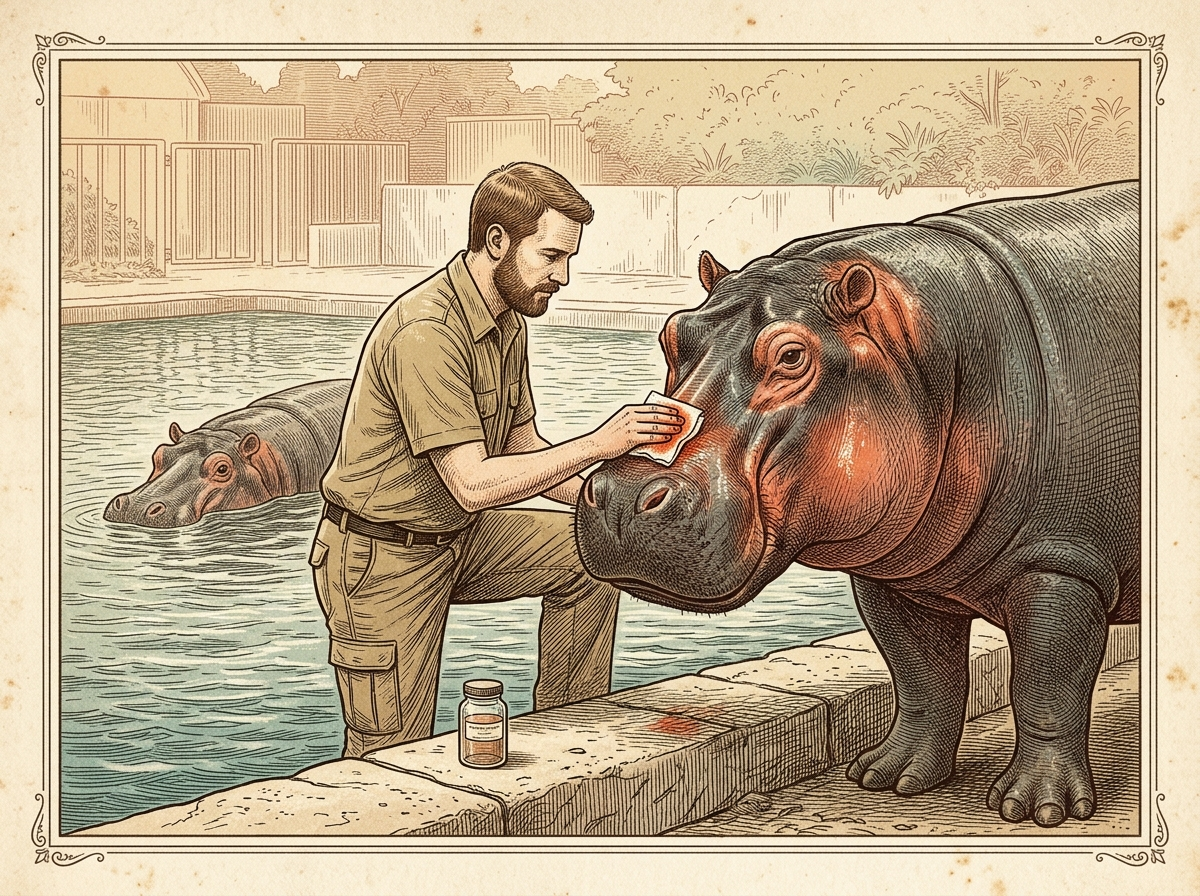
At Tokyo's Ueno Zoo in the early 2000s, keepers had an unusual chore: walking up to two hippopotamuses, Satsuki and Jiro, and dabbing their faces and backs with gauze. The cloth came away stained the color of a fresh wound. For nearly two thousand years, people had looked at that red sheen on a hippo's hide and assumed the animal was sweating blood. A team of Japanese chemists wanted to know what was really in it, and the only way to find out was to ask a three-ton animal to hold still for a wipe.
By the Curiosities Desk · · 5 min read · Filed under Chemistry · Today’s round
What happened?
The idea that hippos bleed on purpose is very old. In his Natural History, written in the first century CE, the Roman author Pliny the Elder told a story about the hippopotamus as a kind of animal physician. When a hippo grew too heavy from overeating, Pliny wrote, it went to the riverbank, found a freshly cut reed stump sharp enough to pierce the skin, and pressed its thigh against it to open a vein. Once it had drained enough blood, it sealed the wound with mud. Pliny even credited the hippo with showing humans the medical practice of bloodletting.
Pliny never watched a hippo do any of this, and no one since has either. But anyone who has seen a hippo out of the water can understand where the notion came from. On land, a hippo’s skin slowly develops a glistening reddish-orange coat. As one British zookeeper put it to Nature’s news team in 2004, “It really does look like blood is pouring down them.”
The person who decided to settle the question was Kimiko Hashimoto, an organic chemist then at Keio University in Yokohama, working with her colleagues Yoko Saikawa and Masaya Nakata. To study the fluid, they needed a supply of it, fresh. So they partnered with staff at Ueno Zoological Gardens, whose keepers swabbed the secretion from Satsuki and Jiro with gauze and passed it to the lab.
The first surprise was the timeline. When the fluid first appears on the skin, it is colorless and thick. Within a few minutes it turns red-orange, and over the following hours it darkens to brown. Whatever was in it was changing, fast.
The chemists separated two pigments responsible for the color. One was red, which they named hipposudoric acid. The other was orange, which they named norhipposudoric acid. Both were unusual molecules: ring-shaped carbon compounds of a type chemists call “non-benzenoid aromatics” (stable rings of carbon that don’t follow the familiar six-sided benzene pattern found in most natural pigments), and they were unexpectedly acidic. The brown color that appears later comes from the pigments linking up into long chains, a process called polymerization.
The team published their findings in May 2004 as a short communication in Nature, titled simply “The red sweat of the hippopotamus.” Four co-authors on the paper came from Ueno Zoo.
Why was it strange?
Almost nothing about the old explanation held up. The fluid isn’t blood. It also isn’t quite sweat in the human sense. Hippos don’t produce sweat the way we do; their secretion comes from larger glands deeper in the skin, which empty through pores you can see with the naked eye.
And the color wasn’t just a cosmetic quirk. When the researchers measured how the two pigments absorbed light, both soaked up ultraviolet light, the part of sunlight that burns skin. In lab tests, the red pigment also slowed the growth of two kinds of disease-causing bacteria, Pseudomonas aeruginosa and Klebsiella pneumoniae.
So the stuff Pliny took for a self-inflicted wound appears to work as a combination sunscreen and antiseptic, produced by the animal’s own skin. A creature famous for bleeding was, if anything, protecting itself from infection.
The hippo turns out to have an older connection to bloodletting, too: The Doctor Who Prescribed 30 Leeches for Everything — and the Paris Dresses Embroidered in His Honor.
What did scientists learn?
The study filled in a puzzle about how hippos survive their own lifestyle. They spend long hours in water, but they also haul out and lie in the African sun. Males fight fiercely over territory and often carry gashes from rivals’ teeth. Wildlife biologist Keith Eltringham, a longtime hippo researcher, told Science News that hippo wounds rarely seem to become infected despite those battles. An antibacterial skin coating offers one possible reason, though the 2004 study tested the pigment against bacteria in a dish, not on a wounded hippo in a river.
The pigments are also fragile. On their own they break down quickly, yet a hippo’s red sheen lasts for hours. The researchers suspected that mucus released alongside the pigments slows that breakdown. Because hippos everywhere produce the same red fluid regardless of what they eat, Hashimoto’s team proposed that the animals build the pigments themselves, probably from common building blocks such as the amino acid tyrosine, rather than absorbing them from their diet.
Not every claim about the fluid is settled. Some researchers have suggested it helps keep hippos cool, while Eltringham was skeptical: a hot hippo can simply walk into the water. The sunscreen and antibiotic effects are the best-supported findings.
Animal chemistry has surprised researchers before: The 7,500 Pounds of Hagfish That Slimed Five Cars and Closed a Highway.
How does it affect us today?
Hippo “sweat” became a favorite example in biomimicry, the practice of borrowing designs from nature, and it prompted talk of a sunscreen inspired by the animal. Hashimoto and her colleagues went on to synthesize the pigments and related compounds in the lab, publishing a detailed follow-up in Pure and Applied Chemistry in 2007.
So far, though, there’s no hippo sunscreen on the drugstore shelf. The same instability that makes the fluid change color in minutes makes it a tough ingredient to bottle. As photobiologist Gavin Greenoak of the University of Sydney noted in 2004, natural UV-blockers from plants have mostly failed as human sunscreens for that reason, and he joked that a product that turned its users red-orange might struggle to sell.
The bigger legacy is a lesson in looking closer. A story that had circulated since Roman times was overturned by a couple of zookeepers, some gauze, and a chemistry lab.
Another animal fluid that turned out to protect people: The Baby-Blue Blood of the Horseshoe Crab That Keeps Every Vaccine Safe.
Fun fact
The name “hipposudoric acid” comes from the Latin sudor, meaning sweat. The red pigment’s scientific name means, more or less, “hippo sweat acid.”
Sources
- Saikawa, Y., Hashimoto, K., Nakata, M., Yoshihara, M., Nagai, K., Ida, M. & Komiya, T. “The red sweat of the hippopotamus”, Nature 429: 363 (2004).
- Hashimoto, K., Saikawa, Y. & Nakata, M. “Studies on the red sweat of the Hippopotamus amphibius”, Pure and Applied Chemistry 79(4): 507–517 (2007).
- Hopkin, Michael. “Hippos beat the burn”, Nature News, May 27, 2004.
- Science News. “Red sweat: Hippo skin oozes antibiotic sunscreen”, 2004.
- Pliny the Elder. The Natural History, Book 8, Chapter 40, trans. John Bostock and H. T. Riley (1855), Perseus Digital Library.