The Moon Buggy Fender That Was Fixed With Duct Tape and Four Maps
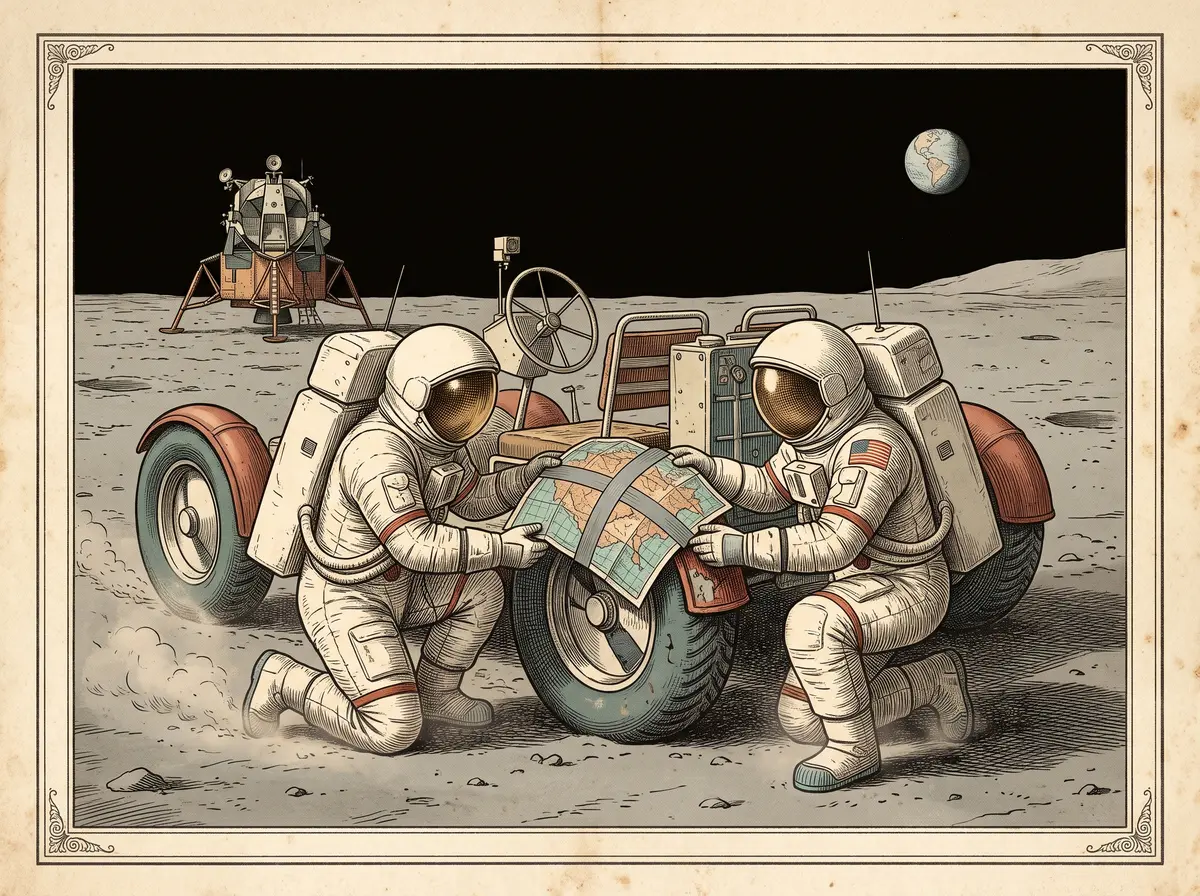
In December 1972, about 240,000 miles from the nearest auto body shop, two astronauts knelt beside their electric car on the Moon and fixed a broken fender with four folded maps, a roll of gray tape, and two borrowed lamp clamps. The repair worked. It is now on display at the Smithsonian.
By the Curiosities Desk · · 5 min read · Filed under Space · Today’s round
What happened: The Moon Buggy Fender That Was Fixed With Duct Tape and Four Maps
Apollo 17 was the last crewed mission to the Moon. On December 11, 1972, commander Eugene “Gene” Cernan and lunar module pilot Harrison “Jack” Schmitt landed in the Taurus-Littrow valley, while Ronald Evans circled overhead in the command module America. Their plan called for three long moonwalks, covering many miles in a Lunar Roving Vehicle, an open, battery-powered car about the size of a dune buggy.
Each of the rover’s four wheels had a fender, and each fender had a lightweight extension that slid out to catch the dust the wheels kicked up. During the first moonwalk, Cernan’s rock hammer, tucked in a pocket on his suit, caught the extension over the right rear wheel and knocked it off. According to the Smithsonian’s National Air and Space Museum, his reaction was a mild “Oh shoot.”
That might sound like a small problem. On the Moon, it wasn’t. Cernan reached for the tool astronauts had been trusting since Apollo 11: duct tape, listed in NASA’s stowage paperwork simply as “Tape.” He taped the extension back on. But his gloves and the fender were coated in fine lunar soil, and the tape couldn’t get a grip. The extension fell off again as they drove between work sites.
Without it, the wheel threw up what the crew called “rooster tails,” arcs of dark grit that showered the rover, its instruments, and the astronauts. Cernan grumbled that cleaning up would take “half a dozen Sundays.”
The real fix came from Earth. While Cernan and Schmitt slept inside the lunar module Challenger, a small group in Mission Control in Houston worked out a repair using only items already on the Moon. A NASA photo caption names them: astronauts John Young and Charlie Duke, flight crew director Deke Slayton, Apollo program director Rocco Petrone, and Ronald Blevins. Young and Duke had a special qualification. Eight months earlier, on Apollo 16, they had driven a lunar rover themselves.
Their solution was pure garage engineering. Take four of the stiff, laminated maps the crew carried, tape them together into a curved sheet about the size of the missing piece, and clamp it to the fender. For clamps, they borrowed two from the lamp on the optical alignment telescope, the instrument the crew used to sight stars and keep the spacecraft’s navigation on track.
On December 12, early in the second moonwalk, the astronauts followed the instructions read up from Houston. NASA photo AS17-137-20979 shows the result: a gray cross of tape holding four maps together over the right rear wheel. It was not pretty. But it held for the rest of the mission, through the second and third moonwalks.
Why it was strange: The Moon Buggy Fender That Was Fixed With Duct Tape and Four Maps
Apollo was one of the most expensive and carefully engineered projects in history. Every switch was tested; every pound of cargo was argued over. And yet one of the last repairs made on the Moon used office supplies.
The deeper surprise was the enemy: dust. Lunar soil, called regolith, is not like beach sand. On Earth, wind and water round off sand grains over time. On the Moon, nothing does, so the grains stay sharp and jagged, more like crushed glass. They cling to almost everything. That’s why the tape failed the first time. It wasn’t a bad roll; the Moon simply coated the sticky side before it could stick.
In one-sixth of Earth’s gravity and with no air to slow them down, the particles flung from a wheel also fly much farther than they would on Earth. A missing scrap of fender could bury a rover in grit. For another Apollo story where a small, ordinary thing caused outsized trouble, see The Corned Beef Sandwich That Got NASA Hauled Before Congress.
What scientists learned: The Moon Buggy Fender That Was Fixed With Duct Tape and Four Maps
The fender episode made clear something earlier crews had already been reporting: dust may be the Moon’s most stubborn hazard. Dark dust on equipment absorbs sunlight, and that extra heat can push electronics and batteries past safe temperatures. That is why the crew had good reason to worry about grit raining down on the rover. Dust also wore on spacesuits. The Smithsonian notes that Cernan’s suit started the mission bright white and finished his third moonwalk with dark legs.
There was a human lesson too. The fix worked because the people on the ground knew exactly what was on board and had hands-on experience with the hardware. Planning with only what is already within reach became a core habit in spaceflight. Apollo 13’s crew had survived two years earlier partly thanks to a carbon dioxide filter adapter improvised with duct tape. The mission’s worry about what might ride home on the dust also echoes The Airstream Trailer That Was Supposed to Save Earth From Moon Germs.
How it reaches us today: The Moon Buggy Fender That Was Fixed With Duct Tape and Four Maps
The map fender came home. The four maps, still taped together, were transferred from NASA to the National Air and Space Museum in 1975 and are displayed in its “Destination Moon” gallery.
The dust problem came home too, and it’s now a priority for NASA’s Artemis program, which aims to send astronauts back to the Moon for longer stays. In March 2025, Firefly Aerospace’s Blue Ghost Mission 1 lander tested a NASA Electrodynamic Dust Shield on the lunar surface. It uses electric fields to lift dust off surfaces such as glass and radiators. NASA reported that it cleared regolith from test panels, the first demonstration of the technology on the Moon.
And duct tape itself keeps its place in the toolbox. Its origins are usually traced to Vesta Stoudt, an Illinois ordnance-plant worker who in 1943 wrote to President Franklin D. Roosevelt proposing a waterproof cloth tape for ammunition boxes. Thirty years later, its descendant was holding a car together on the Moon. The rover’s fender belongs on The Ordinary Object With the Strange Origin.
Fun fact: The Moon Buggy Fender That Was Fixed With Duct Tape and Four Maps
NASA’s Apollo packing lists never called it duct tape. On the official stowage lists for Apollo 11 through 17, the most famous fix-it tool on the Moon was recorded with one modest word: “Tape.”
Sources: The Moon Buggy Fender That Was Fixed With Duct Tape and Four Maps
- Smithsonian National Air and Space Museum, “Duct Tape Auto Repair on the Moon”: https://airandspace.si.edu/stories/editorial/duct-tape-auto-repair-moon
- Smithsonian collections, “Maps, Fender Extension, Lunar Roving Vehicle, Apollo 17” (A19760010000): https://si.edu/object/maps-fender-extension-lunar-roving-vehicle-apollo-17%3Anasm_A19760010000
- NASA, “Duct Tape Saves the Day” (Apollo 17 image AS17-135-20542, 2015): https://www.nasa.gov/image-feature/duct-tape-saves-the-day
- NASA Apollo Lunar Surface Journal, Apollo 17 EVA-2 preparation and fender repair: https://nasa.gov/wp-content/uploads/static/history/alsj/a17/a17.eva2prep.html
- NASA Technical Reports Server, Electrodynamic Dust Shield lunar demonstration (2025): https://ntrs.nasa.gov/api/citations/20250009407/downloads/EDS_ESA Newsletter paper 2025_Final_WithAuthors.pdf