The Jar of Peanuts NASA Won't Launch Without — Thanks to Six Moon Probes That Failed in a Row
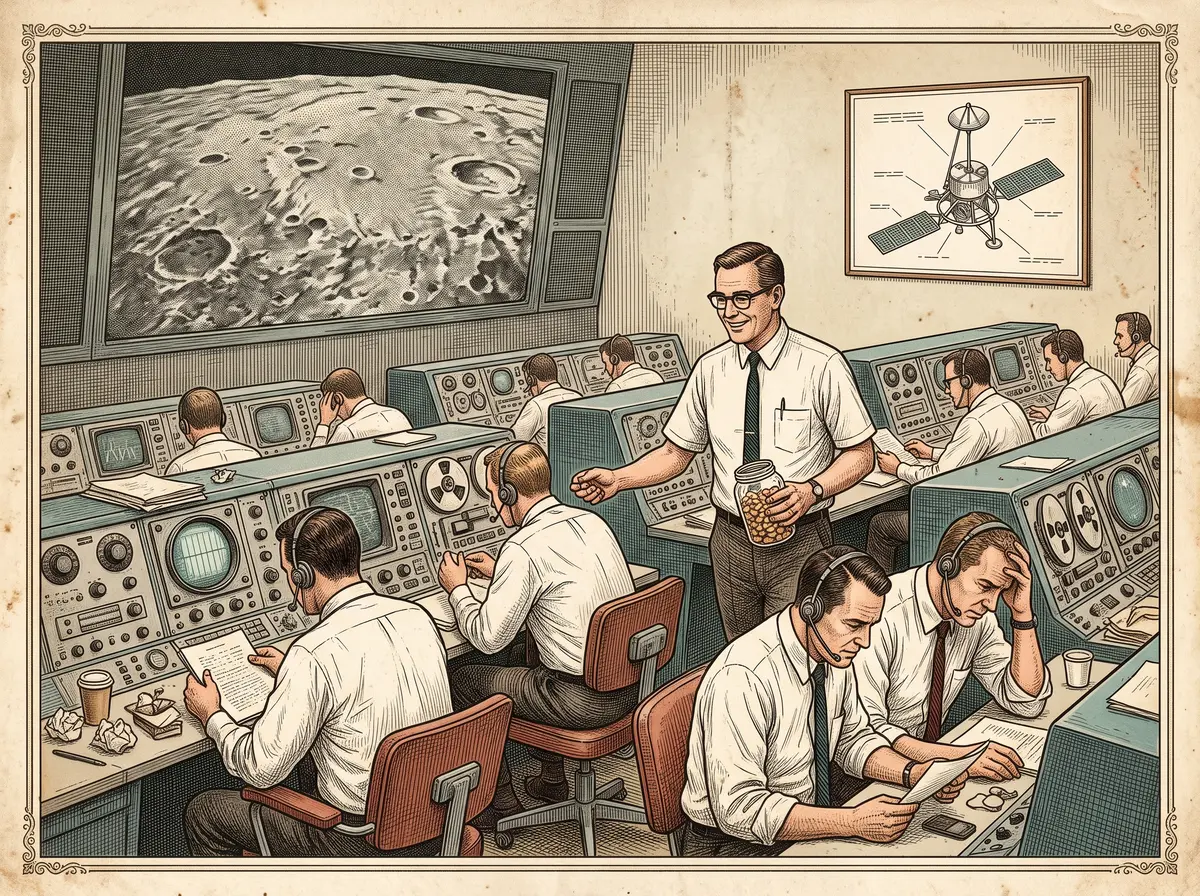
On the morning of July 28, 1964, in a mission control room in Pasadena, California, a trajectory engineer walked between the consoles handing out peanuts. The people in that room had just watched six spacecraft in a row fail on the way to the Moon. Three days later, the seventh one worked perfectly. Engineers at NASA's Jet Propulsion Laboratory have been passing around peanuts at big mission moments ever since.
By the Curiosities Desk · · 5 min read · Filed under Space · Today’s round
What happened: The Jar of Peanuts NASA Won't Launch Without — Thanks to Six Moon Probes
In 1961, NASA’s Jet Propulsion Laboratory (JPL) began launching a series of robot probes called Ranger. The job sounds simple and was anything but: fly to the Moon, point TV cameras at it, and send back close-up pictures right up until the spacecraft smashed into the surface. Nobody had ever seen the Moon up close, and the Apollo program needed to know whether its astronauts would be landing on solid ground.
Ranger kept missing. Rangers 1 and 2 were stranded in low Earth orbit by rocket problems in 1961. Ranger 3 lost radio contact and missed the Moon by about 22,900 miles. Ranger 4’s onboard computer failed, and it hit the Moon on April 26, 1962, without sending back any useful data. Ranger 5 lost contact too and sailed past the Moon by about 450 miles. One NASA official later recalled that, at one point, the program was nicknamed “shoot and hope.”
Ranger 6 was supposed to end the losing streak. It flew a near-perfect course and hit its target on February 2, 1964, but its television system had been knocked out earlier in the flight by an electrical short circuit. It struck the Moon with its cameras dark and returned no pictures. Congress opened an investigation.
So when Ranger 7 lifted off from Cape Canaveral on July 28, 1964, the room at JPL was tense. Dick Wallace, a mission trajectory engineer, had brought peanuts. “I thought passing out peanuts might take some of the edge off the anxiety,” he later explained, according to NASA’s account of the tradition. (Some histories credit the gesture to project manager Harris Schurmeier instead; JPL’s own telling names Wallace.)
On July 31, Ranger 7 reached the Moon, and this time its six TV cameras switched on as planned. Over the final 17 minutes of its flight, it sent back 4,308 images. The last came 2.3 seconds before impact, from about 1,600 feet up, showing details roughly 15 inches across. Then the spacecraft hit the Moon at about 1.62 miles per second, roughly 5,800 miles per hour.
It was the first time an American spacecraft had sent back close-up pictures of the Moon, and the team quickly noticed what had been sitting on their desks. Peanuts started showing up on informal countdown checklists, and they have been part of JPL launches ever since.
Why it was strange: The Jar of Peanuts NASA Won't Launch Without — Thanks to Six Moon Probes
JPL is one of the most data-driven places on Earth. Its engineers calculate trajectories across billions of miles and plan landings that must go right on the first try with no human on board. And yet, at the moments that matter most, someone opens a jar of peanuts.
Nobody there thinks the snack steered Ranger 7. NASA’s own write-up says plainly that JPL staff understand that correlation (two things happening together) is not causation (one thing making the other happen). That’s what makes the tradition so charming: it’s a superstition kept by people who know exactly what a superstition is.
The peanuts have also had some close calls. For the Cassini mission to Saturn, the peanuts were forgotten for the first launch attempt on October 13, 1997. That launch was postponed by weather. Two days later, with peanuts on hand, Cassini lifted off without a hitch. NASA’s account also mentions one launch that slipped 40 days before the peanuts arrived. For a different snack with a surprisingly big role in NASA history, see The Corned Beef Sandwich That Got NASA Hauled Before Congress.
What scientists learned: The Jar of Peanuts NASA Won't Launch Without — Thanks to Six Moon Probes
The real lessons of Ranger 7 were about the Moon, and about how to build reliable spacecraft. The pictures showed a surface pocked with craters of every size, down to pits only a few feet wide. It wasn’t a bottomless sea of dust; it looked firm enough to land on. That gave engineers confidence to design the Surveyor landers and, after them, the Apollo lunar module.
Ranger also taught JPL how to stop losing spacecraft. After the early failures, the lab tightened its testing, quality checks and change-control rules (procedures that require every design change to be documented and reviewed). The peanuts celebrate a success that really came from that slow, careful work. Rangers 8 and 9 succeeded too in 1965, and their images helped scientists choose Apollo landing sites. For another case where one tiny overlooked detail mattered enormously, see The Flake of Chipped Paint That Made a $1.5 Billion Telescope Nearsighted.
How it reaches us today: The Jar of Peanuts NASA Won't Launch Without — Thanks to Six Moon Probes
The peanuts never left. At first they appeared only at launches. Since the Voyager missions, they have been shared at most of JPL’s critical events, including orbit insertions, flybys and landings.
When the Perseverance rover launched on July 30, 2020, a jar of peanuts sat in JPL’s mission control next to face masks, hand sanitizer and COVID-19 guidelines. Before the rover landed on Mars on February 18, 2021, the entry, descent and landing team posed with bags of lucky peanuts.
NASA describes the habit as more than a joke. It gives a large team a shared identity, and it’s a small, humble nod to the things even the best engineers can’t control. For another story about how NASA’s everyday objects get turned into legends, see The Million-Dollar Space Pen Myth — and the $128.89 Pencils NASA Actually Bought.
Fun fact: The Jar of Peanuts NASA Won't Launch Without — Thanks to Six Moon Probes
Scientists gave Ranger 7’s crash site a new name: Mare Cognitum, Latin for “The Known Sea.” It is a patch of the Moon named for the simple fact that, at last, someone had seen it up close.
Sources: The Jar of Peanuts NASA Won't Launch Without — Thanks to Six Moon Probes
- NASA Science, “What Are JPL’s Lucky Peanuts?” (2021): https://science.nasa.gov/missions/what-are-jpls-lucky-peanuts
- NASA History, “60 Years Ago: Ranger 7 Photographs the Moon” (2024): https://www.nasa.gov/history/60-years-ago-ranger-7-photographs-the-moon/
- NASA Jet Propulsion Laboratory, “Slice of History: 60 Years of Ranger”: https://www.jpl.nasa.gov/images/slice-of-history-60-years-of-ranger/
- NASA Science, “Ranger 7” mission page: https://science.nasa.gov/mission/ranger-7/
- R. Cargill Hall, Lunar Impact: A History of Project Ranger, NASA SP-4210 (1977), summarized in Air & Space/Smithsonian, “A Smashing Success”: https://www.smithsonianmag.com/air-space-magazine/a-smashing-success-46511279/