Strange Animals Scientists Studied · Physics
The Falling Cat That Seemed to Break the Laws of Physics
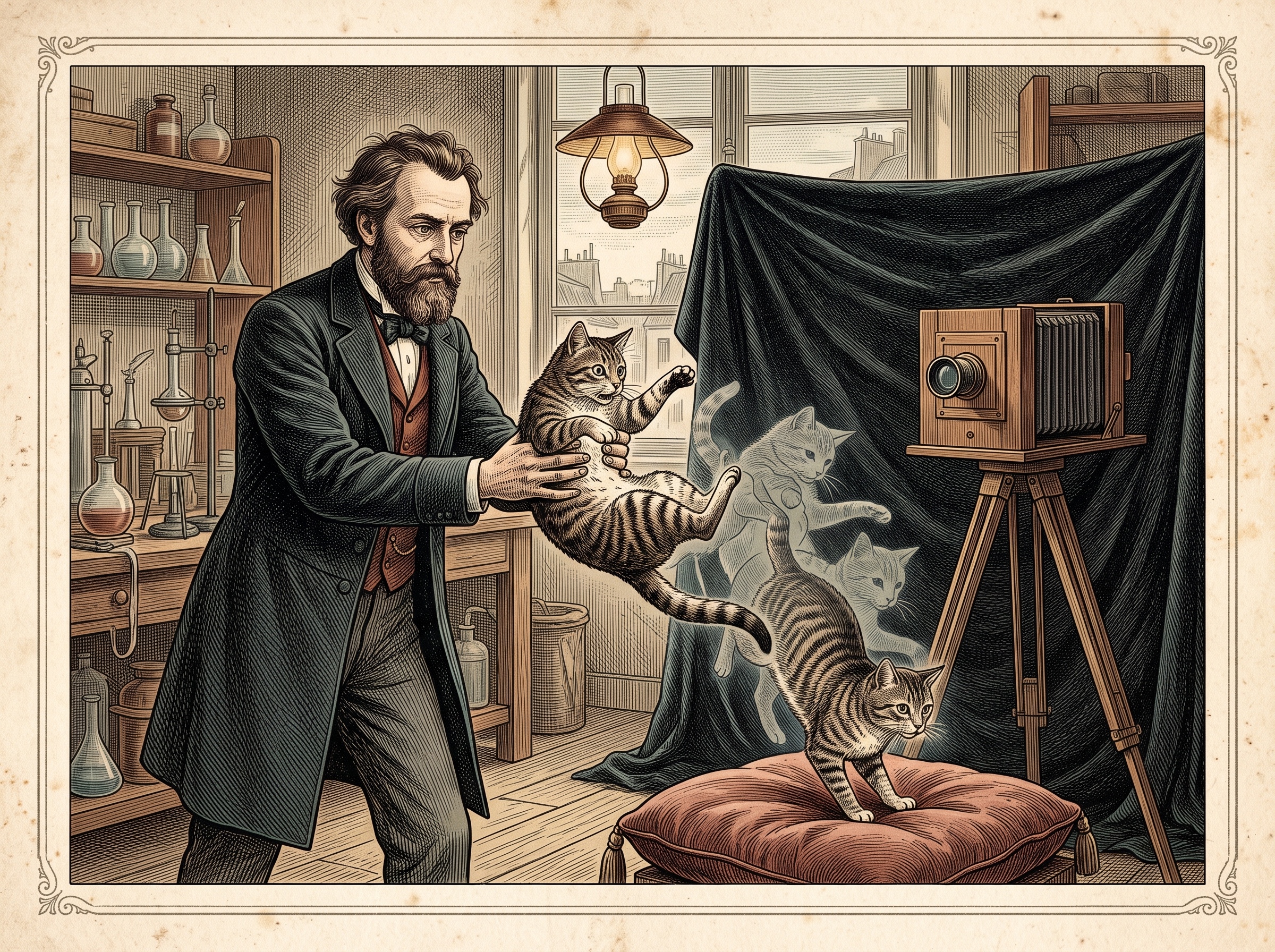
In 1894, the French physiologist Étienne-Jules Marey held a cat upside down by its feet, let go, and photographed it about a dozen times as it fell. When he showed the pictures to the French Academy of Sciences in Paris, the room did not see a cat landing on its feet. It saw a problem. By the rules of mechanics everyone had learned, a cat dropped without any spin should not have been able to turn over at all. And yet there it was, frame by frame, doing exactly that — and looking, as one British journal put it, thoroughly unimpressed.
By the Curiosities Desk · · 5 min read · Filed under Physics · Today’s round
What happened?
Everyone knew cats land on their feet. How they did it quietly attracted some of the best minds in 19th-century physics.
At Cambridge, the mathematician George Gabriel Stokes was fond of what his circle called “cat-turning.” His daughter later recalled that he would hold a cat by its four feet and drop it, back downwards, close to the floor. James Clerk Maxwell — the man who worked out that light is an electromagnetic wave — was at it too. In an 1870 letter to his wife, Maxwell complained that Trinity College had a tradition that he used to throw cats out of windows. He set the record straight: the proper method, he explained, was to drop the cat onto a table or bed from about two inches up, and even then the cat landed on its feet.
Neither man could see what the cat was actually doing. The whole flip happens in a fraction of a second, far too fast for the human eye.
That is where Marey came in. A physician and physiologist by training, he had spent years inventing ways to record motion. His tool was chronophotography: a camera that captured a rapid series of images, one after another, on a single strip. His cat sequence was shot at roughly 12 frames per second, from the side and from the front.
The photographs showed something important. When the cat was released, it was not spinning. It did not push off against the hand that held it. It simply began to fall, upside down and still — and then, in mid-air, it twisted itself around and came down feet first.
Marey presented the images to the Academy in late October 1894 and published them in its journal, the Comptes Rendus, under a title that translates roughly as “On the movements that certain animals make to land on their feet when dropped from a height.” According to physicist and historian Gregory Gbur, the meeting was thrown into disarray. One member declared that Marey had handed them a paradox in direct contradiction with the most basic principles of mechanics.
A few weeks later, the British journal Nature ran a summary with the photographs. Its writer noted that the cat’s “expression of offended dignity” at the end of the first series suggested a want of interest in scientific investigation.
Why was it strange?
By the late 1800s, physicists had firmly established a rule called conservation of angular momentum. Angular momentum is, roughly, the “amount of spin” an object has. The rule says a free object can’t start spinning on its own — if one thing starts turning one way, something else has to turn the other way to balance it out. You can feel this in a swivel office chair: twist your upper body left and the chair swings right.
So the reasoning went like this. A cat released without any spin has zero angular momentum. In free fall, nothing outside the cat can give it any. Therefore the cat cannot turn over. The standard explanation had been that cats must “cheat” by pushing off the dropper’s hand at the moment of release.
Marey’s photographs demolished the cheating theory. The cat started with no spin, and it turned over anyway. Some physicists at first insisted it couldn’t be so; others quickly sided with Marey.
The same thread — Cats — continues in The Cat Who Co-Authored a Physics Paper Because His Owner Used the Word ‘We’.
What did scientists learn?
The laws of physics were fine. The mistake was treating the cat as a rigid body — a solid, unbendable object, like a spinning wheel. Anyone who has picked up a cat knows it is nothing of the sort.
Marey had the right instinct. He suggested the cat uses the inertia of its own body: it tucks its front legs in so its front half turns easily, while its outstretched back legs resist turning. Then it reverses the trick for the rear half.
In 1935, Dutch physiologists G.G.J. Rademaker and J.W.G. ter Braak proposed the key idea, now called “bend and twist.” Picture the cat as two cylinders — front half and back half — joined at the waist. If the cat bends in the middle and then twists both halves, their opposing spins largely cancel each other out. The body as a whole counter-rotates only a little, so the cat ends up turned over while its total angular momentum stays at zero the whole time.
In 1969, Stanford engineers T.R. Kane and M.P. Scher published a full mathematical model of the two-cylinder cat. Gbur notes that NASA’s interest in teaching astronauts to reorient themselves in weightlessness helped revive the question; it’s unclear whether any astronaut actually tried the move in space. Later, mathematicians found that the falling cat is a textbook example of something called geometric phase — the same deep idea behind Foucault’s pendulum, which slowly changes direction as the Earth turns beneath it. Real cats don’t follow the tidy model exactly; they also use their legs, and the details vary from cat to cat.
Another creature that ended up in the notes: The Horses That Battled an Army of Electric Eels.
How does it affect us today?
The falling cat is now a standard example in the study of “nonholonomic” systems — a mouthful that means systems whose final position depends on the path they took, not just where they started. That same math shows up in how robots plan their movements, how microscopic organisms swim, and even — as one philosopher of physics pointed out — in parallel parking.
Roboticists have built falling “robot cats” hoping to teach machines to land safely. Divers and gymnasts rely on related body-shape tricks to add twists in mid-air. And Marey’s sequence, now listed in film databases as Falling Cat (1894), is one of the earliest cat films ever made — long before the internet made them a genre.
Another animal the lab could not ignore: The Pigeons Trained to Spot Breast Cancer — and the Flock That Got It Right 99% of the Time.
Fun fact
James Clerk Maxwell was so annoyed by his reputation as a cat-thrower that he defended himself in a letter to his wife: the proper drop height for serious feline research, he insisted, was about two inches.
Sources
- Marey, É.-J. (1894). “Des mouvements que certains animaux exécutent pour retomber sur leurs pieds, lorsqu’ils sont précipités d’un lieu élevé.” Comptes Rendus de l’Académie des Sciences 119: 714–717. Internet Archive
- “Photographs of a Tumbling Cat.” Nature 51, 80–81 (1894). doi:10.1038/051080a0
- Gbur, G. J. “The enduring puzzle of why cats always land on their feet.” BBC Science Focus (2020), adapted from Falling Felines and Fundamental Physics (Yale University Press, 2019). sciencefocus.com
- Kane, T. R. & Scher, M. P. (1969). “A dynamical explanation of the falling cat phenomenon.” International Journal of Solids and Structures 5(7): 663–670. doi:10.1016/0020-7683(69)90086-9
- The Public Domain Review. “Photographs of a Falling Cat (1894).” publicdomainreview.org