Strange Animals Scientists Studied · Medicine
The Pigeons Trained to Spot Breast Cancer — and the Flock That Got It Right 99% of the Time
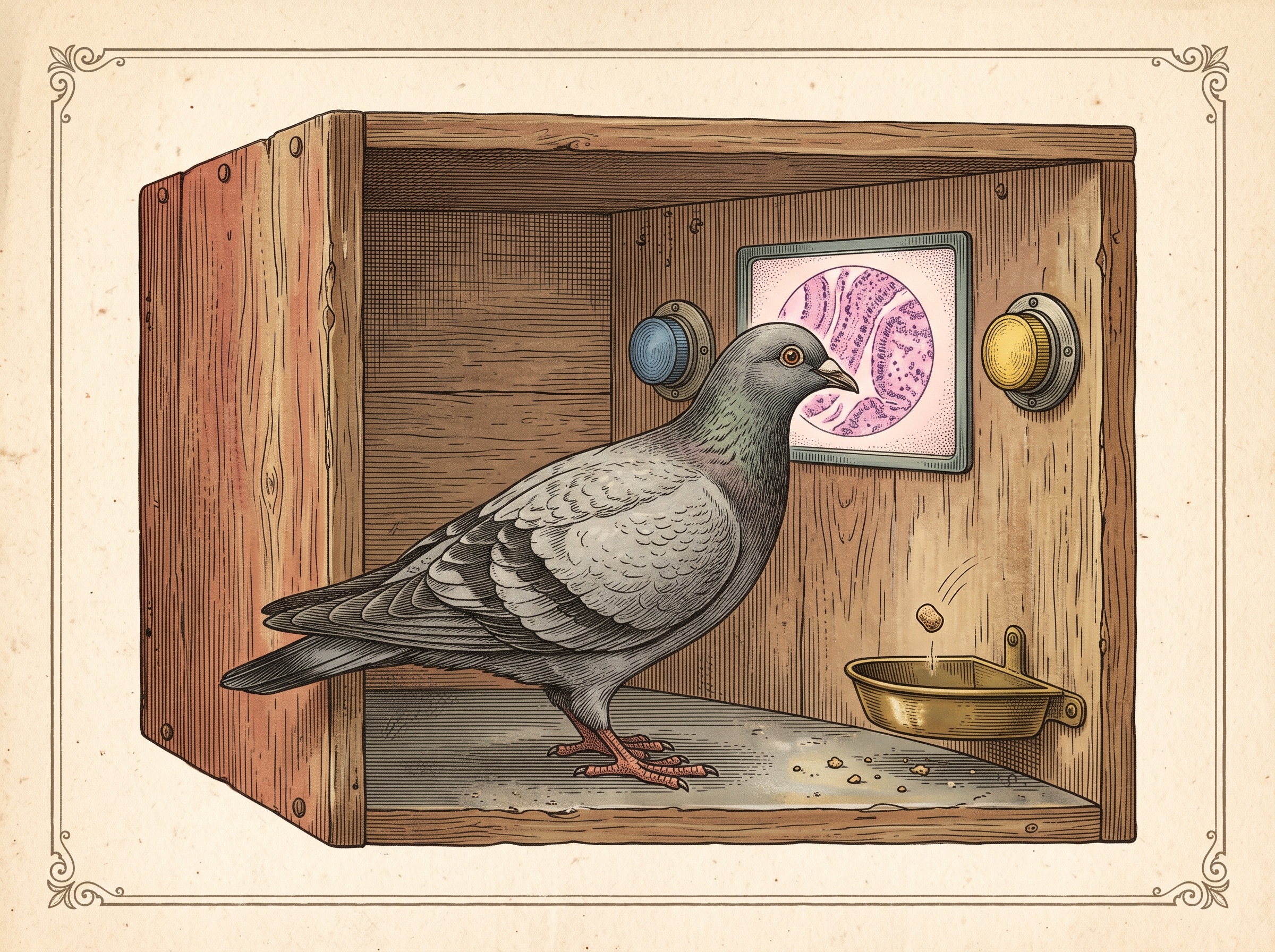
In a lab at the University of Iowa, a pigeon stands in front of a small touchscreen. On the screen is a magnified slice of human breast tissue, stained pink and purple. The bird pecks the picture a few times, then pecks one of two colored buttons beside it, the one it has learned means "cancer." A food pellet drops. The pigeon is right. None of the four birds in this group went to medical school, but together they would match the right answer 99% of the time.
By the Curiosities Desk · · 5 min read · Filed under Medicine · Today’s round
What happened?
In November 2015, the journal PLOS ONE published a paper with a title that sounds like a joke: “Pigeons (Columba livia) as Trainable Observers of Pathology and Radiology Breast Cancer Images.” The work was led by Richard Levenson, a pathologist at UC Davis Medical Center, with radiology expert Elizabeth Krupinski and two animal-learning researchers at the University of Iowa, Victor Navarro and Edward Wasserman.
Levenson’s question was practical. Doctors who read medical images, pathologists looking at tissue slides and radiologists looking at mammograms, are expensive and busy. Every time someone invents a new scanner, a new way to compress images, or a new screen to view them on, it has to be tested by trained human observers. Could an animal stand in for those humans in the testing stage?
Pigeons were a natural candidate. Wasserman’s lab had spent decades showing that pigeons can learn to sort pictures into categories. Earlier researchers in Japan had even trained pigeons to tell paintings by Monet from paintings by Picasso.
The setup was simple. Each bird worked in a small chamber with a touchscreen. An image appeared in the middle, flanked by a blue button and a yellow button. The pigeon first had to peck the image several times, which made it actually look at the picture, before the buttons became available. If it pecked the correct button for “benign” (not cancerous) or “malignant” (cancerous), it got a food pellet. If it was wrong, it got no reward and saw the image again. No one explained anything to the birds. They learned purely from which pecks paid off.
In the first experiment, eight pigeons studied 144 slides of breast tissue at three different magnifications. At the lowest magnification, the birds started at 50%, which is pure guessing, and climbed to about 85% correct within 15 days. Then came the real test: slides the birds had never seen before. They got those right about 85% of the time too, almost exactly as well as the familiar ones. They weren’t memorizing pictures. They had learned something about what cancer looks like.
Then the researchers tried “flock-sourcing,” pooling the votes of four birds on each image. Individually, the birds were good. Together, by a standard measure of diagnostic accuracy, they scored 0.99 out of a possible 1.0, which the authors described as 99% accuracy.
The team then moved on to mammograms. A second group of four pigeons learned to spot microcalcifications, tiny clusters of calcium that can be an early warning sign of cancer. Within about two weeks they passed 85% on the training images and did better than chance, around 70%, on new ones.
The third task stumped them. Asked to judge whether a lump on a mammogram was benign or malignant, the birds trained for about 80 days. Some eventually got good at the training images, but on new images they did no better than a coin flip. They had memorized the pictures instead of learning the warning signs.
Why was it strange?
We tend to think of medical diagnosis as one of the most human skills there is. It takes years of school, residency, and practice. Pigeons have a brain about the size of a fingertip, and their usual job description is “statue decorator.”
Yet with nothing but food rewards and a touchscreen, the birds picked up a visual skill that takes people a long time to learn. Even their failure was telling. The mass-classification task that defeated the pigeons is also one that radiologists find hard. As Levenson told the BBC, that pattern suggested the birds “may be faithful mimics” of human observers, struggling where people struggle.
Another animal the lab could not ignore: The Battlefield Maggots That Became a Prescription Medical Device.
What did scientists learn?
The study showed that pigeons can learn to judge medical images based on visual features, not just memorized examples, for at least some kinds of tasks. The researchers think the birds rely heavily on texture and fine local detail, a strategy that resembles how many computer image-analysis programs work.
The birds were also sensitive to image quality. When slides were shown in black and white with the colors evened out, the pigeons’ accuracy on new images fell from about 85% to about 70%. Heavily compressed images also hurt their scores at first, though further training brought them back up. That sensitivity is the point: if a new display or compression method makes the pigeons worse, it might make doctors worse too.
The authors were careful not to oversell. They wrote plainly that they were “not (yet) proposing such a role for pigeons” in diagnosing actual patients. The study was also small, with four to eight birds per experiment and a few dozen to 144 images per task.
Another creature that ended up in the notes: The 180,000 Mummified Cats That Were Sold by the Ton as Fertilizer.
How does it affect us today?
No hospital has a pigeon on staff. The idea the study raised is about testing, not treatment: trained birds could act as cheap, tireless observers for checking whether new imaging tools preserve the details doctors need, before expensive human reader studies.
The work also lands in the middle of a bigger shift. Hospitals increasingly use computer programs to help read scans and slides. Studies like this one are a reminder that “learning to see” disease from examples is something a brain can do without understanding biology at all, which is both encouraging and a good reason to test such systems carefully.
A close cousin: The 2,478 Baby Jellyfish NASA Sent to Space — and the Ones That Came Home Dizzy.
Fun fact
This wasn’t the first time pigeons were hired for their eyesight. In the late 1970s and early 1980s, the U.S. Coast Guard and the Navy ran “Project Sea Hunt,” strapping a clear pod with three pigeons under a rescue helicopter. Trained to peck a key when they saw something orange, like a life jacket, the birds spotted targets on the first pass far more often than the human crew in early tests.
Breast cancer is common, and screening saves lives. If you have questions about your own risk or when to start mammograms, a doctor or local health service is a good place to start.
Sources
- Levenson RM, Krupinski EA, Navarro VM, Wasserman EA. “Pigeons (Columba livia) as Trainable Observers of Pathology and Radiology Breast Cancer Images.” PLOS ONE 10(11): e0141357 (2015). https://journals.plos.org/plosone/article?id=10.1371/journal.pone.0141357
- NOVA Next (PBS). “Pigeons Can Identify Breast Cancer in Tissue Samples as Well as Humans” (November 23, 2015). https://www.pbs.org/wgbh/nova/article/pigeons-can-identify-breast-cancer-in-tissue-samples-as-well-as-humans/
- NPR, Morning Edition. “Pigeons Identify Cancerous Tissues On Medical Images, Study Says” (November 20, 2015). https://www.hppr.org/2015-11-20/pigeons-identify-cancerous-tissues-on-medical-images-study-says
- Watanabe S, Sakamoto J, Wakita M. “Pigeons’ Discrimination of Paintings by Monet and Picasso.” Journal of the Experimental Analysis of Behavior 63(2): 165–174 (1995). https://pmc.ncbi.nlm.nih.gov/articles/PMC1334394/
- U.S. Coast Guard Historian’s Office. “1978–83 Project Sea Hunt Study.” https://media.defense.gov/2023/Jun/23/2003246763/-1/-1/0/1978-83_PROJECT_SEA_HUNT_STUDY.PDF