Strange Animals Scientists Studied · Medicine
The Dog That Kept Trying to Bite Off Its Owner's Mole — and Turned Out to Be Right
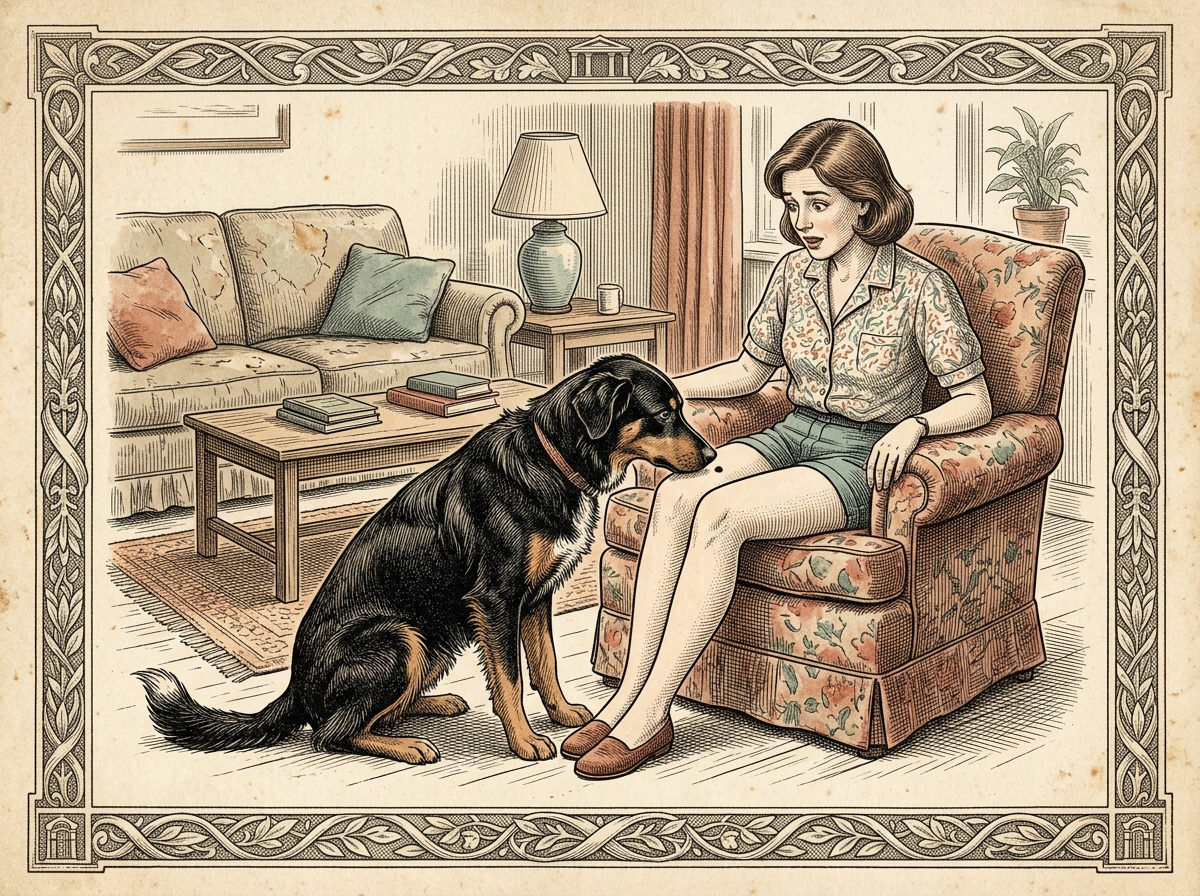
In 1989, two London dermatologists published a letter in *The Lancet* about a patient with an unusual complaint: her dog would not leave one of her moles alone. It sniffed that single spot on her leg again and again, ignoring every other mark on her skin. When she wore shorts, the dog tried to bite it off. She finally had the mole checked. It was a malignant melanoma, the most dangerous common form of skin cancer.
By the Curiosities Desk · · 5 min read · Filed under Medicine · Today’s round
What happened?
The letter appeared in The Lancet on April 1, 1989, under the cautious title “Sniffer dogs in the melanoma clinic?” Its authors were Hywel Williams, then a trainee dermatologist at King’s College Hospital in London, and his colleague Andres Pembroke. Despite the date, it was not a joke.
According to the letter, the patient was a 44-year-old woman. Her dog, a female border collie and Doberman cross, kept returning to one pigmented spot on her thigh. It wasn’t a passing sniff. The dog seemed fixated on that one mole while showing no interest in the others, and the attention escalated to the attempted bite. The behavior worried the owner enough that she went to see a doctor, and the mole was cut out and examined under a microscope. The diagnosis was malignant melanoma. Because it was removed, the dog’s odd habit may well have helped her.
Williams and Pembroke did not claim to have discovered anything. They offered a question. Might melanomas give off a distinctive smell that people can’t detect but a dog can? If so, they suggested, it could be worth investigating.
For more than a decade, almost nobody did. The letter was a single anecdote, and medicine runs on studies, not stories. But the idea kept resurfacing. In 2001, Williams co-wrote a second Lancet letter with an even more hopeful title: “Another sniffer dog for the clinic?”
Around the same time, a dermatologist in Tallahassee, Florida, named Armand Cognetta teamed up with Duane Pickel, a professional trainer who had spent years teaching dogs to find drugs and explosives. Their idea was simple: if a dog can learn the smell of contraband, maybe it can learn the smell of a tumor. Newspaper coverage in the mid-1990s showed off a schnauzer named George, who would circle a person, sniff hard, and sit down beside a cancerous spot.
The team’s results appeared in 2004 in Applied Animal Behaviour Science. Two dogs, a four-year-old standard schnauzer and a six-year-old golden retriever, were first trained to find melanoma tissue hidden in one of ten holes in a box, with harmless decoys in the others. Next, small samples were taped to volunteers’ skin under bandages, and the dogs had to find them. Finally, the dogs sniffed real patients. The schnauzer pointed to the melanoma on six of seven people; the retriever, on three of four.
Why was it strange?
Diagnosing skin cancer is a visual job. Dermatologists look for moles that are uneven, oddly colored, or changing, and they confirm with a microscope. The 1989 case flipped that around. The first “doctor” to flag the problem didn’t look at the mole at all. It smelled it.
It also came from the least scientific source imaginable: a pet being a nuisance. Plenty of owners would have pushed the dog away and thought nothing of it. Instead, the patient took the hint, and her dermatologists took her seriously enough to write it up.
For another animal that turned out to have a diagnostic eye, see The Pigeons Trained to Spot Breast Cancer — and the Flock That Got It Right 99% of the Time.
What did scientists learn?
The leading explanation is chemistry. Living tissue constantly releases volatile organic compounds, small molecules that evaporate into the air. Tumors have an altered metabolism, so the mix of compounds they give off can differ from healthy skin. A dog’s nose, with its enormous number of scent receptors, may be able to pick up those differences at concentrations far below what people can notice.
Later work tested the idea more carefully. In 2016, a small proof-of-principle study in the British Journal of Dermatology reported that trained dogs could tell melanoma apart from benign moles, another skin cancer called basal cell carcinoma, and healthy skin. More untrained-dog stories also turned up in medical journals, including a 2013 BMJ Case Reports account of a dog that kept licking a spot behind its owner’s ear that turned out to be melanoma.
The caveats matter. Most canine studies have been small, and reviews of the field note that the most rigorous trials tend to produce less impressive results than the early ones. Dogs get tired, get distracted, and can pick up on unintended cues. Researchers still haven’t pinned down exactly which molecules the dogs are responding to.
A related story about learning to listen to the body in a new way: The Rolled-Up Paper That Became the Stethoscope.
How does it affect us today?
No clinic is replacing its dermatologists with dogs. The bigger legacy is the question the 1989 letter asked: does cancer have a smell? That question helped launch a whole research area. Scientists are now working on “electronic noses,” chemical sensors designed to detect the same kinds of compounds a dog might, with the goal of building cheap, consistent tests that don’t need a nap or a treat.
Meanwhile, the anecdotes keep coming. A 2019 case report in the dermatology journal Cutis described a dog that sniffed, scratched, and tried to bite its owner’s changing mole, which turned out to be melanoma. The authors cited the 1989 letter as the first of its kind.
Fun fact
Hywel Williams, the trainee who co-wrote the 1989 letter, went on to become a professor of dermato-epidemiology at the University of Nottingham. Guinness World Records lists his letter as the first reported case of canine cancer detection.
If a mole on your skin is new, changing, bleeding, or just keeps catching your attention (or your dog’s), it’s worth showing to a doctor. Most turn out to be harmless, and the ones that aren’t are far easier to treat when they’re caught early.
Sources
- Williams H, Pembroke A. “Sniffer dogs in the melanoma clinic?” The Lancet 1(8640): 734 (1989). https://doi.org/10.1016/S0140-6736(89)92257-5
- Gould O, Smart A, Ratcliffe N, de Lacy Costello B. “Canine Olfactory Differentiation of Cancer: A Review of the Literature” (University of the West of England, 2015), summarizing Pickel D, et al., Applied Animal Behaviour Science 89: 107–116 (2004). https://arxiv.org/pdf/1510.05495
- Campbell LF, Farmery L, George SM, et al. “Canine olfactory detection of malignant melanoma.” BMJ Case Reports (2013). https://doi.org/10.1136/bcr-2013-008566
- Srivastava R, John JJ, Reilly C, John AM, Rao BK. “Sniffing Out Malignant Melanoma: A Case of Canine Olfactory Detection.” Cutis 104(3): E4–E6 (2019). https://cdn.mdedge.com/files/s3fs-public/CT104003004_e.PDF
- Guinness World Records. “First reported case of canine cancer detection.” https://www.guinnessworldrecords.com/world-records/685564-first-reported-case-of-canine-cancer-detection