Strange Animals Scientists Studied · Archaeology
The 180,000 Mummified Cats That Were Sold by the Ton as Fertilizer
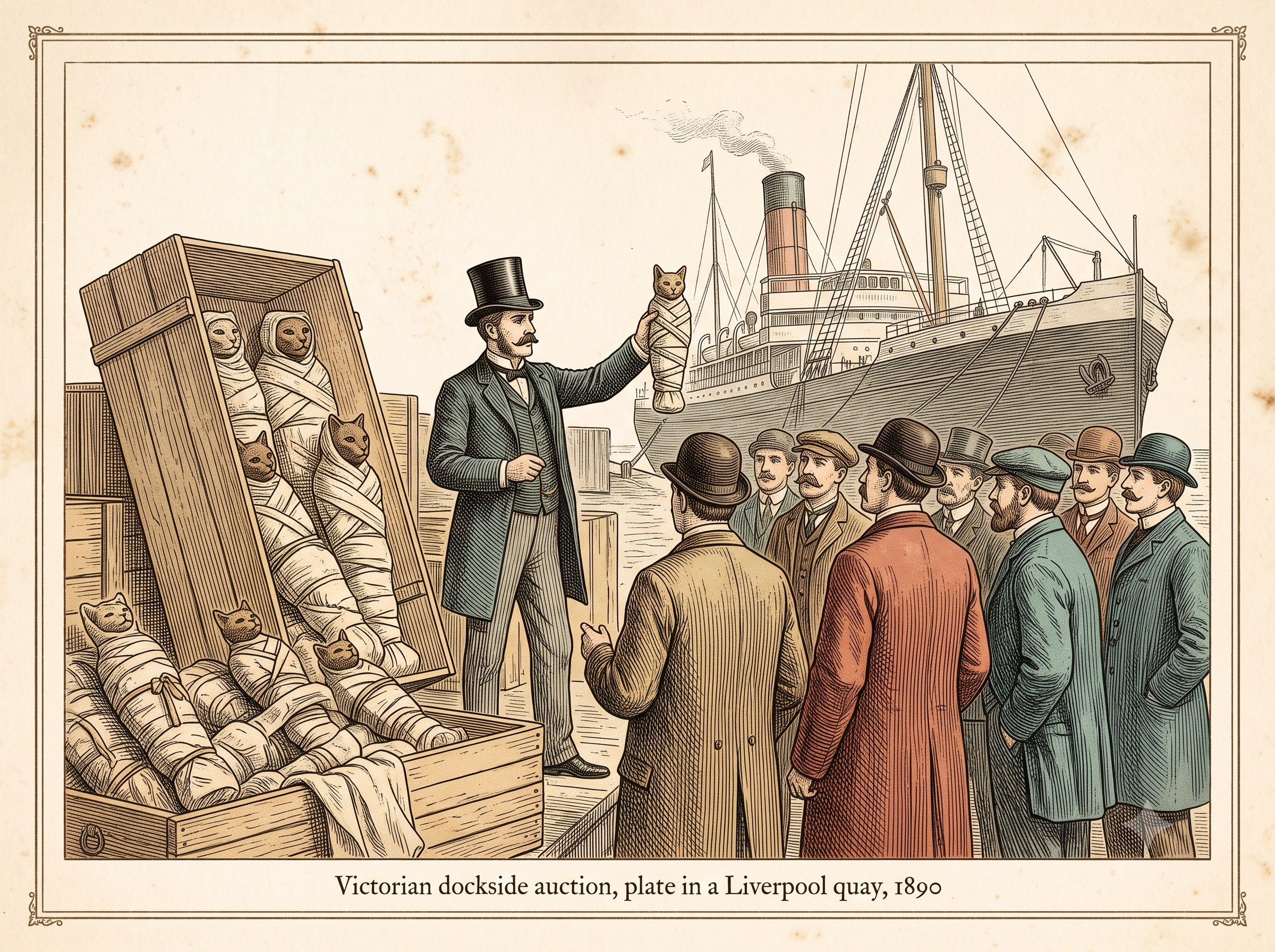
In February 1890, a ship called the *Pharos* docked at Liverpool carrying nineteen and a half tons of cargo from Alexandria. The cargo was cats — roughly 180,000 of them, each one individually embalmed, wrapped in linen, and dead for about two thousand years. They were unloaded onto the quayside and auctioned off by the ton, to be ground up and spread on English farm fields. Contemporary newspaper reports say the auctioneer knocked down the lots using one of the cats' heads as a hammer.
By the Curiosities Desk · · 5 min read · Filed under Archaeology · Today’s round
What happened?
The story starts, as so many Egyptian discoveries do, with someone falling into a hole.
In the late 1880s, near the village of Beni Hasan on the east bank of the Nile — about a hundred miles south of Cairo — a local farmer stumbled into an underground chamber. It was not a tomb in the usual sense. It was a catacomb, packed floor to ceiling with mummified cats, laid out in rows. The site sat beside Speos Artemidos, a rock-cut temple to the lion-headed goddess Pakhet, and it held cats in numbers nobody was prepared for. Estimates ran into the hundreds of thousands.
Egypt already had a mummy economy — human mummies had been sold to European tourists for centuries, unwrapped at parlor parties, ground into medicinal powder. But no museum wanted several hundred thousand cats, and no curiosity market existed at that volume.
There was, however, a market for bone meal. Nineteenth-century agriculture ran on imported fertilizer — guano from Peru, bones from European battlefields, phosphates from anywhere they could be dug. Mummified cats are essentially dry bone and desiccated tissue, exactly what the fertilizer trade wanted. So a merchant bought the lot and shipped it to England.
The first auction was held in Liverpool in February 1890. According to National Museums Liverpool, bidding opened at £3 per ton and climbed to £5 17s 6d. Individual specimens in good condition sold separately for what one paper called “fancy prices” — 40 shillings and sixpence for a single well-preserved head. The bulk lots went to fertilizer dealers. A second consignment of nine tons followed.
The British press treated the whole affair as a comedy. The Manchester Times ran a paragraph headlined “A Fortunate Cat-astrophe,” marveling that after “being buried decently for four thousand years, they have been exhumed to furnish manure for a distant land.” Almost nobody at the time framed it as a loss to science.
A handful of cats escaped the grinder. Museum staff and private buyers picked out specimens at the auctions, which is why a small number of Beni Hasan cats survive today in British collections — including one unwrapped head sealed in a Victorian glass jar with a party invitation used as a makeshift label, now one of the best-known objects at the Ure Museum in Reading.
Why was it strange?
Two things break your expectations here, and they pull in opposite directions.
The first is the Victorian side: a civilization’s sacred animals arriving in a modern port and being priced by weight. Do the arithmetic on the auction figures and each cat worked out to a fraction of a penny. A single head, sold as a curiosity, fetched close to a thousand times the bulk rate for the same animal — the only difference being that one of them was interesting to look at.
The second is the ancient side, and it is the stranger of the two. A cemetery holding hundreds of thousands of cats is not a cemetery of beloved pets. It is the output of an industry.
The same thread — ancient Egypt — continues in The Crocodile Mummy a Fed-Up Workman Smashed — and Found Stuffed With Ancient Paperwork.
What did scientists learn?
Cats in Egypt were associated with the goddess Bastet, and by the Late and Ptolemaic periods (roughly 664–30 BC) pilgrims could buy a mummified cat at a temple, choose the wrapping style, and leave it as a votive offering — a physical prayer, deposited by the thousand. Demand on that scale required supply. Temples appear to have kept catteries.
Modern imaging has filled in what that meant, without unwrapping anything. In 2020, a team led by Richard Johnston at Swansea University put a mummified cat from the Egypt Centre collection through X-ray microCT — a scanner that builds a three-dimensional model from thousands of X-ray slices, at a resolution fine enough to see individual tooth roots. The skull inside was 68.9 millimeters long, about half the size of its wrappings. Its first molars had not yet erupted, which put the animal at under five months old. And the first two neck vertebrae were separated by nearly six millimeters, a gap the team flagged as a possible cause of death. These were kittens — young animals were easier to mummify.
Scale matters to the science too. The Ancient Egyptian Animal Bio Bank at the University of Manchester has now scanned roughly 800 animal mummies from dozens of museums. Only about a third contained a complete animal. Another third held partial remains. The final third contained no animal material at all — just mud, sticks, reeds, eggshell, feathers. The researchers have been careful not to call this fraud. It looks more like a supply chain straining to meet demand, with every scrap of sacred material stretched as far as it would go.
And the cats themselves carry data. In 2017, a team led by Claudio Ottoni sequenced DNA from 352 ancient cats, including skin and hair taken from Egyptian mummies, and traced how the Egyptian lineage of Felis silvestris lybica spread along trade routes across the Old World — a major contribution to the ancestry of modern domestic cats, alongside an earlier Near Eastern population. The mummies are, among other things, a genetic archive.
Another animal the lab could not ignore: The Roman Pet Monkey Buried With Three Kittens and a Piglet of Her Own.
How does it affect us today?
The 1890 auction is now a standard cautionary tale about destroying material before anyone knows what questions it might answer. In 1890, a cat mummy could tell you almost nothing. Today the same object yields age at death, wrapping technique, likely cause of death, and DNA — none of which requires cutting it open.
That shift is the practical legacy. Non-destructive imaging is now normal practice in museum Egyptology: CT, microCT, and X-ray instead of scalpels and unwrapping parties. It’s also why institutions are cautious about collections whose provenance is murky — an object with no record of where it came from has lost most of its scientific value, whatever it looks like in a case.
Elsewhere in archaeology: The 3,300-Year-Old Golden Beard That Got Glued Back On With Epoxy.
Fun fact
The cats were sold at roughly £4 per ton. At about 9,000 cats to the ton, that priced each two-thousand-year-old mummified cat at around a tenth of a penny — while one exceptionally well-preserved head, sold on its own at the same auction, went for 40 shillings and sixpence. Same species, same catacomb, nearly a thousandfold difference in price.
Sources
- Johnston, R. et al., “Evidence of diet, deification, and death within ancient Egyptian mummified animals,” Scientific Reports 10, 14113 (2020) — the microCT study of the Swansea cat mummy.
- Ottoni, C. et al., “The palaeogenetics of cat dispersal in the ancient world,” Nature Ecology & Evolution 1, 0139 (2017).
- Elliott, C., “Cats, Commerce, and Cemeteries: The Mummified Felines of Beni Hasan,” Journal of Egyptian Archaeology (2023) — the scholarly reconstruction of the discovery and the Liverpool sales from contemporary press.
- National Museums Liverpool, “Animal mummies” — auction prices and the Bastet votive trade.
- Manchester Museum, “Gifts for the Gods: Animal Mummies Revealed” — the Ancient Egyptian Animal Bio Bank scanning project.