Strange Animals Scientists Studied · Archaeology
The Crocodile Mummy a Fed-Up Workman Smashed — and Found Stuffed With Ancient Paperwork
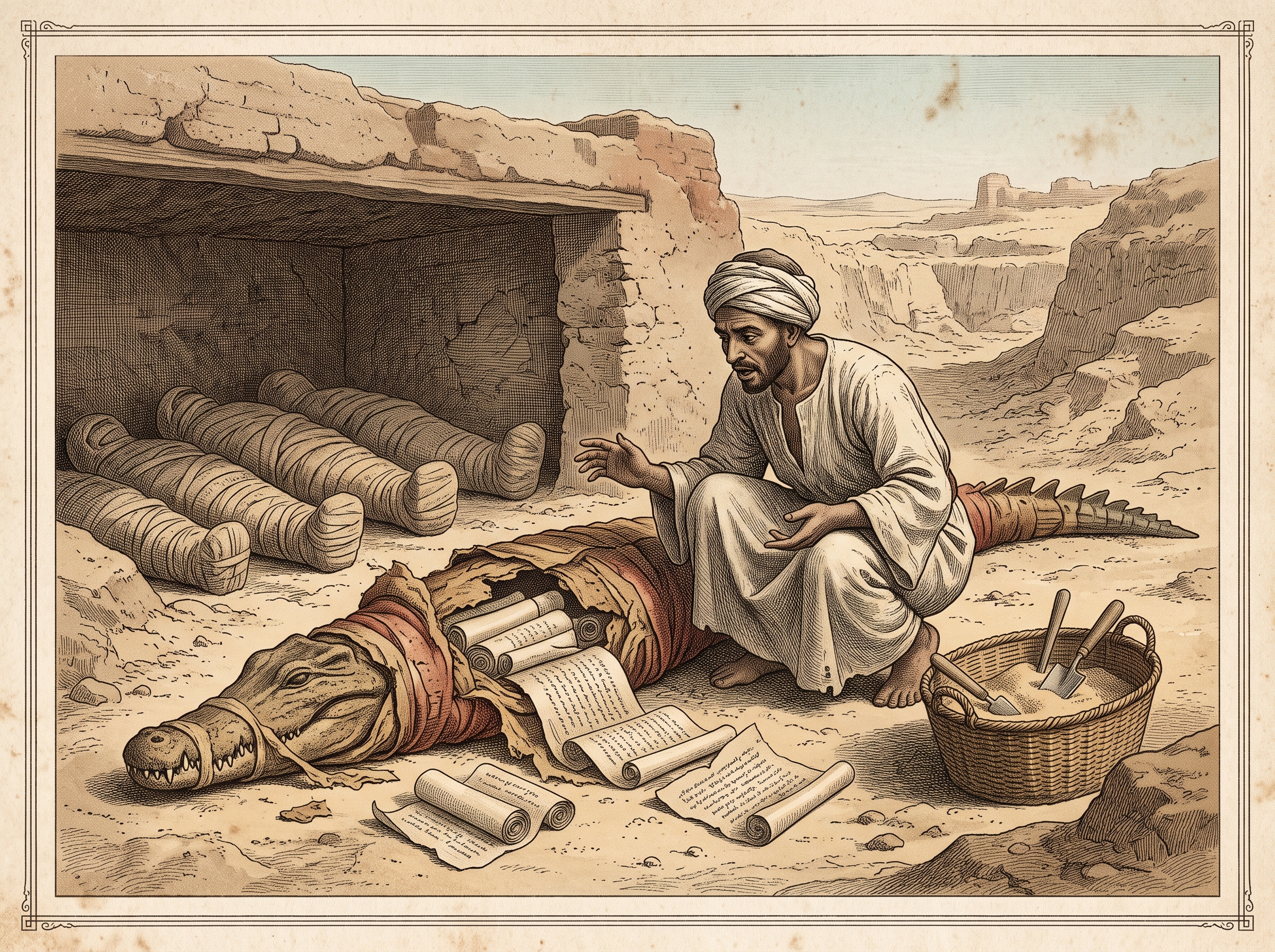
On January 16, 1900, in the Egyptian desert, a digger opened yet another tomb hoping for a human coffin and found, once again, a row of mummified crocodiles. In a burst of frustration he broke one to pieces. Out of the shattered reptile spilled sheets of papyrus: tax records, contracts, and letters written more than 2,000 years earlier. The crocodile had been stuffed with paperwork.
By the Curiosities Desk · · 5 read · Filed under Archaeology · Today’s round
What happened?
In December 1899, two Oxford papyrologists, Bernard Grenfell and Arthur Hunt, arrived at Tebtunis, a ruined town on the southern edge of Egypt’s Fayum region (today called Umm el-Baragat). They were digging on behalf of the University of California, with the money coming from the philanthropist Phoebe Apperson Hearst. Their real quarry was papyrus, the paper-like writing material ancient Egyptians made from reeds. Egypt’s dry sand preserves it unusually well, and Grenfell and Hunt had already become famous for pulling lost texts out of ancient rubbish heaps.
Tebtunis had been a busy town in the Ptolemaic and Roman periods, and its patron god was a crocodile. The local temple honored Soknebtunis, a form of the crocodile god Sobek. The team found plenty of papyri in the town and temple. In early January 1900 they moved to the town’s cemetery, where they uncovered more than 50 human mummies wrapped in cartonnage, a kind of ancient papier-mâché made from layers of linen or recycled papyrus, glued and plastered into masks and body cases. Peeling that cartonnage apart is a classic way to recover old documents.
But many of the tombs held something else. In Grenfell and Hunt’s own words, the tombs of the Ptolemaic cemetery “proved in many instances to contain only crocodiles.” To a crew looking for human burials, the reptiles were simply in the way.
Then came January 16. According to Grenfell and Hunt’s published account, a workman “disgusted at finding a row of crocodiles where he expected sarcophagi, broke one of them in pieces and disclosed the surprising fact that the creature was wrapped in sheets of papyrus.” It is a story the excavators told themselves, and scholars today treat its dramatic details with some care. Berkeley Egyptologist Rita Lucarelli has called it “a story.” But the result is not in doubt: the crocodiles were full of documents.
The dig changed course on the spot. The team went on to unearth more than 1,000 mummified crocodiles. Most were plain, but 31 had been wrapped or padded with discarded papyri. In the habits of the time, the excavators removed the papyri and set most of the crocodiles aside. Grenfell and Hunt began publishing the crocodile papyri in 1902, and in 1938 most of the papyri arrived at Berkeley, where the Center for the Tebtunis Papyri now holds more than 26,000 fragments.
Why was it strange?
Animal mummies were not unusual in Egypt. Millions of cats, ibises, and dogs were mummified as offerings to the gods. What made Tebtunis odd was what was inside.
The priests who prepared these crocodiles needed material to bulk out the bodies and hold their shape. So they grabbed what any office has too much of: old paper. Much of it turned out to be the files of Menches, the village scribe of nearby Kerkeosiris in the late second century BC. A village scribe was a local government clerk, and his files were exactly what you would expect: land surveys, tax lists, petitions, contracts, and official letters from his bosses.
So a sacred animal, prepared as a gift to a god, was packed with a bureaucrat’s recycling. One of the holiest objects in town was also, in effect, a filing cabinet with teeth.
The same thread — ancient Egypt — continues in The 180,000 Mummified Cats That Were Sold by the Ton as Fertilizer.
What did scientists learn?
The documents gave historians a rare, street-level view of how Egypt was run under the Ptolemies, the Greek-speaking dynasty that ruled after Alexander the Great. Menches’s reports describe the farmland around one village in fine detail: who held which plot, what crops were planted, which fields had flooded or dried out, and what was owed in taxes. Letters among the files show ordinary worries about money, work, and family that feel familiar today.
The crocodiles themselves have also become a subject of study. Crocodile mummies were most likely votive offerings, gifts meant to win a god’s favor. Egyptians relied on the Nile’s yearly flood, and feared that without offerings to Sobek the flood might fall short.
Modern scanning has opened them without breaking anything. In 2024, researchers at the University of Manchester used CT scans (cross-sectional X-ray imaging) on a 2.2-meter crocodile mummy at Birmingham Museum and Art Gallery. They found an undigested fish still attached to a bronze fishhook in its stomach, along with gastroliths, stones crocodiles swallow to help grind food. Because the fish had barely begun to digest, the team suggests the crocodile was caught deliberately, possibly as an offering to Sobek, and died soon after its last meal. And at Qubbat al-Hawā near Aswan, a 2023 study of ten crocodile mummies found two species, the Nile crocodile and the West African crocodile, preserved simply by drying rather than with resin or removal of organs.
Another creature that ended up in the notes: The Roman Pet Monkey Buried With Three Kittens and a Piglet of Her Own.
How does it affect us today?
The Tebtunis papyri remain one of the largest papyrus collections in North America and are still being conserved, catalogued, and digitized. Many fragments have never been fully published, so new readings keep appearing.
The story also changed how archaeologists think about animal mummies. A century ago, the crocodiles were obstacles between excavators and the “real” finds. Today the animals are treated as evidence in their own right, telling us about ancient religion, hunting, and the crocodile populations that once filled the Nile. Researchers now use scans first, so the reptile and the paperwork can both survive.
Another animal the lab could not ignore: The Battlefield Maggots That Became a Prescription Medical Device.
Fun fact
The first volume of The Tebtunis Papyri, published in 1902, opened with the documents pulled out of crocodiles. Some of the first texts released from one of the world’s great papyrus collections came out of reptiles.
Sources
- The Bancroft Library — Center for the Tebtunis Papyri: About Us (excavation history, 1899–1900)
- UC Berkeley Library Update — Grenfell and Hunt’s account of the crocodile tombs, quoting The Tebtunis Papyri
- Berkeley News — “Crocodile mummies” (2021), with Rita Lucarelli
- University of Manchester — “Croc’s deadly last meal in ancient Egypt unearthed” (2024)
- De Cupere et al., “Newly discovered crocodile mummies of variable quality from an undisturbed tomb at Qubbat al-Hawā (Aswan, Egypt),” PLOS ONE (2023)