Strange Animals Scientists Studied · Archaeology
The Roman Pet Monkey Buried With Three Kittens and a Piglet of Her Own
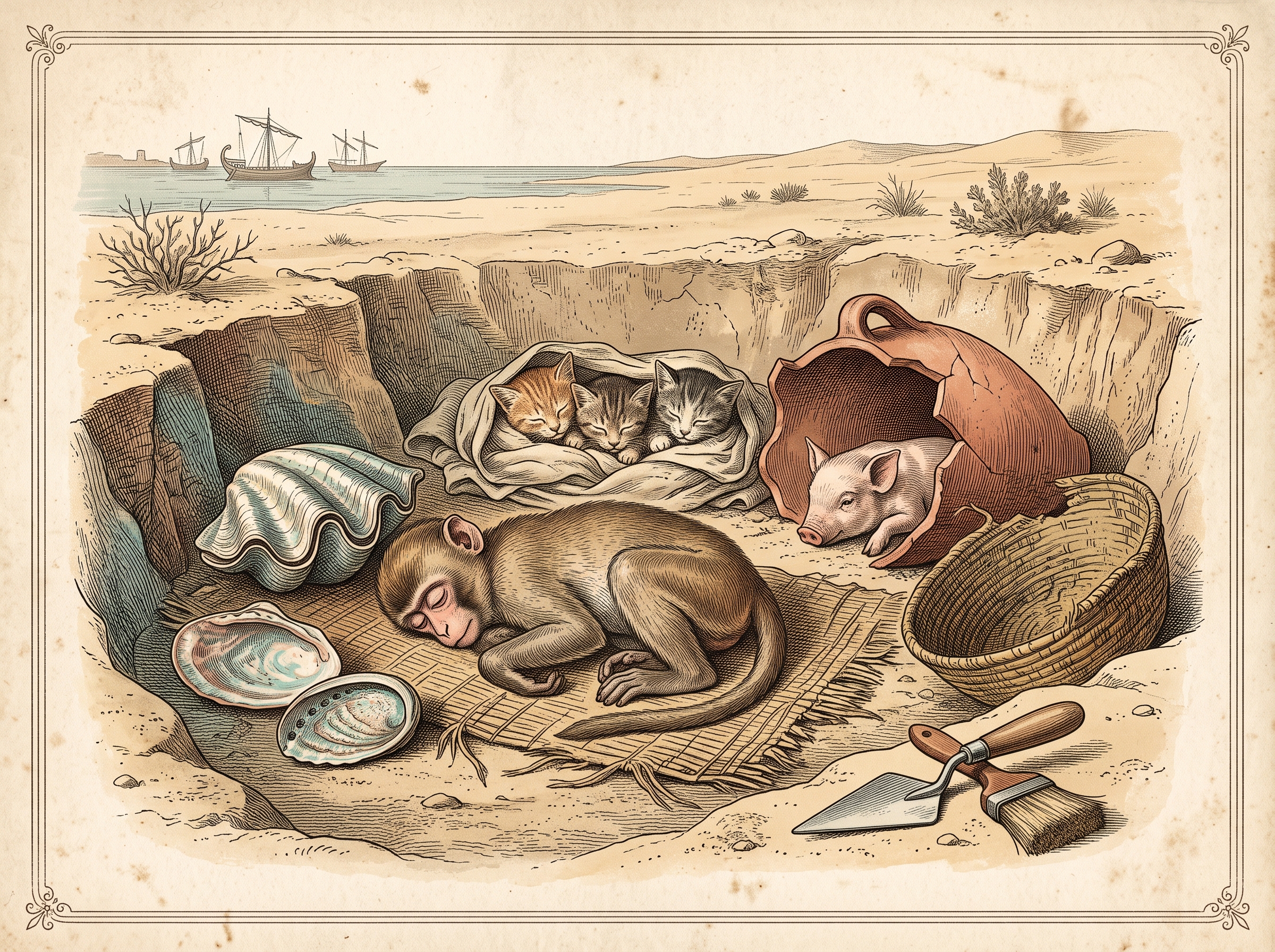
Nearly 2,000 years ago, in a dusty port on Egypt's Red Sea coast, someone dug a grave for a young monkey. They laid her on her left side and set two big seashells beside her head. Then they added a basket, a folded rag that looks a lot like a doll, a baby pig tucked inside a broken wine jar — and, on top of it all, three small cats wrapped in textiles. The researchers who excavated the grave think the kittens and the piglet may have been her pets.
By the Curiosities Desk · · 5 read · Filed under Archaeology · Today’s round
What happened?
In 2011, Marta Osypińska — an archaeozoologist, meaning she studies animal remains from archaeological sites — was digging through an ancient rubbish dump on the edge of Berenike, a harbor town about 480 miles southeast of Cairo. Beneath the trash she found something nobody expected: animal skeletons, carefully laid out in individual graves.
Berenike had a long résumé by then. Egypt’s Greek-speaking king Ptolemy II set up a post there in the 3rd century BCE to ship in African elephants for his army. By the early Roman period, it was a busy gateway for ships trading with southern Arabia and India.
The graves kept coming. By 2020, Osypińska and her colleagues had counted 585 animals: 536 cats, 32 dogs, 15 monkeys, one fox, and one falcon. None were mummified, and the team found no sign they were offerings to the gods. Many cats wore iron collars or bead necklaces. Some animals were old, lame, or deformed, which meant someone had fed and cared for them long after they stopped being useful. As Osypińska told Live Science, “Someone fed and kept such a ‘useless’ cat.” The team concluded these were simply pets.
The monkeys were the puzzle. At first, the researchers assumed they were grivets, an African monkey that would have been a fairly short trip from Berenike. But closer study, including 3D imaging of the skulls, told a different story. In a paper published in the Journal of Roman Archaeology in late 2025, Osypińska, Piotr Osypiński, and Iwona Zych reported that the cemetery — now nearly 800 burials strong — held about three dozen monkeys. Most were rhesus macaques and bonnet macaques: species native to India, thousands of miles across the Indian Ocean.
And the monkeys got special treatment. About 40% of their graves held grave goods, compared with roughly 3% of cat burials. One grivet appears to have been buried embracing a kitten of three to six months, which faced the monkey and clutched its body. A young rhesus was buried with a year-old cat wrapped in cloth and a five-month-old puppy laid over her. Another young female rhesus wore an iron collar with a chain still attached, had a pearl oyster shell placed near her head, and lay on a reed mat over a layer of plant oil, with a stone-and-ceramic marker on the surface.
The richest grave of all belonged to the young bonnet macaque from the Hook: three kittens, a piglet in a fragment of an amphora (a large clay storage jar), a folded cloth “reminiscent of a rag doll,” a woven-grass basket, and two big shells — a giant clam and an abalone — beside her head.
Why was it strange?
Romans were known to keep pet monkeys, but the few skeletons found before Berenike were Barbary macaques from North Africa. Nobody had physical proof that Romans were shipping live monkeys all the way from India.
Then there’s the age and sex of the animals. Every monkey identified at Berenike was female, and all were young — infants and juveniles, a few around three or four, never an adult. Two young rhesus showed bone damage in the eye sockets typical of poor nutrition, probably from a diet short on fresh fruit in a desert port where dried dates and figs were about the best on offer.
That pattern led the authors to a bittersweet idea: Berenike may never have been meant as the monkeys’ final stop. They may have been waiting, for weeks or months, to be sent inland to markets in the Nile Valley or beyond. The ones in the cemetery are the ones who didn’t make it — and who were mourned anyway.
The paper’s title asks whether this was “a centurion’s monkey?” — and the question mark matters. The authors suggest the owners were part of a wealthy Roman community at the harbor, possibly linked to army officers, but they present that as a reasonable guess rather than a proven fact. Whether the kittens and piglet were truly the monkeys’ companions is also an interpretation, though a hard one to explain any other way.
Another creature that ended up in the notes: The Crocodile Mummy a Fed-Up Workman Smashed — and Found Stuffed With Ancient Paperwork.
What did scientists learn?
The bones carry a surprising amount of history. Identifying the species pinned down where the monkeys came from: northwestern India, possibly the Indus Valley region, or southern India. That makes the Berenike monkeys, in the authors’ words, the first zooarchaeological evidence — physical animal remains, rather than written accounts — of a live animal trade from India.
The graves also show how people treated their animals. The collars, the shells, the linen and wool wrappings, and the care given to sick and aging cats and dogs suggest a relationship that looks a lot like modern pet-keeping. The monkeys, it seems, were status symbols — a living souvenir that said its owner was connected to the far edges of the known world.
The same thread — Roman Egypt — continues in The Coin-Operated Holy Water Machine That Beat the Vending Machine by 1,800 Years.
How does it affect us today?
Ancient trade is usually reconstructed from pottery, coins, and texts like shipping documents. Berenike shows that animal bones can fill in gaps the paperwork leaves out, revealing not only what was traded but how it was treated along the way.
The cemetery also pushes back the history of something many of us take for granted: the idea of an animal as a companion rather than a tool. Long before pet insurance and dog beds, someone in a remote Roman port tucked a kitten into a monkey’s arms before closing the grave.
Another animal the lab could not ignore: The 180,000 Mummified Cats That Were Sold by the Ton as Fertilizer.
Fun fact
Berenike’s cats turn up in writing, too. A message scratched on a broken piece of pottery (an ostracon) found at the site reads, “Concerning the cats, Ourses is taking care of them” — a nearly 2,000-year-old note about who was minding the cats.
Sources
- Osypińska, M., Osypiński, P., & Zych, I. (2025). “A centurion’s monkey? Companion animals for the social elite in an Egyptian port on the fringes of the Roman Empire in the 1st and 2nd c. CE.” Journal of Roman Archaeology, 38(2), 593–609. Cambridge Core
- Osypińska, M., Skibniewski, M., & Osypiński, P. (2020). “Ancient pets: the health, diet and diversity of cats, dogs and monkeys from the Red Sea port of Berenice (Egypt) in the 1st–2nd centuries AD.” World Archaeology, 52(4). PDF copy
- University of Wrocław, “Berenike – A City of Humans and Animals.” berenike.animals.uwr.edu.pl
- Live Science, “World’s oldest ‘pet cemetery’ discovered in ancient Egypt.” livescience.com
- Popular Science, “Roman generals gifted kittens and piglets to their pet monkeys.” popsci.com