Impossible Inventions · Archaeology
The Coin-Operated Holy Water Machine That Beat the Vending Machine by 1,800 Years
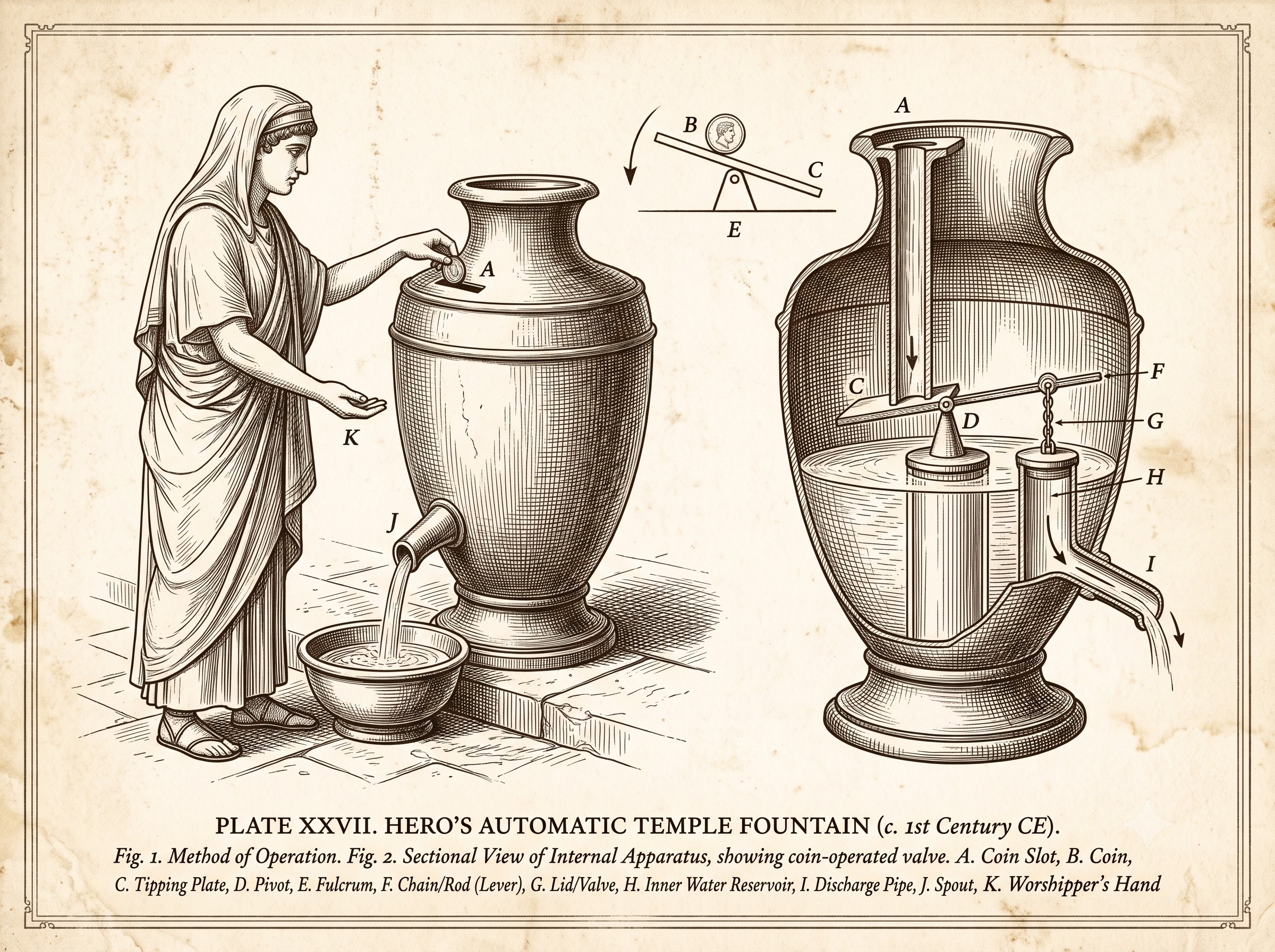
Somewhere in Roman Egypt, roughly nineteen centuries ago, an engineer sat down and wrote out instructions for a bronze box. Drop a five-drachma coin through the slot in the top, he explained, and holy water will pour out on its own. Take your water. Walk away. The box closes itself behind you. It is a vending machine, and it was described before the Colosseum was finished.
By the Curiosities Desk · · 5 read · Filed under Archaeology · Today’s round
What happened?
The engineer was Hero of Alexandria — Heron, in Greek — and he worked in the great Egyptian port city during the Roman era, probably around the first century AD. Almost nothing is known about his life. He may have taught at the Mouseion, the research institution attached to the Library of Alexandria, because several of his surviving books read like lecture notes.
Even his dates are a puzzle. In one of his works, Dioptra, Hero uses a lunar eclipse seen from both Alexandria and Rome as a worked example for measuring the distance between the two cities. In 1938 the historian of astronomy Otto Neugebauer matched that description to a real eclipse in March of AD 62, and for decades that gave scholars a firm-looking peg. More recent work is less sure: Hero never says he watched it himself, and the numbers may simply be a textbook exercise. Published estimates for when he lived still range from 150 BC to AD 250. Somewhere in the first century is the common guess.
What survives more clearly is the work. Hero’s Pneumatica is a catalogue of seventy-eight machines that run on air, steam, and water pressure — the ancient world’s most entertaining engineering manual. Device 21 is the one that matters here. Bennet Woodcroft’s 1851 English translation gives it the deadpan title “Sacrificial Vessel which flows only when Money is introduced,” and the text opens: “If into certain sacrificial vessels a coin of five drachms be thrown, water shall flow out and surround them.”
The mechanism is beautifully simple. Inside a sealed chest sits a reservoir of water and a small box, L, with a pipe running out through the wall. A lever pivots on a vertical rod. One end of the lever widens into a flat plate; the other end holds a lid that plugs the outlet box. Hero is precise about the balance: the lid must be heavier than the plate, but lighter than the plate and coin combined. So the lid sits closed — until a coin drops through the mouth of the chest onto the plate. The extra weight tips the lever, the lid lifts, water runs. The plate keeps tilting until the coin slides off. The lid falls back. The flow stops.
No springs. No clockwork. Just a lever and a coin heavy enough to lose an argument with gravity.
Why was it strange?
The strangeness isn’t that someone in antiquity thought of it. It’s that nobody did anything with it for eighteen centuries.
The coin-operated machine as a commercial idea doesn’t reappear in the record until the 1880s, when Percival Everitt patented a cast-iron machine in London that sold a postcard for a penny — a design that spread quickly through British railway stations and post offices. Between Hero’s page and Everitt’s patent lies a gap of roughly 1,800 years in which the working principle existed, in writing, in a book people could and did read.
It is tempting to say the ancients “invented the vending machine.” That overstates what we know. No physical example of Hero’s machine has ever been excavated. Every one of his devices reaches us as text and diagram, not artifact, and historians can’t confirm that most of them were ever built. Hero also doesn’t say what the machine was for — the popular explanation that temples were losing money to worshippers helping themselves is a modern guess, not something he writes down.
The same thread — Ancient Technology — continues in The 2,000-Year-Old Computer Found in a Shipwreck.
What did scientists learn?
Hero’s real subject wasn’t gadgets. Pneumatica opens with an argument about the nature of air: that air is a body, that it occupies space, that it can be compressed and rarefied, and that matter contains void — small empty gaps between particles. Every machine in the book is a demonstration of those claims made visible. If air were nothing, none of it would work.
The devices themselves fall into a pattern we would now call automation: a physical input produces a controlled output with no human in the loop. The vending machine is triggered by weight. Device 37, “Temple Doors opened by Fire on an Altar,” is triggered by heat — a fire warms air in a sealed chamber, the expanding air pushes water into a hanging bucket, and the bucket’s weight pulls ropes that swing the temple doors open. Let the fire die and the water siphons back, the bucket lightens, the doors close.
That is a feedback system, built out of nothing but fire, air, water, and rope.
Another machine that should not have worked: The Bronze Dragon That Spat Out a Ball Over an Earthquake Nobody Felt.
How does it affect us today?
The direct line runs through a book, not a workshop. Greek manuscripts of Pneumatica survived in the Byzantine world and reached Renaissance Europe; Federico Commandino’s Latin translation, Heronis Alexandrini Spiritalium liber, was printed in 1575 and reprinted repeatedly. It landed among engineers and garden designers building the trick fountains and hydraulic automata of the sixteenth and seventeenth centuries, and it shaped how early modern Europe thought about machines that appeared to act on their own.
One caution worth keeping. Hero also describes the aeolipile, a hollow sphere spun by jets of steam — the first recorded steam engine. Some later writers merged it with the temple-door device and claimed the aeolipile did useful work, opening doors. Hero says no such thing. His sphere spins, and that is all it does.
Elsewhere in archaeology: The Roman Pet Monkey Buried With Three Kittens and a Piglet of Her Own.
Fun fact
Elsewhere in the same book, Hero specifies device 40: “On an Apple being lifted, Hercules shoots a Dragon which then hisses.” Two entries from the end, device 77 is an altar organ played by a windmill — the earliest known description of wind powering a machine.
Sources
- Hero of Alexandria, The Pneumatics of Hero of Alexandria, trans. Bennet Woodcroft (London, 1851) — full text, including device 21 quoted above (primary source in translation)
- Woodcroft’s 1851 edition, Library of Congress Rare Book and Special Collections
- Nathan Sidoli, “Heron of Alexandria’s Date,” Centaurus 53 (2011): 55–61
- AQUA project (CIUHCT), “Pneumatica of Hero of Alexandria” — manuscript transmission and printed editions
- Linda Hall Library, “Hero of Alexandria,” Scientist of the Day