Impossible Inventions · Archaeology
The Bronze Dragon That Spat Out a Ball Over an Earthquake Nobody Felt
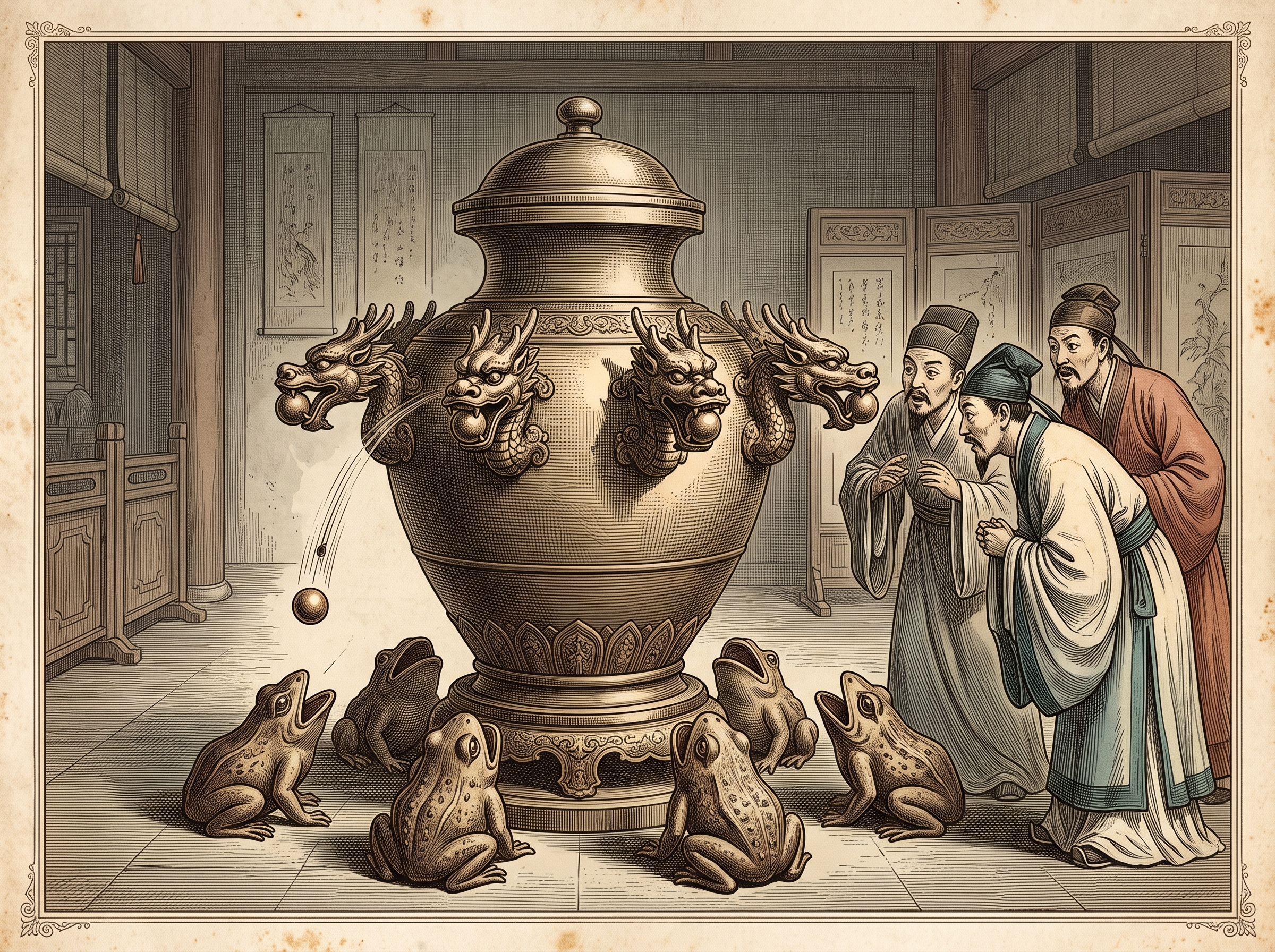
In the Han dynasty capital of Luoyang, sometime in the 130s CE, a bronze ball rolled out of a bronze dragon's mouth and dropped — clang — into the open mouth of a bronze toad below. Nobody in the city had felt a thing. The ground was still. The scholars of the capital found the whole business deeply suspicious. The machine, it seemed, had cried wolf. Then, a few days later, a messenger arrived from the west.
By the Curiosities Desk · · 5 read · Filed under Archaeology · Today’s round
What happened?
The machine belonged to Zhang Heng (78–139 CE), one of the great all-rounders of the ancient world. He was an astronomer, mathematician, mapmaker, and court official, and he was also a respected poet. In 132 CE, according to the Book of Later Han (the official history of the Eastern Han dynasty), he presented the imperial court with an instrument he called the houfeng didong yi — roughly, “instrument for inquiring into the seasonal winds and the movements of the Earth.”
The history describes it in loving detail. It was a vessel of fine cast bronze shaped like a large wine jar, about eight Han feet (roughly two meters) across. It had a domed lid and was decorated with old-style seal script and images of mountains, tortoises, birds, and animals. Around the outside were eight dragon heads, one for each main compass direction, and each held a small bronze ball in its jaws. Underneath each dragon crouched a bronze toad with its mouth open, waiting.
Inside, the text says, was a central column — often translated as a “pillar” — that could shift along eight tracks. When the ground moved, the column would trip a mechanism, a dragon’s mouth would open, and its ball would drop into the toad with a loud ring. Whoever heard it could look at which toad had caught a ball and know the direction of the earthquake.
For a while, the story goes, the dragons did nothing. Then came the moment in the hook: one ball dropped, but no one in Luoyang had felt any shaking. The Book of Later Han records that the scholars in the capital were puzzled that the machine had gone off with no earthquake to explain it. Days later, a messenger arrived with news that an earthquake had struck Longxi, a region in what is now Gansu Province, hundreds of miles to the west — in the direction the dragon had pointed. After that, the history says, everyone admitted the device’s remarkable power, and officials were given the job of recording the direction of earthquakes.
That quake is usually dated to 138 CE. Some modern seismologists, including Feng Rui and Yu Yanxiang of the China Earthquake Administration, have argued for a different quake in 134 CE instead. Either way, it is the only detection the historical record credits to the machine.
Why was it strange?
A nearly 1,900-year-old machine supposedly noticed an earthquake that people standing next to it could not. That is what a modern seismometer does — not what anyone expects from a bronze jar with toads on it.
Then there’s the problem that nobody can check. The original was lost more than a thousand years ago. There are no surviving drawings, and the Book of Later Han was compiled by the historian Fan Ye in the 400s CE — roughly three centuries after Zhang Heng’s death. It describes what the machine looked like very clearly, but says frustratingly little about how its insides worked. The toads are vivid. The engineering is a mystery.
And the story itself has critics. In 2010, the Chinese science writer Fang Zhouzi publicly argued that the detection tale was likely embellished, pointing out that another historical record of the same year says the earthquake was felt in the capital. So the famous “nobody felt it” detail may be more legend than log entry — which is why this counts as an impossible invention: we know it was described, but we can’t be sure it did everything the story claims.
The same thread — Ancient Technology — continues in The 2,000-Year-Old Computer Found in a Shipwreck.
What did scientists learn?
The machine sits on a principle called inertia — the tendency of a heavy object to stay put while the ground moves beneath it. If you hang a heavy weight inside a vessel and the Earth shifts sideways, the vessel moves first and the weight lags behind. That tiny difference in motion can push a lever or knock something over, and the direction it pushes tells you roughly where the shaking came from. Because Zhang’s device only showed that a quake happened and its direction, without recording the shaking over time, historians call it a seismoscope rather than a seismograph.
Modern researchers have spent more than a century trying to rebuild it. The British seismologist John Milne and the Chinese scholar Wang Zhenduo both proposed versions with a hanging pendulum inside. The Japanese seismologist Akitsune Imamura, working with a colleague at Tokyo University in 1939, argued instead for an upside-down “inverted” pendulum. In 1983 the historians André Wegener Sleeswyk and Nathan Sivin noted that none of the reconstructions so far could detect tremors too faint for people to feel — the very thing that made the original famous.
In 2005 a team led by Feng Rui announced a new replica. In their design, the pendulum nudges a small ball perched on a pedestal, which rolls down one of eight channels and trips the matching dragon. The team reported that it responded to recreated shaking from real earthquakes. Critics countered that it hadn’t caught actual quakes since. The honest answer is that we have plausible mechanisms, not the original.
Another machine that should not have worked: The Coin-Operated Holy Water Machine That Beat the Vending Machine by 1,800 Years.
How does it affect us today?
The core idea survived. Many modern seismometers still rely on a mass that tries to stay still while the ground moves; today the “pendulum” might be a magnet, and the signal is electrical rather than a falling ball. Global networks of these instruments can locate an earthquake’s origin within minutes and power early-warning systems that give people seconds to take cover.
Zhang’s machine also shows up in the late-1800s revival of interest in earthquake science: as seismology became a modern field, researchers returned to his design, and replicas now sit in museum collections from China to Japan to the United States. The Smithsonian’s version has only two dragons and two toads. Even a simplified toad, it turns out, is hard to resist.
Elsewhere in archaeology: The Baghdad Battery: The 2,000-Year-Old ‘Battery’ That Probably Never Held a Charge.
Fun fact
The Smithsonian’s catalog calls the catchers frogs, but the original Chinese word, chanchu, means toad. Frog or toad, the one famous catch on record is a single ball — which makes them some of the most patient employees in the history of science.
Sources
- Fan Ye, Book of Later Han (Hou Hanshu), “Biography of Zhang Heng” — original Chinese text at the Chinese Text Project: https://ctext.org/hou-han-shu/zhang-heng-lie-zhuan
- Sleeswyk, A. W., and Sivin, N. “Dragons and Toads: The Chinese Seismoscope of A.D. 132.” Chinese Science 6 (1983): 1–19: https://brill.com/view/journals/east/6/1/article-p1_2.xml
- National Museum of American History (Smithsonian), “Chinese Seismoscope (replica)”: https://americanhistory.si.edu/collections/object/nmah_1135162
- Global Times via China.org.cn, “Ancient seismograph debunked” (2010), on Fang Zhouzi’s critique and the 2005 replica: http://www.china.org.cn/china/2010-12/03/content_21472907.htm
- Engadget, “The ancient earthquake detector that puzzled modern historians” (2018), on the 2005 reconstruction’s mechanism: https://www.engadget.com/2018-09-28-backlog-zhang-heng-seismoscope.html