Impossible Inventions · Archaeology
The Ancient Greek Robot Maid Who Poured Your Wine — and Then Quietly Watered It Down
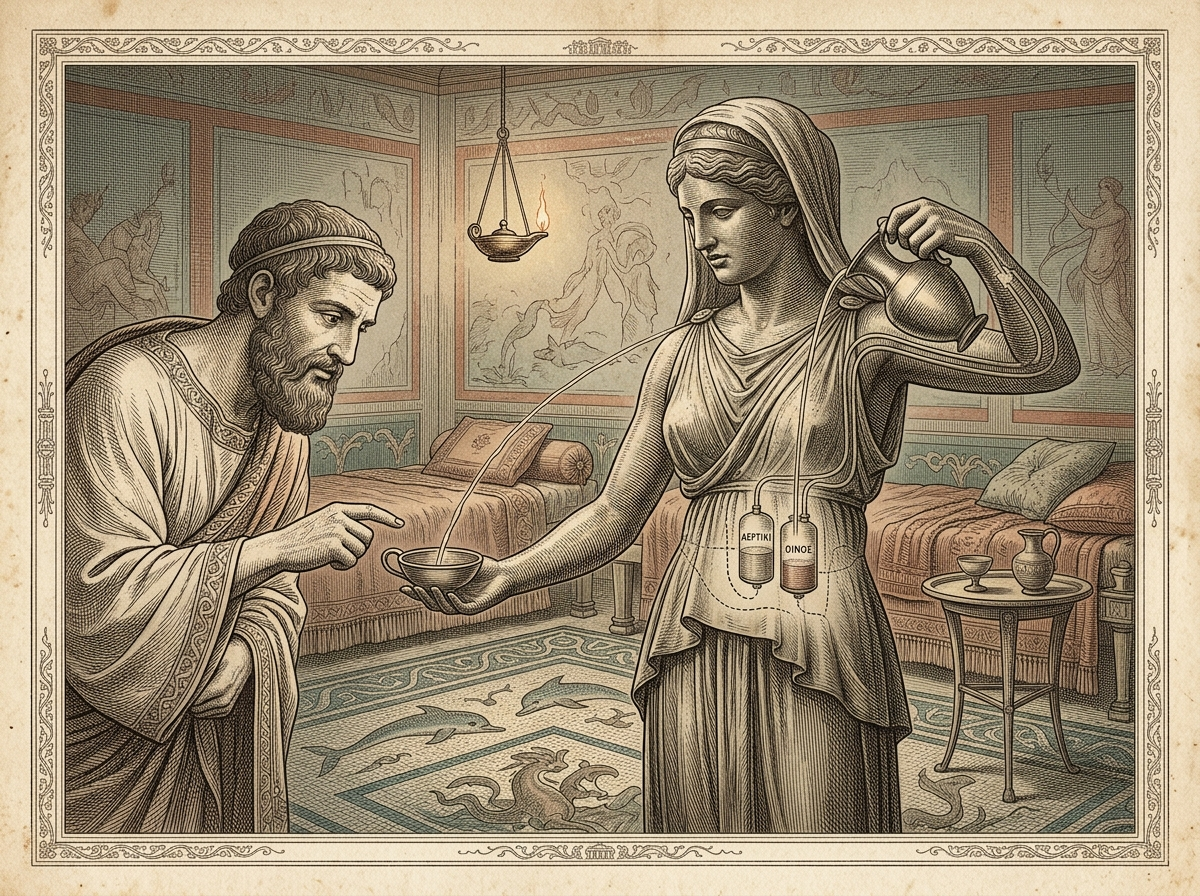
You set an empty cup in the open palm of a bronze servant girl. Her hand sinks a little under the weight, and from the jug in her other hand comes a stream of wine. Halfway up the cup, the wine stops on its own. Then, without anyone touching her, she tops off your drink with water. According to a text credited to Philo of Byzantium, a Greek engineer of the 3rd century BC, this was a machine — and very possibly one of the first humanlike robots ever described.
By the Curiosities Desk · · 5 min read · Filed under Archaeology · Today’s round
What happened?
Philo of Byzantium lived from roughly 280 to 220 BC and spent most of his working life in Alexandria, Egypt, then the busiest research city in the Mediterranean. He wrote a huge engineering encyclopedia, the Mechanike Syntaxis (“Compendium of Mechanics”), with books on levers, harbors, catapults, siegecraft, secret writing, and automata. One volume, the Pneumatics, was about devices driven by air and water pressure.
Most of that encyclopedia is lost. The Pneumatics survived only because medieval scholars translated it into Arabic, and part of that Arabic version was later turned into Latin. For centuries, European readers knew only the first 16 chapters. Then, at the start of the 20th century, the French scholar Bernard Carra de Vaux tracked down fuller Arabic manuscripts — one in Oxford’s Bodleian Library and two in the library of Hagia Sophia in Constantinople — and published the Arabic text with a French translation in a volume dated 1902.
Chapter 30 of that fuller text describes the maid. She is a metal statue of a serving girl holding a wine jug in her right hand, with her left hand held out, palm up. Hidden in her body are two sealed tanks, one filled with wine and one with water. Thin tubes run from the bottom of each tank up through her right arm to the jug’s spout. Separate air pipes lead from the top of each tank.
Her left arm is the switch. It is hinged at the shoulder and held up by a springy rod. When a guest sets a cup in her palm, the arm dips, and a pair of tiny pipes in the shoulder joint swing into line with the wine tank’s air pipe. Air rushes in, and wine flows out of the jug. As the cup fills, the extra weight pushes the hand lower still. That blocks the wine tank’s air supply — the wine stops — and lines up the water tank’s pipe instead, so water pours in to dilute the drink. When the cup is full, the hand drops far enough to seal the water pipe too. Lift the cup away at any point, and the arm springs back up, sealing everything.
A medieval Arabic copy of the treatise now in the Bodleian (MS Marsh 669, copied sometime between about 1300 and 1500) includes a diagram of her, labeled with the Arabic word jāriya, “serving girl.”
Why was it strange?
Because nothing about it needed electricity, gears, or a person behind a curtain. The whole “brain” of the robot is a trick of physics: a sealed tank of liquid won’t drain unless air can get in to replace what flows out. Philo — or whoever wrote the chapter — turned that simple rule into a valve system controlled by nothing more than the weight of a cup.
It was also built for a deeply Greek problem. Greeks usually drank their wine mixed with water, and the mixing ratio was a matter of taste and etiquette. Here was a machine that served both and handled the mixing itself, in order, every time.
There is a real puzzle under the charm, though. Philo’s Greek original is gone, and scholars agree the Arabic versions contain later additions. Nobody can say for certain whether the maid came from Philo’s own drawing board in Alexandria or was added or elaborated by a later engineer in the Islamic world. The safest statement is that she appears in the Philo tradition and may date back to him.
Machines like this kept Alexandria’s engineers busy; see The Coin-Operated Holy Water Machine That Beat the Vending Machine by 1,800 Years.
What did scientists learn?
The maid is a lesson in pneumatics — the study of how air and other gases push and pull. A liquid in a sealed container is held in place by the pressure of the outside air. Open a path for air to enter, and gravity can drain it; close the path, and the flow stops almost instantly, as if by magic. It’s the same reason a drinking straw holds liquid when you cover the top with your finger.
What the maid adds is control logic. Her arm acts like a set of valves that open and close in a fixed sequence — wine, then water, then off — triggered by a changing load. Engineers today would call that a mechanical feedback system: the output (a fuller cup) changes the input (the arm’s position), which changes what the machine does next.
Hellenistic engineers were capable of startling precision; see The 2,000-Year-Old Computer Found in a Shipwreck.
How does it affect us today?
The Pneumatics became a bridge between ancient and medieval engineering. Arabic-language engineers copied and extended devices like these, and later inventors in the Islamic world built elaborate automata of their own, including humanlike servers. That long chain of copying is the only reason Philo’s ideas reached us at all.
The basic idea — a machine that senses a weight and switches a flow on or off — lives on in toilet cisterns, drink dispensers, and the float valves that keep tanks from overflowing. And the maid herself has been rebuilt: Greece’s Kotsanas Museum of Ancient Greek Technology made a working reconstruction based on the text.
Later automata leaned harder on showmanship; see The Mechanical Duck That Fooled Paris With Fake Poop.
Fun fact
In 2023 the Bank of Greece put her on money: a €10 silver proof coin titled “The Automatic Maidservant of Philo,” limited to 2,000 pieces, with a design based on the Kotsanas Museum’s reconstruction.
Sources
- Bernard Carra de Vaux (ed. and trans.), “Le livre des appareils pneumatiques et des machines hydrauliques, par Philon de Byzance,” Notices et extraits des manuscrits de la Bibliothèque nationale 38 (Paris: Imprimerie Nationale, 1902; sometimes cited as 1903) — https://tpsalomonreinach.mom.fr/s/TAPReinach/item/16101
- “Philo of Byzantium,” Complete Dictionary of Scientific Biography, via Encyclopedia.com — https://www.encyclopedia.com/science/dictionaries-thesauruses-pictures-and-press-releases/philo-byzantium
- Bank of Greece, “Silver Collector 10 Euro Coin – Ancient Greek Technology: The Automatic Maidservant of Philo” (2023) — https://mint.bankofgreece.gr/en/coins/2023/silver-collector-10-euro-coin-greek-culture-ancient-greek-technology-the-automatic-maidservant-of-philo/
- Kotsanas Museum of Ancient Greek Technology, “The Automatic Servant of Philon” — https://kotsanas.com/en/the-automatic-servant-of-philon-3rd-c-b-c-to-proto-leitourgiko-robot-tis-anthropotitas-the-first-operating-robot-of-humanity/
- Aquincum Museum, “Philon of Byzantium: Everyone’s favourite science teacher from Antiquity” — https://www.aquincum.hu/en/blog/bizanci-philon/
Related stories
- The Coin-Operated Holy Water Machine That Beat the Vending Machine by 1,800 Years — Hero of Alexandria’s coin-triggered dispenser
- The 2,000-Year-Old Computer Found in a Shipwreck — The Antikythera mechanism’s bronze gears
- The Mechanical Duck That Fooled Paris With Fake Poop — An 18th-century automaton with a secret