Strange Animals Scientists Studied · Engineering
The Termite Mounds That Taught an Architect to Cool a Building — Using a Theory the Termites Didn't Follow
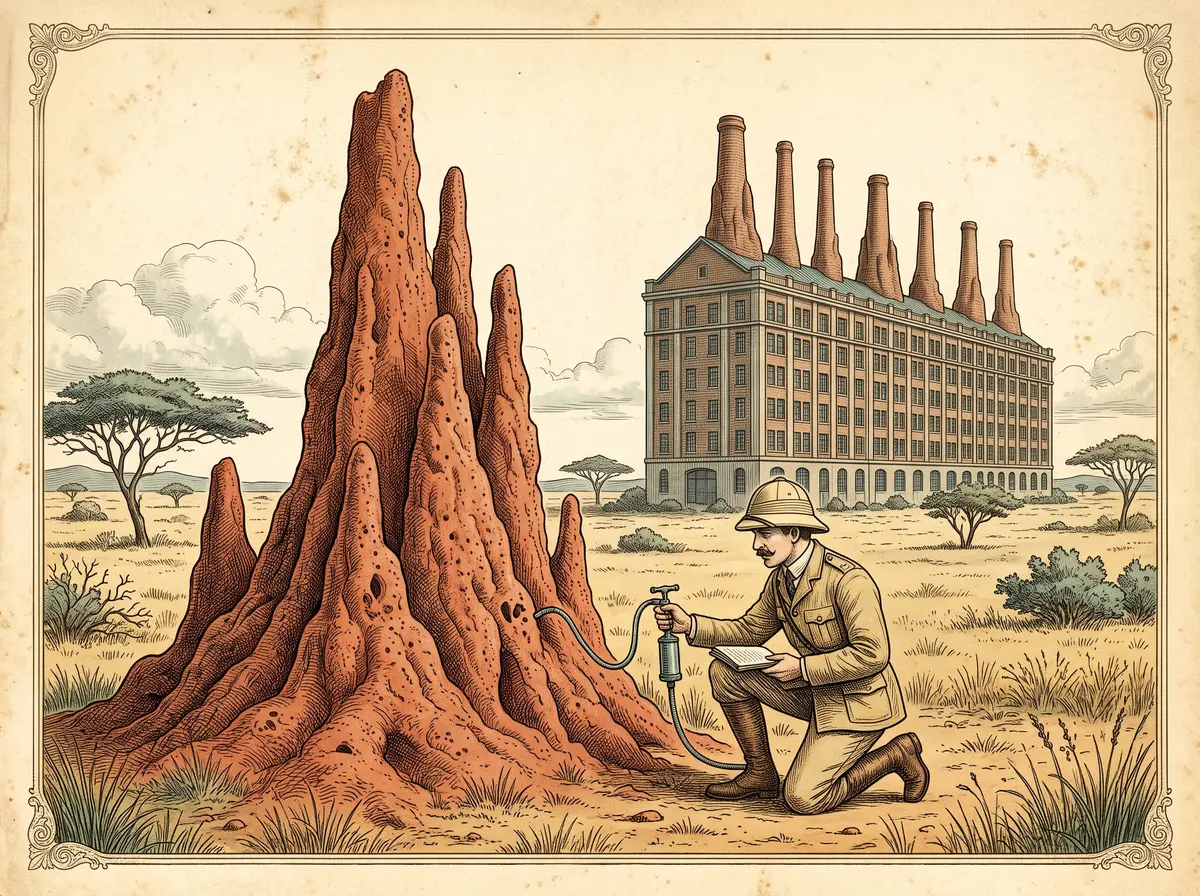
In 1996, a nine-story office block opened in Harare, Zimbabwe, with no conventional air conditioning, 48 brick chimneys poking out of its roof, and a famous source of inspiration: the towering mud mounds of African termites. The building worked beautifully. There was just one small problem, which scientists would spend the next twenty years uncovering — the termites weren't actually doing it that way.
By the Curiosities Desk · · 5 min read · Filed under Engineering · Today’s round
Part of Creatures That Changed Science
What happened: The Termite Mounds That Taught an Architect to Cool a Building — Using a
The story starts with a magazine article. In July 1961, the Swiss entomologist Martin Lüscher described “air-conditioned termite nests” in Scientific American. Some African termites, he explained, build huge earthen mounds above their underground colonies, and those mounds seemed to keep the nest at a steady temperature and humidity. His proposed mechanism was elegant: the colony’s own body heat, and the heat from the fungus gardens the termites farm for food, warms the air in the nest. Warm air rises up a central chimney, cools near the mound’s skin, and sinks back down — a self-powered loop, like a house that breathes on its own.
It was a lovely idea, and it spread. Decades later it reached Mick Pearce, a Zimbabwean architect who had long been fascinated by termite mounds. In the early 1990s the investment group Old Mutual hired him to design a large office-and-shopping complex in central Harare, later named the Eastgate Centre. Pearce, working with the engineering firm Arup, set out to cool it the way he understood the termites cooled theirs.
The result, which opened in 1996, was two long office blocks joined by a glass-roofed atrium. According to a 1996 Inter Press Service report, city rules would have allowed a 28-story tower on the site; Pearce chose nine stories instead. The building’s thick concrete and brick soak up heat during the day. At night, rows of large fans draw in cool night air to flush that stored heat out, and warm air leaves through the 48 brick chimneys on the roof. Air was changed about twice an hour by day and seven times an hour at night.
Early press coverage was ecstatic. The 1996 report quoted Pearce describing a building that “responds to natural forces and doesn’t need mechanical energy” — though, in fairness to the fans, it used some. Claims about its savings varied widely: that first report said it used about 5 percent of the energy of a conventional air-conditioned building, while later, more conservative figures put it at roughly 35 percent of comparable Harare buildings, saving about $3.5 million in energy costs in its first five years. Either way, it became a textbook example of biomimicry — designing human technology by copying solutions from nature.
Meanwhile, in the Namibian savanna, a physiologist named J. Scott Turner was doing something nobody had done thoroughly before: actually measuring what happens inside the mounds. Over more than two decades, Turner and colleagues pumped propane into mounds as a tracer gas and tracked where it went, filled mounds with plaster to cast their tunnels, scanned them with lasers, and fed termites microscopic beads. The airflow did not look like Lüscher’s tidy loop. Turner concluded that the mounds he studied worked less like chimneys and more like lungs — “accessory organs of gas exchange,” as he put it — with gusting outside wind pushing and pulling air through the mound’s porous walls. Their main job, in his view, was swapping carbon dioxide for oxygen, not keeping the nest cool.
Why it was strange: The Termite Mounds That Taught an Architect to Cool a Building — Using a
We usually imagine biomimicry as a straight line: scientists figure out how an animal does something, then engineers copy it. Eastgate ran the line backward. A celebrated building was “inspired” by a mechanism that, at least in the mounds that were later measured closely, turned out to be mostly wrong.
The French biologist Guy Theraulaz summed it up neatly to the engineering society ASME: Eastgate was built on the wrong idea of how termites regulate their nests — and yet Eastgate works. Turner himself has called it “termite-inspired” rather than termite-copied, crediting Pearce’s skill as an architect more than any faithful imitation of the insects.
If you like nature-meets-engineering stories, compare The Kingfisher That Redesigned the Bullet Train.
What scientists learned: The Termite Mounds That Taught an Architect to Cool a Building — Using a
The real termite story turned out to be richer than the original theory. In 2015, Hunter King, Samuel Ocko, and L. Mahadevan of Harvard published measurements in the Proceedings of the National Academy of Sciences from mounds of the Asian termite Odontotermes obesus. They found that these mounds are ventilated not mainly by colony heat or wind but by the daily swing in outdoor temperature.
Here’s how it works. The thin outer tunnels near the mound’s surface heat up faster in the sun than the thick central chimney. During the day, warm air rises through the outer tunnels and sinks down the middle; at night, when the surface cools first, the loop reverses. That back-and-forth flow flushes carbon dioxide out of the nest. The mound, in other words, turns the rhythm of day and night into a slow-motion breath. A follow-up study by the same group took more than 100 measurements across 30 mounds of the African species Macrotermes michaelseni.
The bigger lesson is that termite mounds are not one machine with one trick. Wind, sun, porous walls, and the termites’ constant rebuilding all play parts, and the balance differs by species and setting.
For another animal that solved an engineering puzzle long before people did, see The Ship-Sinking Clam That Taught an Engineer How to Dig Under the Thames.
How it reaches us today: The Termite Mounds That Taught an Architect to Cool a Building — Using a
Eastgate’s thermal-mass-and-night-flushing approach is now a standard tool of low-energy design, especially in climates with hot days and cool nights. And the corrected science is shaping a second wave of ideas. In 2008, Turner and the engineer Rupert Soar argued for going “beyond biomimicry” — not copying a mound’s shape, but designing buildings with porous, responsive skins that behave more like living tissue. Researchers are still testing how far that idea can go.
The termites also offer a quiet lesson in humility: a design can succeed for reasons different from the ones its creators believed. Good engineering still has to be checked against the real world — something both Pearce’s building and Turner’s propane pumps did, in their own ways.
For the burr that launched biomimicry in the first place, see The Burrs on a Dog That Became Velcro.
Mounds that taught an architect the wrong lesson, and still cooled a building, sit with Creatures That Changed Science.
Fun fact: The Termite Mounds That Taught an Architect to Cool a Building — Using a
To figure out how termites move water around their mounds, Turner’s team dyed the termites’ water fluorescent green — and discovered that the insects’ habit of touching mouths, often described as “kissing,” was really a bucket brigade passing water from termite to termite.
Sources: The Termite Mounds That Taught an Architect to Cool a Building — Using a
- Hunter King, Samuel Ocko, and L. Mahadevan, “Termite mounds harness diurnal temperature oscillations for ventilation”, Proceedings of the National Academy of Sciences 112, no. 37 (2015): 11589–11593.
- Martin Lüscher, “Air-Conditioned Termite Nests”, Scientific American 205, no. 1 (July 1961).
- Mercedes Sayagues, “Architecture-Zimbabwe: Termites Inspire New Office Complex”, Inter Press Service, June 4, 1996.
- “What Termites Can Teach Engineers”, ASME, November 21, 2019.
- Lisa Margonelli, feature on J. Scott Turner’s termite-mound research, National Geographic, August 2, 2014.