Weird Medical History · Physics
The Radioactive Water Crock You Filled Every Night Before Bed — and the Arsenic Nobody Noticed
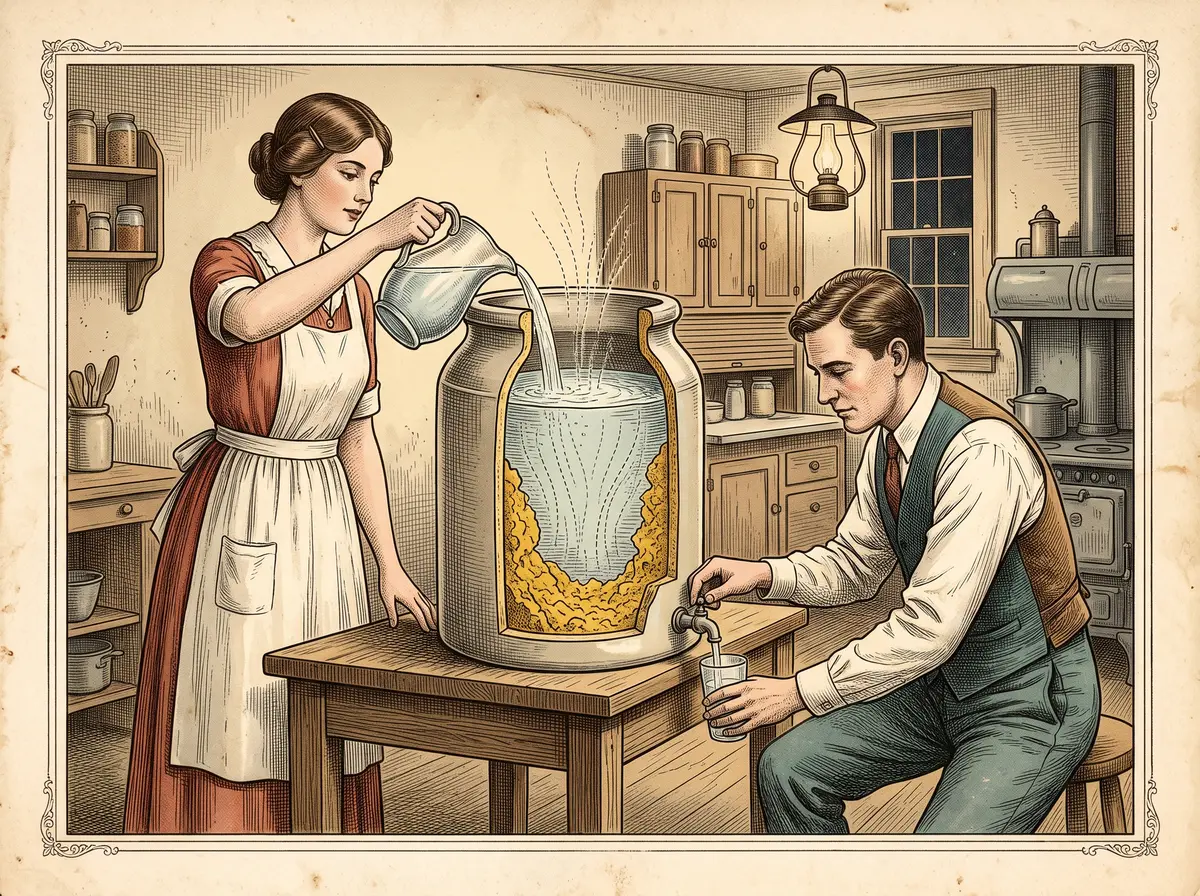
In the mid-1920s, somewhere in California, a family is following the instructions printed on the side of a big stoneware jar called the Revigator. Fill it every night. Drink freely when thirsty, on rising and on retiring, "six or more glasses daily." Its inner lining is made with uranium ore. By morning, the water inside has been made radioactive, on purpose. That was the whole point.
By the Curiosities Desk · · 5 min read · Filed under Physics · Today’s round
What happened: The Revigator
At the start of the 20th century, radioactivity was the most exciting discovery in science. Marie and Pierre Curie had announced the discovery of radium in 1898, and soon afterward scientists found that water from some famous mineral springs was naturally radioactive. People had soaked in hot springs for centuries, believing they healed. Now there seemed to be a modern, scientific explanation for why. Physicians and entrepreneurs began promoting “radium baths” and radioactive waters for arthritis, fatigue, and much else.
There was a practical problem. The radioactivity in spring water comes mostly from radon, a radioactive gas produced when radium decays. Radon escapes from water and decays quickly, so bottled spring water lost its “charge” long before it reached a customer’s table. If you wanted the effect, you had to drink at the spring. Or, as several companies realized, you could make the radioactive water at home.
Enter R. W. Thomas, a former stock salesman born in Kansas in 1873. According to research by the Museum of Radiation and Radioactivity at Oak Ridge Associated Universities (ORAU), Thomas was advertising radium ore by 1921, and by 1924 he was selling the “Thomas Radium C.R. Jar” in 2-, 4-, and 10-gallon sizes. In 1923 he offered a $500 reward in the Los Angeles Times to anyone whose jar failed to produce radioactive water.
Demand outgrew him. In late 1924, Thomas sold the business to a San Francisco pump company, Dow-Herriman, which formed the Radium Ore Revigator Company. The new jar was about a foot tall, glazed on the outside, with a porous lining that contained carnotite, a yellow uranium-bearing ore. Water poured in at night sat against that lining, soaking up radon as the radium in the ore decayed. The jar’s front carried a 1912 patent date. ORAU’s curators traced it to a broadly worded patent filed by a different inventor, Curt Schmidt, not to Thomas. Wikipedia and some other accounts credit the patent to Thomas, so it’s a detail worth treating with care.
The marketing was confident. Company literature told customers that ordinary water was “devoid of its life element” and called radioactivity “nature’s way to health.” According to a 2010 summary by the National Institute of Standards and Technology (NIST), the maker claimed the water could treat ailments “from arthritis to senility.” Hundreds of thousands of jars were sold between the mid-1920s and the early 1930s.
The first serious government complaint was not about the radiation at all. In 1930, the Federal Trade Commission charged the company with falsely advertising that the government endorsed its jars. By the time the FTC issued its final order in 1934, the Revigator companies had already gone out of business.
Why it was strange: The Revigator
Today, adding radioactivity to your drinking water on purpose sounds backward. In the 1920s, it sounded like progress. Radium was new and glamorous, and the leap from “healing springs are radioactive” to “radioactivity must be what heals” felt logical to a lot of people, including some doctors.
The deeper irony emerged eighty years later. When chemists finally tested surviving jars, the radiation turned out not to be the main problem. The lining was leaking other things into the water, things no one in the 1920s was looking for.
The Revigator belongs alongside other remedies that did more harm than good in Cures That Were Worse Than the Disease.
What scientists learned: The Revigator
In 2009, chemist Michael Epstein and students at Mount St. Mary’s University in Maryland, working with NIST scientists, analyzed several original Revigators. They published their results in the journal Applied Spectroscopy under a title that asks the obvious question: “What Were They Drinking?”
They sealed water in the jars for a day or a week, then measured what came out. Radon levels in the water ran from 50,000 to 200,000 picocuries per liter, far above the U.S. Environmental Protection Agency’s limits. (A picocurie is a tiny unit of radioactivity, about two atoms decaying per minute.) Still, the researchers judged the radon’s added risk to be low compared with other causes of death at the time, partly because radon escapes so readily.
The bigger danger was dissolved metals. The jars were leaching arsenic, lead, vanadium, and uranium into the water. In plain water from one jar, arsenic ran 2 to 20 times the EPA’s limit. When the team used slightly acidic water to imitate juice or wine, arsenic reached 300 times the limit. In other words, the device sold for its glow was most hazardous for its chemistry.
The principle is one the dial painters and Radithor drinkers taught the hard way: radioactivity does not care what you hoped it would do. For one wealthy man who drank radium water in bottles, see The Radioactive Tonic That Dissolved a Millionaire’s Jaw.
How it reaches us today: The Revigator
Radon is still in many people’s homes, not by design but because it seeps out of the ground, especially in regions with uranium-bearing rock. The EPA now considers radon the leading cause of lung cancer among nonsmokers and estimates it causes about 21,000 lung cancer deaths a year in the United States. Home radon test kits are inexpensive, and the gas is easy to vent once found.
The Revigator also helped show why claims about medical devices need independent testing before, not after, they reach kitchen counters. And collectors still trade the jars, which still give off measurable radiation, because uranium decays over billions of years.
For another radioactive product that went on sale before anyone checked, see The Children’s Toy That Came With Four Jars of Uranium — and Flopped Because of the Price.
If you’re concerned about radon or lung health, a home test kit and a conversation with your doctor are both good, low-stress first steps.
Fun fact: The Revigator
The ORAU museum keeps its Revigators locked in a vault, because almost a century later the jars still read as radioactive.
Sources: The Revigator
- M. S. Epstein, D. G. Miles Jr., and L. L. Yu, “What Were They Drinking? A Critical Study of the Radium Ore Revigator”, Applied Spectroscopy 63(12), 1406–1409, 2009.
- National Institute of Standards and Technology, “What Were They Drinking? Researchers Investigate Radioactive Crock Pots”, January 12, 2010.
- Museum of Radiation and Radioactivity, Oak Ridge Associated Universities, “Revigator (ca. 1924–1926)”.
- Museum of Radiation and Radioactivity, ORAU, “R. W. Thomas, the Revigator and the Thomas Cone”.
- U.S. Environmental Protection Agency, “Health Risk of Radon”.
#radium #quack medicine #radioactivity #patent medicine #1920s