The Children's Toy That Came With Four Jars of Uranium — and Flopped Because of the Price
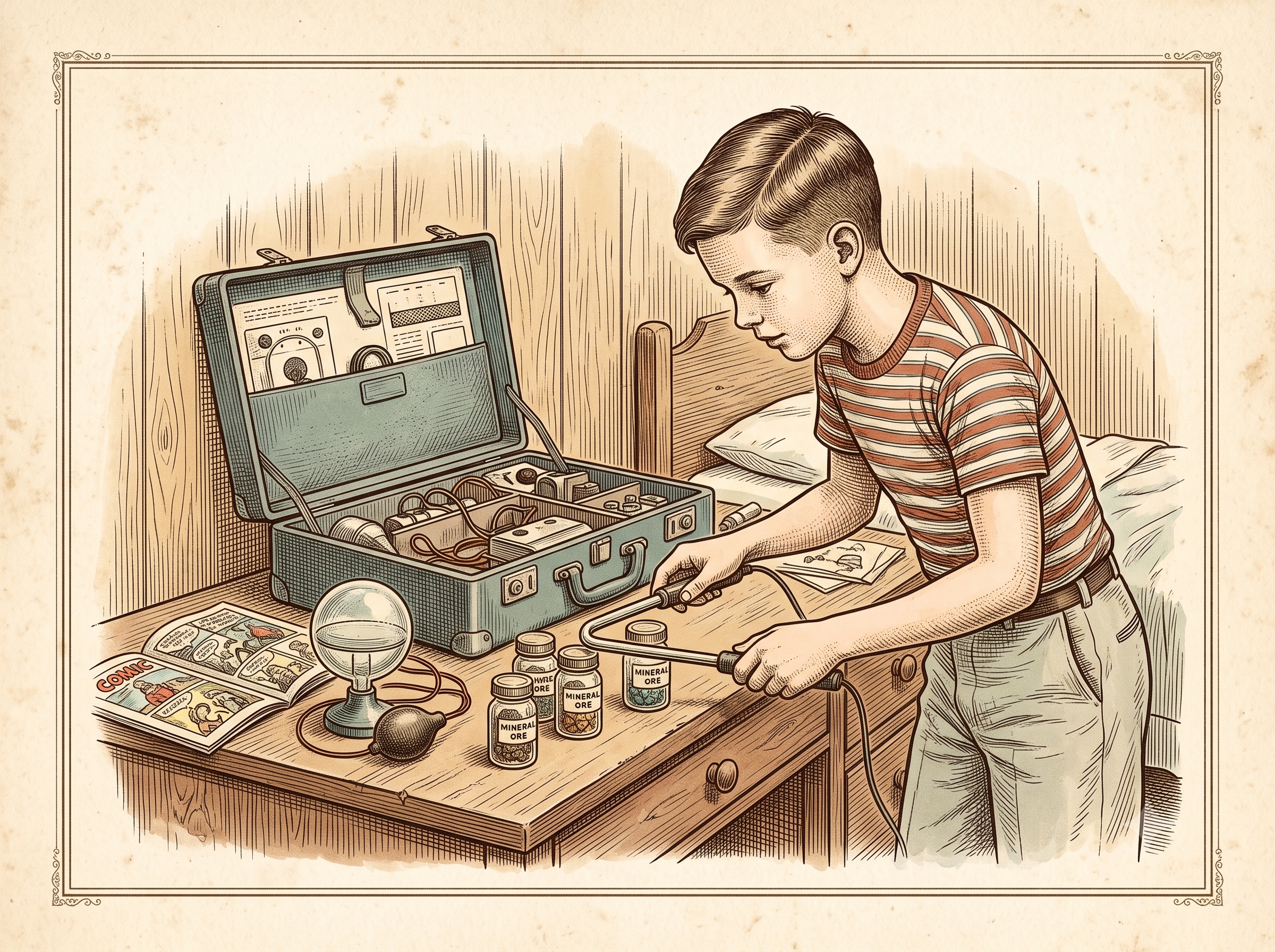
Christmas, 1950. A boy unwraps a case the size of a small suitcase, flips the lid, and finds a Geiger counter, a cloud chamber, a comic book starring Dagwood Bumstead, and four little glass jars of uranium ore dug out of the Colorado Plateau. The instruction manual has one firm rule about the jars: don't open them. Not because of your health — because loose ore dust would raise the background count and ruin your experiments.
By the Curiosities Desk · · 5 read · Filed under Chemistry · Today’s round
What happened?
The A. C. Gilbert Company was, by 1950, the most trusted name in American toys that made kids feel like scientists. Founder Alfred Carlton Gilbert — Olympic pole-vault gold medalist, working magician, and inventor of the Erector Set in 1913 — had been selling chemistry sets since 1922. He is also remembered as “the man who saved Christmas,” having talked the U.S. Council of National Defense out of banning toy sales during World War I.
So when Gilbert announced, in February 1950, the U-238 Atomic Energy Lab, it landed as the natural next step: a chemistry set for the atomic age.
The contents are worth listing in full, because the list is the joke and the list is also true. Inside the case: a battery-powered Geiger–Müller counter (with three C batteries), an electroscope, a spinthariscope, a Wilson cloud chamber with a short-lived polonium-210 alpha source in the form of a wire, three sealed low-level radiation sources (a beta-alpha source of lead-210, a probable pure beta source of ruthenium-106, and a gamma source of zinc-65), a set of “nuclear spheres” for building a model of an alpha particle, and four glass jars of natural uranium-bearing ore — autunite, torbernite, uraninite, and carnotite — sourced from the Colorado Plateau.
For reading material, the kit shipped with a 60-page Gilbert Atomic Energy Manual written by the physicist Ralph E. Lapp; a copy of Prospecting for Uranium, a 1949 government handbook published jointly by the Atomic Energy Commission and the U.S. Geological Survey; and a comic book, Learn How Dagwood Splits the Atom.
The Department of Energy’s Office of Legacy Management counts about 150 possible experiments. Gilbert’s marketing leaned on the cloud chamber, where a child could watch faint vapor trails appear as charged particles tore through supersaturated alcohol vapor: “this is the closest man has come to watching the atom!”
Then the thing sank. Fewer than 5,000 sets sold. It appeared in the Gilbert catalog for 1950 and 1951 and then vanished, replaced by the far tamer No. 11 Gilbert Chemistry Atomic Energy Set — a big box whose atomic component amounted to some ore, a spinthariscope, and a booklet. Advertisements ran into 1952 and 1953, but the Museum of Radiation and Radioactivity notes these were stores discounting old stock.
Gilbert’s own explanation for the short run was price and complexity. At $49.50, the set cost somewhere around $500 to $650 in today’s money, depending on which inflation conversion you use. Competing atomic kits from the Porter Chemical Company — which had beaten Gilbert to the idea in late 1947, and which needed an Atomic Energy Commission license to include uranium ore — sold for $10 and $25.
Why was it strange?
The strangeness isn’t only that a toy company sold uranium to eleven-year-olds. It’s the direction of the alarm. In 1950, the radioactivity was the selling point. The inside cover of the case advertised the product as “Safe!” The warning about the ore jars was written as lab technique, not as danger.
And the modern legend has the ending backwards. In 2006, Radar magazine named the U-238 Atomic Energy Lab the world’s most dangerous toy, and the label stuck so hard that the kit now circulates online as a parable about reckless mid-century parenting. But it was never recalled, never banned, and never the subject of a safety panic. It died on the shelf. It was a flop about money.
Another claim that stuck harder than the correction: The 14-Year-Old Who Convinced 43 Classmates to Ban Water.
What did scientists learn?
The set worked as science education partly because uranium-238 is such a poor performer. Its half-life is about 4.5 billion years, which is the whole reason there’s still uranium in the ground — and also the reason a jar of ore is only weakly radioactive. Half-life and intensity trade off directly: the longer an isotope takes to decay, the fewer atoms in a given gram decay each second, and the fewer particles come flying out.
Natural ore is weaker still, since the uranium is diluted through ordinary rock. IEEE Spectrum has estimated the exposure from the kit’s samples at roughly the equivalent of a day’s worth of the sun’s ultraviolet — a comparison across two different kinds of radiation, so treat it as a rough order-of-magnitude claim rather than a precise dose. That is not the same as harmless. Uranium is a chemical toxin as well as a radioactive one, and a swallowed or inhaled particle behaves very differently from one sitting inside a sealed jar. Nobody’s recommendation, then or now, was to carry the stuff in your pocket.
What a child with the kit could actually learn was real, though: that radioactivity is a natural background feature of the planet, not an exotic wartime substance. Rocks are slightly radioactive. So are bananas, Brazil nuts, and the potassium in your own body.
Another story that outran the evidence: Spontaneous Human Combustion: The Myth That Refused to Burn Out.
How does it affect us today?
The Atomic Energy Lab sits right at the hinge where American toy regulation swung. Through the 1950s, there was almost no federal law governing what could go in a toy box. Then came the Federal Hazardous Substances Labeling Act of 1960, the Child Protection Act of 1966, the Child Protection and Toy Safety Act of 1969, and the creation of the Consumer Product Safety Commission in 1972.
Chemistry sets were quietly gutted: reagents diluted or removed, thick manuals reduced to pamphlets. Whether that trade was worth it is still argued by science teachers. The A. C. Gilbert Company didn’t survive to weigh in — it struggled after Gilbert’s death in 1961 and went bankrupt in 1967.
The market eventually delivered its own verdict on the price. A complete set today can fetch more than a hundred times its original tag; one was listed by Sotheby’s at $4,800.
A close cousin: The Chess-Playing Machine That Beat Napoleon (With a Man Hidden Inside).
Fun fact
The included comic book, Learn How Dagwood Splits the Atom, has Blondie, Dagwood, their kids, and the family dog shrunk to atomic scale while Mandrake the Magician supervises the fission of a uranium-235 nucleus. The scientific consultants credited on this comic about a magician were Leslie R. Groves, military director of the Manhattan Project, and John R. Dunning, one of the physicists who confirmed uranium fission experimentally.
Sources
- Gilbert U-238 Atomic Energy Lab (1950–1951) — Museum of Radiation and Radioactivity, Oak Ridge Associated Universities (artifact record and contents list)
- Holiday Toy Shopping During the 1950s Looked a Bit Different than During the 2020s — U.S. Department of Energy, Office of Legacy Management
- Fun — and Uranium — for the Whole Family in This 1950s Science Kit — Allison Marsh, IEEE Spectrum, 31 January 2020
- 1950s “Atomic Energy Lab” Kit for Kids Used Real Radioactive Materials? — Snopes
- World’s Most Dangerous Toy? Radioactive Atomic Energy Lab Kit with Uranium (1950) — Bulletin of the Atomic Scientists