The Fizzing Candy That Supposedly Exploded Kids' Stomachs — and the 50,000 Letters Sent to Say It Didn't
Sometime in the late 1970s, a woman in the Bronx picked up the phone and heard a friend offering condolences on the death of her son. Her son was fine. He had just walked in the door from school. But half the playgrounds in America were sure he was dead, killed by a packet of crackling candy washed down with a can of soda. He was the little boy from the Life cereal commercials. The candy was Pop Rocks.
By the Curiosities Desk · · 5 min read · Filed under Chemistry · Today’s round
What happened?
The candy started as a failed drink. In 1956, William A. Mitchell, a chemist at General Foods, was trying to make a powder that would turn plain water into an instant fizzy soft drink. The drink mix didn’t work, but one ingredient behaved strangely. Mitchell had made tiny granules of hard sugar candy with carbon dioxide gas trapped inside them. When he put them in his mouth, they crackled.
Mitchell and his colleague Leon Kremzner filed a patent on January 6, 1959, for a “gasified confection.” It was granted on December 12, 1961. The method was simple to describe and hard to do: melt sugar, then let it harden while it’s squeezed by carbon dioxide gas at hundreds of pounds per square inch (the patent’s examples used 400 and 600). The gas ends up locked inside the hardened candy in tiny bubbles. The patent promised that the candy, once in the mouth, “disintegrates with a mild popping sound.”
For years the candy was mostly a curiosity Mitchell shared with his family. General Foods finally test-marketed it in Canada in the mid-1970s. Cold places were a deliberate choice, because heat and humidity ruined it. It spread across the United States from about 1976 as “Pop Rock Crackling Candy,” 15 to 25 cents a packet, in grape, orange, and cherry.
Kids loved it. Store shelves emptied. In places where Pop Rocks hadn’t arrived yet, packets were resold for as much as a dollar. In 1978, The New York Times found a 9-year-old in Manhattan running his own small Pop Rocks resale business.
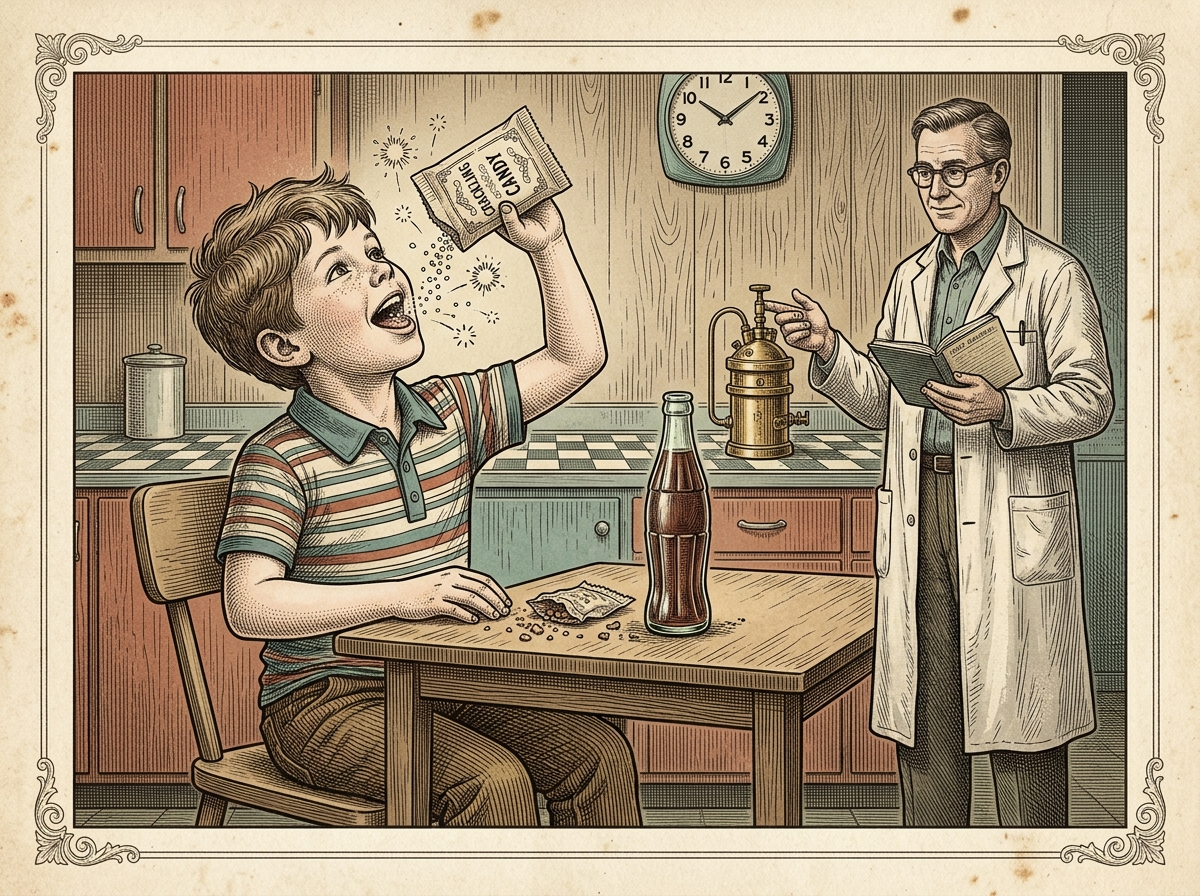
Then the rumors came. Some said the candy could make your stomach explode. The most specific version had a named victim: “Little Mikey,” the picky boy from the 1972 Life cereal ad (“He likes it! Hey, Mikey!”). The story went that he had eaten several packs of Pop Rocks, drunk a soda, and died. The boy was played by John Gilchrist, a child actor from the Bronx. He hadn’t died. The rumor reached his own family anyway, which is how his mother ended up taking that phone call.
The rumor spread far enough that the U.S. Food and Drug Administration (the FDA) reportedly set up a telephone hotline in Seattle to reassure worried parents. General Foods fought back hard. By 1979, the company had run full-page ads in 45 major publications and written to some 50,000 school principals across the country. It also sent Mitchell himself on the road to explain the chemistry. The message: a packet of Pop Rocks holds less gas than half a can of soda. The worst it could do was make you burp.
It didn’t help enough. The rumors, the patchy supply, and the price-gouging took their toll. General Foods stopped making Pop Rocks around 1980, and the candy largely disappeared. It came back in the mid-1980s under license to a new company, and it’s still sold today.
Why was it strange?
A food company spent a fortune proving that its product would not kill its customers. Nobody had actually died. There was no case, no hospital, no autopsy. There was just a candy that felt like it was doing something alive in your mouth. It popped and fizzed and hissed, and that sensation made the danger feel believable.
The legend also came with a strangely solid-sounding detail: a famous face. Pinning the rumor on a boy from a TV commercial gave it a victim everyone could picture. It took the boy’s own family to prove the story false, and even that didn’t settle it for some kids. Rumors about chemicals in everyday life can move faster than the facts, as another young myth-buster showed in The 14-Year-Old Who Convinced 43 Classmates to Ban Water.
What did scientists learn?
The chemistry of Pop Rocks is the chemistry of a soda can, in solid form. Carbon dioxide dissolves into a liquid, or gets trapped in a solid, when it’s under pressure. When the pressure is released, the gas escapes. In a soda, that’s the hiss when you open the can. In Pop Rocks, the “can” is a shell of hardened sugar. Your saliva dissolves the sugar wall around each tiny bubble until it suddenly breaks open, and the pressurized gas pops out with a crackle you can hear.
The amount of gas is small. By General Foods’ measure, a whole packet releases less carbon dioxide than half a can of soda. The stomach can stretch, and the body can let gas out the easy way, as a burp. When MythBusters tested the legend on an early episode, they filled a pig’s stomach with simulated stomach acid, six packs of Pop Rocks, and a six-pack of cola. The stomach swelled, but it didn’t burst. The real problem the FDA reported was much more ordinary. Some kids ate six or seven packets at a time and ended up with sore mouths and throats.
How does it affect us today?
The Pop Rocks rumor became a template for the modern urban legend about food: a fun, harmless product, a specific child victim, and a chemical reaction that sounds scary. Similar stories later attached themselves to Mentos and cola. Each time, the pattern repeats: the claim spreads faster than the correction.
Mitchell’s career is also a reminder that food science is real chemistry. The same inventor worked out the powdered drink mix Tang and the whipped topping Cool Whip, as told in The ‘Astronaut Drink’ NASA Never Invented — and the Moonwalker Who Said It Sucks. Chemists still use Pop Rocks in classrooms. A 2003 paper in the Journal of Chemical Education turned the candy into a lab exercise for measuring how much carbon dioxide it holds.
Fun fact
The boy supposedly killed by Pop Rocks grew up to work in television. In 2011, John Gilchrist became director of media sales for MSG Networks. That’s the New York sports channel, not the flavor enhancer.
Sources
- Leon Kremzner and William A. Mitchell, U.S. Patent 3,012,893, “Gasified confection and method of making the same” (filed January 6, 1959; granted December 12, 1961) — the original patent, with the pressures used and the “mild popping sound.”
- Barbara Mikkelson, “Pop Rocks Death,” Snopes — the Mikey rumor, the ads in 45 publications, the 50,000 letters, the Seattle hotline, and the Gilchrist family’s phone call.
- Smithsonian Magazine, “The Scientist Behind Some of Our Favorite Junk Foods” — Mitchell’s 1956 attempt at an instant soda and General Foods’ response to the rumor.
- Mental Floss, “When Pop Rocks Candy Exploded in the 1970s” — the Canadian test market, the resale trade, the 1978 New York Times report, and the FDA’s comments on overindulgence.
- Craig M. Davis and Matthew C. Mauck, “Titrimetric Determination of Carbon Dioxide in a Heterogeneous Sample (‘Pop Rocks’)”, Journal of Chemical Education 80(5): 552 (2003) — Pop Rocks as a chemistry lab exercise.
#urban legends #William A. Mitchell #carbon dioxide #General Foods