The 14-Year-Old Who Convinced 43 Classmates to Ban Water
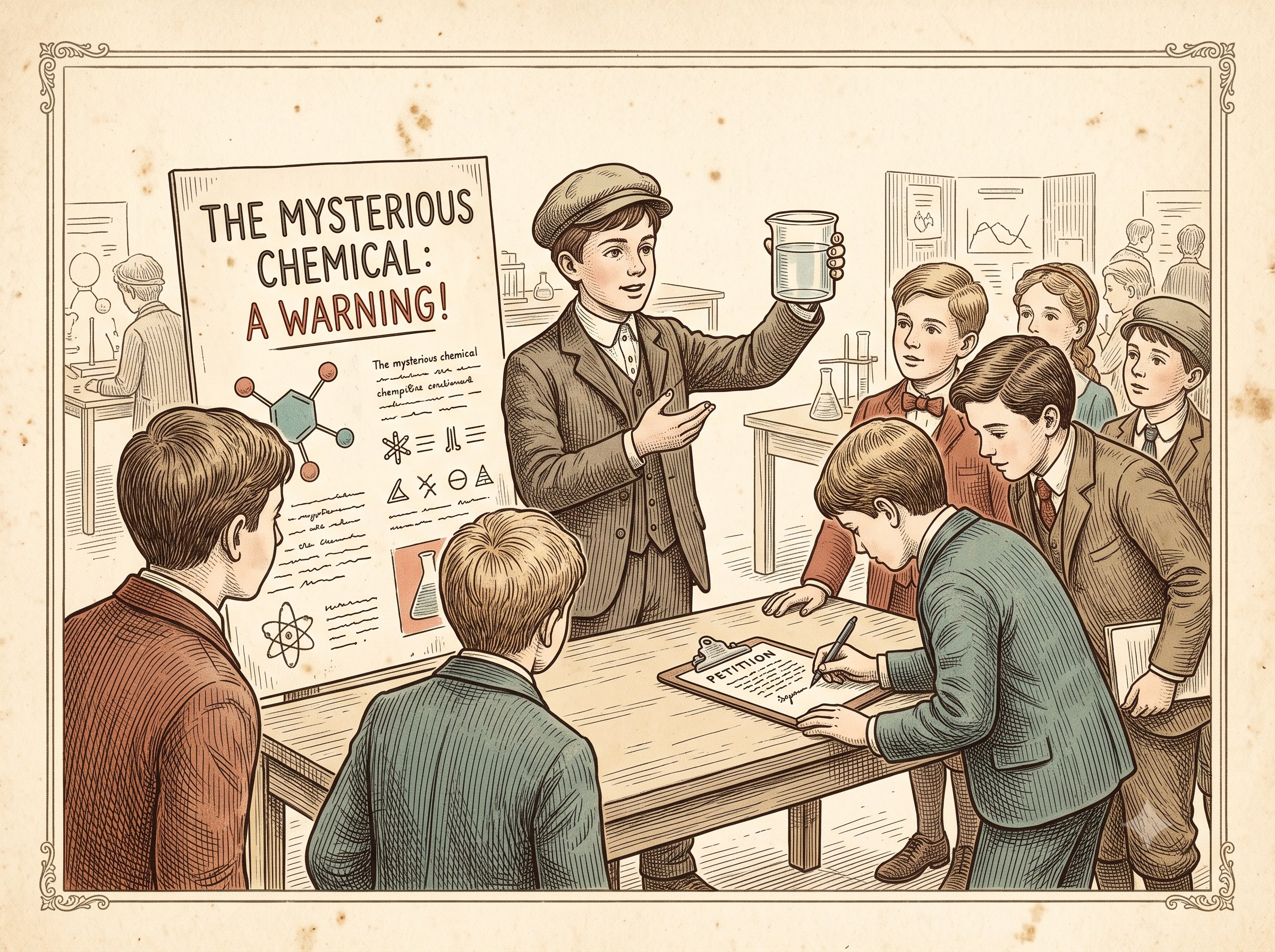
In the spring of 1997, a ninth-grader in Idaho Falls handed fifty classmates a short report about a colorless, odorless chemical. It corrodes metal. It causes severe burns in both its gaseous and solid states. It is a major component of acid rain. It turns up in the excised tumors of terminal cancer patients, and it kills thousands of Americans every year through accidental ingestion. Then he asked what should be done about it. Forty-three of them voted to ban water.
By the Curiosities Desk · · 5 read · Filed under Chemistry · Today’s round
What happened?
The student was Nathan Zohner, fourteen years old, at Eagle Rock Junior High School. His science fair project was called “How Gullible Are We?” and the report he circulated was titled, with a straight face, “Dihydrogen Monoxide: The Unrecognized Killer.”
Dihydrogen monoxide is water. Two hydrogen atoms, one oxygen. Di- for two, mon- for one, -oxide for the oxygen. It is a perfectly serviceable way to name H₂O, just not one anybody uses at the kitchen sink.
The genius of the report was that it did not contain a single false statement. Water really does accelerate rust. Steam really does cause severe burns, and so does prolonged contact with ice. Acid rain really is mostly water. Tumors, being tissue, really are largely water — so any tumor removed from a patient does contain the stuff. And thousands of people in the United States really do die each year from accidentally inhaling it, a phenomenon we usually call drowning.
Given those facts and asked what the world should do, forty-three of Zohner’s fifty classmates voted to ban the compound. Zohner won the grand prize at the Greater Idaho Falls Science Fair for his analysis of the results.
He had not invented the joke. The earliest documented version appeared on April Fools’ Day in 1983, when the Durand Express, a weekly paper in Durand, Michigan, reported that “dihydrogen oxide” had been found in the city’s water pipes. The modern internet version is generally traced to fliers circulated by students at UC Santa Cruz around 1989 and 1990 — though that origin rests largely on later recollection rather than surviving records. What does survive is the 1994 web page Craig Jackson built for the “Coalition to Ban DHMO,” which laid out the warnings in tidy bullet points, right down to the substance’s alarming use in nuclear power plants and styrofoam production.
What Zohner added was data. He turned a gag into a measurement, and that made it news. In October 1997 the Washington Post columnist James K. Glassman wrote the story up and coined a word for what the kid had documented: a Zohnerism, meaning the use of a true fact to lead a scientifically illiterate audience to a false conclusion.
The prank has kept working ever since, and not only on teenagers. In March 2004, the city council of Aliso Viejo, California came within a step of considering a ban on foam containers at city events, partly on the grounds that dihydrogen monoxide is used to make them. A paralegal had asked for the item to be placed on the agenda; the city manager later summed it up as bad research, and the item was pulled before any vote. In 2007, New Zealand MP Jacqui Dean wrote to the Associate Minister of Health asking whether the government’s drug advisory committee had a view on banning DHMO. The minister wrote back to explain that it was water. Dean, to her credit, said she had been well and truly set up and laughed about it.
Why was it strange?
Most hoaxes work by lying. This one works without a single lie in it.
That is what makes it unsettling rather than merely funny. Zohner’s classmates were not fooled by bad facts. They were fooled by an unfamiliar name attached to good facts, arranged in the shape of a warning. Nobody had to deceive them. They deceived themselves, using accurate information, in a completely reasonable way.
And the reasoning wasn’t stupid. If you handed most adults a list of seven true, frightening-sounding properties of an unknown compound, “ban it until we know more” is a defensible answer. The failure wasn’t in the logic. It was in the missing step where somebody asks what the substance actually is.
Another claim that stuck harder than the correction: The Children’s Toy That Came With Four Jars of Uranium — and Flopped Because of the Price.
What did scientists learn?
Chemists have a name for the reflex Zohner tripped: chemophobia — an automatic fear of a substance triggered by its name or its unfamiliarity rather than by anything known about how it behaves.
The parody is a near-perfect demonstration of the field’s oldest rule, usually credited to the 16th-century physician Paracelsus: the dose makes the poison. Water isn’t harmless because it’s water. It’s harmless in the amounts and forms we normally meet it in. Drink far too much far too fast and you can dilute the sodium in your blood to dangerous levels — a real and occasionally fatal condition called hyponatremia. The frightening bullet points on the flier are not exaggerations. They are just missing their denominators.
There’s a naming lesson too. Under the rules of chemical nomenclature, a compound can have several legitimate names. The point of the system is that each name should refer unambiguously to one substance, not that each substance should have exactly one name. “Water” is an accepted name for H₂O. So is “oxidane,” the systematic form recommended by the International Union of Pure and Applied Chemistry. None of them makes the molecule any more or less dangerous.
Another story that outran the evidence: Spontaneous Human Combustion: The Myth That Refused to Burn Out.
How does it affect us today?
The dihydrogen monoxide flier has become a standard teaching tool in chemistry and media-literacy classrooms, precisely because it’s so hard to feel superior to once you’ve fallen for it.
Its real descendants are everywhere on grocery shelves. “Chemical-free” is printed on bottles of substances made entirely of chemicals. The rule of thumb that you shouldn’t eat any ingredient you can’t pronounce would rule out thiamine and cholecalciferol, which are vitamins B1 and D. Ascorbic acid sounds like something you’d wear gloves for; it’s vitamin C.
The useful habit Zohner’s project points at is not more skepticism, exactly — his classmates were plenty skeptical. It’s one extra question, asked before the alarm goes off: what is this thing, and how much of it are we talking about?
A close cousin: George Washington’s Wooden Teeth — Which Were Never Made of Wood.
Fun fact
In 2006, the executive director of Louisville’s Waterfront Park had signs installed at a public fountain reading: “DANGER! — WATER CONTAINS HIGH LEVELS OF HYDROGEN — KEEP OUT.” The actual problem was elevated bacteria levels, but he decided, at public expense, that hinting at a connection to the hydrogen bomb would be more persuasive. For a while, it worked.
Sources
- Glassman, James K. “Dihydrogen Monoxide: Unrecognized Killer.” The Washington Post, October 1997. — the contemporaneous column that reported Zohner’s results and coined “Zohnerism.”
- Jackson, Craig. “Ban Dihydrogen Monoxide!” Coalition to Ban DHMO, 1994 (archived 1996). — the original web version of the flier.
- Mikkelson, David. “Is Dihydrogen Monoxide Dangerous?” Snopes.
- Halford, Bethany. “Danger! H in H2O.” Chemical & Engineering News, Vol. 84, No. 43, 2006. — the Louisville fountain signs.
- “Local officials nearly fall for H2O hoax.” NBC News, March 15, 2004. — the Aliso Viejo foam container agenda item.