George Washington's Wooden Teeth — Which Were Never Made of Wood
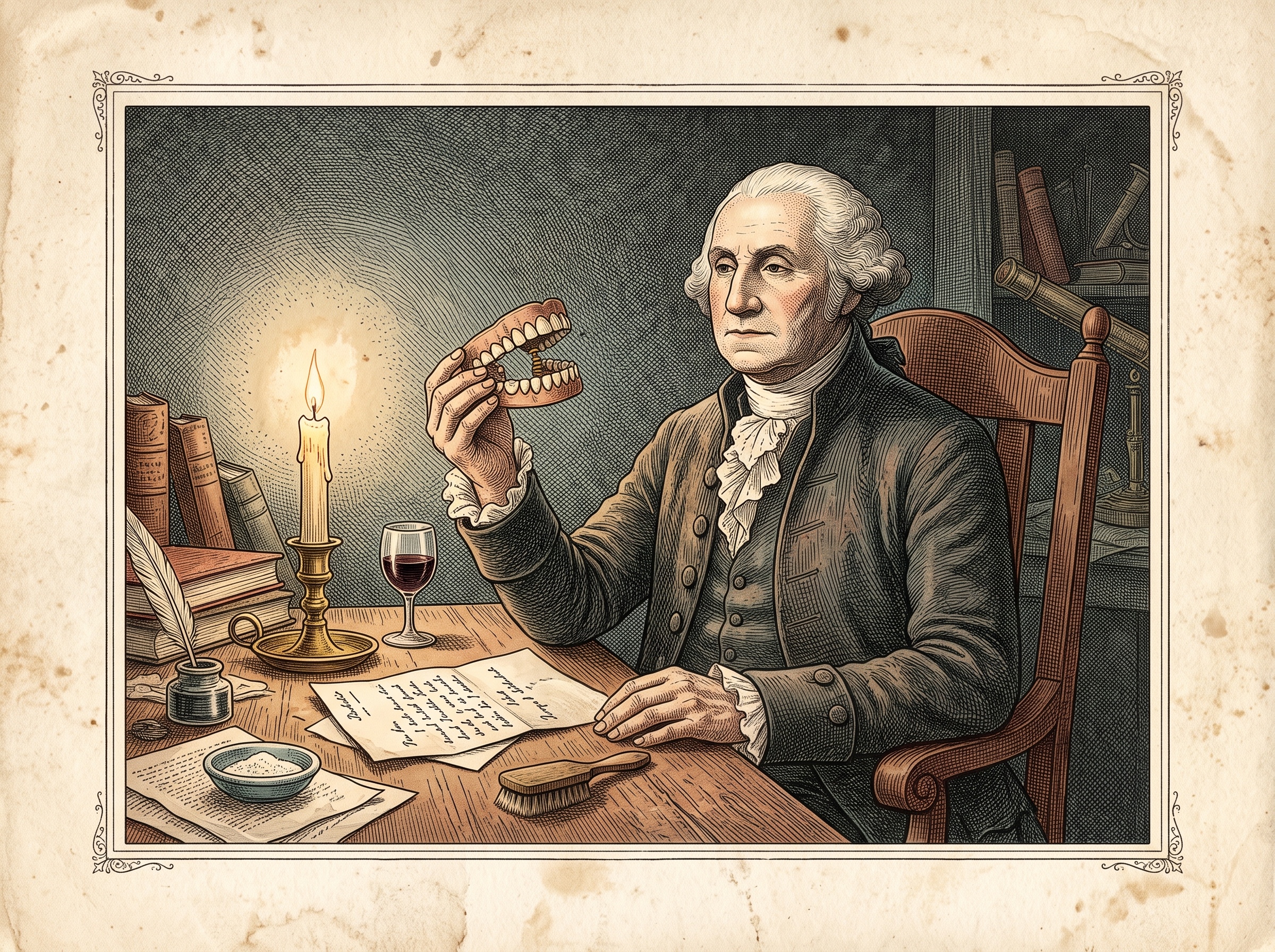
In December 1798, a New York dentist opened a parcel from the former President of the United States and found a set of false teeth that had turned "very black." His diagnosis was blunt: either George Washington had been soaking his dentures in port wine, or he had simply been drinking a lot of it. The teeth were not wood. They had never been wood. But stained, cracked and darkened, they were well on their way to looking like it.
By the Curiosities Desk · · 5 min read · Filed under Medicine · Today’s round
What happened?
George Washington’s dental troubles began early. In 1756, when he was 24, he paid a “Doctor Watson” five shillings to pull a tooth, according to his own records. According to his home and museum, Mount Vernon, he suffered regular toothaches, decay and tooth loss from his twenties onward. By 1781 he was wearing partial dentures, and by the time he took the oath of office on April 30, 1789, he had exactly one natural tooth left: a single lower premolar.
Washington saw several dentists over the years. One, Dr. John Baker, made him a partial denture of ivory wired to his remaining real teeth. Another, the French dentist Jean-Pierre Le Mayeur, specialized in tooth transplants, a fashionable and mostly unsuccessful procedure of the era. The most important was John Greenwood of New York, who built Washington a set carved from hippopotamus ivory, then called “sea horse,” fitted with human teeth held on by brass screws and gold wire springs. The springs pushed the upper and lower plates apart so they pressed against the gums and stayed in place.
None of these devices were comfortable. Washington complained in a letter that one set was “uneasy in the mouth” and made his lips “bulge” outward, and that the teeth had “by degrees, worked loose.” His step-grandson, George Washington Parke Custis, later described “a marked change” in the projection of his lower lip. The painter Gilbert Stuart, whose 1796 portrait of Washington ended up on the one-dollar bill, said Washington had just had a new set of false teeth inserted when he sat for it. That helps explain the tight, slightly puffed expression we still see in our wallets.
Then came the port wine. In his letter of December 28, 1798, now preserved in the National Archives, Greenwood told Washington that the set sent from Philadelphia had arrived “very black,” caused “either by your soaking them in port wine, or by your drinking it.” Wine, he explained, is acidic and “takes of[f] all the polish.” His advice: take them out after dinner, put them in clean water, and scrub them with a brush and finely scraped chalk. And if Washington preferred his teeth “more yellower,” he could soak them in broth, but never in tea or anything acidic.
There is also a hard part of this story. In May 1784, Mount Vernon’s account books record a payment of £6 2s (122 shillings) to “Negroes for 9 Teeth, on acc[oun]t of the French Dentis Doctr Lemay.” The people who sold their teeth were enslaved, and their names were not recorded. Historians at Mount Vernon note the entry shows the teeth were bought for Le Mayeur’s use, so it is not known whether they ever ended up in Washington’s own mouth. They also point out that people who were enslaved could hardly refuse such a request freely.
Why was it strange?
For most of the 1800s, and in schoolbooks well into the 1900s, Americans “knew” that the father of their country wore wooden teeth. It became one of the most repeated facts about him. Yet no set of Washington’s dentures, surviving or described, contains any wood. According to Mount Vernon, wood was not commonly used by dentists of his time at all.
So where did the idea come from? No one knows for certain. The most widely accepted explanation is the one Greenwood’s letter hints at. Ivory and bone are full of microscopic cracks. Dark wine and food seeped into those hairline fractures over time, and the stained lines looked a lot like wood grain. Later observers looking at old, discolored dentures may simply have believed their eyes.
Another story that outran the evidence: The Doctor Who Cracked the Knuckles of Only One Hand for 60 Years to Prove His Mother Wrong.
What did scientists learn?
Washington’s dentures are a snapshot of what dentistry could and couldn’t do in the 18th century. There was no understanding yet of how bacteria cause tooth decay, and no anesthetic for extractions. Tooth loss was common, especially among the wealthy, whose diets included more sugar.
Dentists had to build replacements from whatever lasted in the mouth. Ivory from hippos, elephants and walruses could be carved to fit, but it is porous and slowly absorbs stains and odors. Real human and animal teeth looked natural but had to be pinned in place. Metal fittings of lead, tin, copper and silver alloys held everything together. The only complete set of Washington’s dentures that survives, kept at Mount Vernon, contains human teeth, probably horse and cow teeth, and all of those metals.
The advice in Greenwood’s letter is also surprisingly modern. Take your dentures out after eating, keep them in water, brush them, and avoid acidic drinks. Dentists still give versions of that advice today.
Another claim that stuck harder than the correction: The Night-Fighter Ace Whose Secret Radar Got Blamed on Carrots.
How does it affect us today?
The search for a better denture material eventually led away from ivory and toward porcelain in the late 1700s, then vulcanized rubber bases in the mid-1800s, and finally the acrylic plastics used in most dentures now. Each step solved the problems Washington lived with: staining, smell, cracking and a poor fit.
The story also shows how myths stick. A simple, vivid image like “wooden teeth” is easier to remember than “hippopotamus ivory, human teeth and brass screws.” And because the real story includes the teeth of enslaved people, the cozy myth can crowd out a more uncomfortable truth. In 2020, Mount Vernon stopped selling souvenir replica dentures in its gift shop because of that history.
A close cousin: The 14-Year-Old Who Convinced 43 Classmates to Ban Water.
Fun fact
Washington’s very last natural tooth didn’t end up in a grave or a dish. He gave it to John Greenwood, who kept it in a special case as a keepsake. That case is now held by the New York Academy of Medicine.
If tooth pain or dental anxiety has been keeping you away from the dentist, you’re far from alone. Modern dentistry is much gentler than in Washington’s day, and it’s worth reaching out.
Sources
- Founders Online (U.S. National Archives), John Greenwood to George Washington, 28 December 1798: https://founders.archives.gov/documents/Washington/06-03-02-0200
- George Washington’s Mount Vernon, “False Teeth” (Digital Encyclopedia): https://www.mountvernon.org/library/digitalhistory/digital-encyclopedia/article/false-teeth
- George Washington’s Mount Vernon, “Wooden Teeth Myth” (Digital Encyclopedia): https://www.mountvernon.org/library/digitalhistory/digital-encyclopedia/article/wooden-teeth-myth
- George Washington’s Mount Vernon, “George Washington and Slave Teeth”: https://www.mountvernon.org/george-washington/facts/washingtons-teeth/george-washington-and-slave-teeth
- Smithsonian Magazine, “George Washington Didn’t Have Wooden Teeth—They Were Ivory”: https://www.smithsonianmag.com/smart-news/george-washington-didnt-have-wooden-teeth-they-were-ivory-180953273/