The Night-Fighter Ace Whose Secret Radar Got Blamed on Carrots
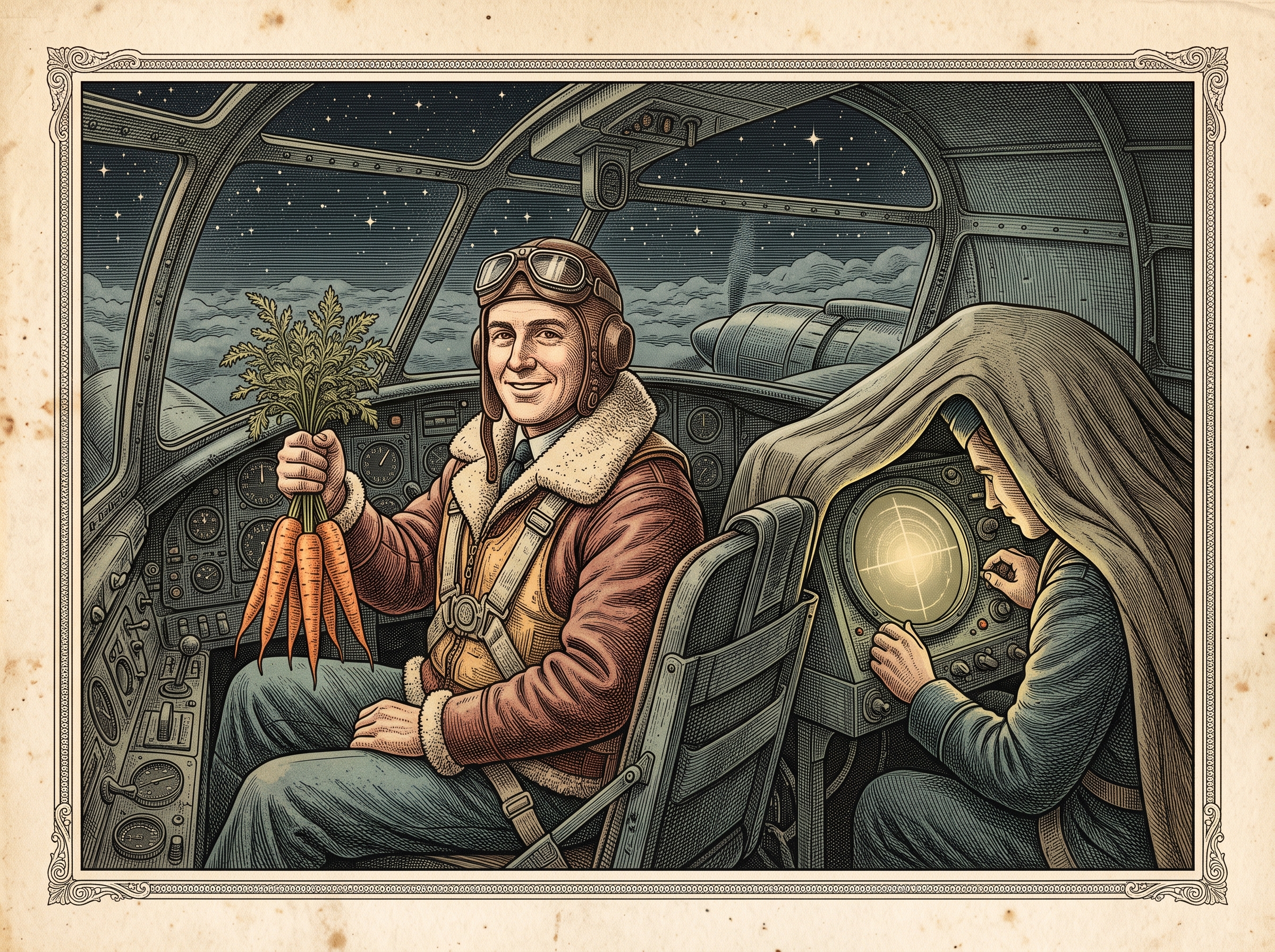
In early 1941, British newspapers gave their readers a new hero: a young RAF pilot who could hunt German bombers in the pitch dark. The papers called him "Cat's Eyes." The explanation for his gift, readers were told, was diet — lots of carrots, rich in the vitamin A that sharpens eyes at night. The pilot, John Cunningham, could not say a word. What actually found those bombers was a secret radar set in the back of his plane, run by a man in the seat behind him whom almost nobody wrote about. The vegetable got the credit.
By the Curiosities Desk · · 5 min read · Filed under Medicine · Today’s round
What happened?
In September 1940 the Luftwaffe began the Blitz, the months-long bombing campaign against London and other British cities. Daylight raids had proved costly for the Germans, so the bombers increasingly came at night. Britain answered with the blackout: streetlights off, windows curtained, car headlamps hooded. The cities went dark, and so did the sky.
Finding a bomber at night was almost impossible by eye. But the RAF had a new tool. Aircraft interception radar — “A.I.” for short — was a radar set small enough to fit inside a fighter. It let a crew track an enemy plane they couldn’t see until they were close enough to spot its outline.
Cunningham flew with No. 604 Squadron, one of the first units to get A.I. His radar operator was Jimmy Rawnsley, who sat behind him reading the screen and calling out directions. On the night of November 19–20, 1940, during a raid on Birmingham, the pair claimed their first kill. By the end of the Blitz in mid-1941, Cunningham had 13 enemy aircraft destroyed. He would finish the war with 20 victories, nearly all of them at night.
That success posed a problem. The Air Ministry didn’t want the enemy to learn that British night fighters were carrying radar. So when the press was allowed to cover Cunningham, a story came with him. Photo captions said his eyesight was so good he could see in the dark like a cat, and that a carrot-heavy diet supplied the vitamin A that kept it sharp. Cunningham disliked the attention, but he accepted the “Cat’s Eyes” nickname as a necessary deception. Rawnsley, who shared in nearly every victory, was largely left out of the coverage.
Meanwhile, the Ministry of Food had its own reasons to love carrots. Britain had imported about 60% of its food before the war, and German submarines were sinking supply ships. Butter, sugar, and bacon were rationed from January 1940. Carrots grew easily at home. So the ministry printed posters with a woman and child crossing a dark street in front of a car, under the line “Carrots keep you healthy and help you to see in the blackout.” A cartoon mascot, Doctor Carrot — top hat, briefcase — showed up in ads and recipes alongside his friend Potato Pete. The food minister, Lord Woolton, pushed carrot recipes so hard that the New York Times’ London correspondent wrote in 1942 that, to hear him talk, carrots had “enough vitamin A to make moles see in a coal mine.”
Did the trick fool the Germans? Probably not. Bryan Legate, an assistant curator at the RAF Museum, has said the Air Ministry was “happy to go along with the story” but “never set out to use it to fool the Germans,” who already knew about British ground radar and would not have been surprised by radar in planes. Stories that the Luftwaffe started feeding its own pilots carrots are, as the curator of the online World Carrot Museum puts it, apocryphal. The carrot story may have worked better as a morale boost at home than as a deception abroad.
Why was it strange?
Because the cover story was built from a real fact. Vitamin A really does matter for seeing in dim light, and a shortage of it really does cause night blindness. The propaganda didn’t invent the science; it stretched it. It took “a deficiency hurts your night vision” and turned it into “extra carrots give you superhuman night vision,” which is a very different claim.
It’s also strange how the story outlived its purpose. The radar secret came out after the war. The carrot claim stayed, and parents still repeat it at dinner tables.
Another claim that stuck harder than the correction: The Doctor Who Cracked the Knuckles of Only One Hand for 60 Years to Prove His Mother Wrong.
What did scientists learn?
The low-light cells in your retina, called rods, rely on a pigment called rhodopsin. When light hits it, a vitamin A–derived molecule called retinal changes shape, and that change starts the signal to your brain. Your eye then has to rebuild the pigment, and it needs vitamin A to do it.
Carrots don’t contain vitamin A directly. They contain beta-carotene, the orange pigment, which your body converts into vitamin A. The conversion isn’t efficient: estimates suggest it takes roughly 12 or more molecules of dietary beta-carotene to make one of vitamin A. And once your body has enough, it largely stops converting. Eat a great many carrots and you may get carotenemia, a harmless orange tint to the skin, but not better night vision.
For people who are deficient, the effect is real and dramatic. Vitamin A deficiency is a leading cause of preventable blindness in children worldwide; an estimated 250,000 to 500,000 children lose their sight to it each year. In those settings, vitamin A or beta-carotene can restore normal night vision. For a well-fed adult, though, extra carrots just keep you where you already are.
Another story that outran the evidence: George Washington’s Wooden Teeth — Which Were Never Made of Wood.
How does it affect us today?
The carrot story is still one of the first nutrition “facts” many children learn, and eye doctors still field questions about it. The more useful version of the advice is broader: a balanced diet supports eye health, and leafy greens such as spinach and kale supply lutein and zeaxanthin, pigments studied for their role in protecting the retina as we age.
The other legacy is the radar itself. Airborne interception radar grew into the radar systems that now guide aircraft and spot weather. The thing hidden behind the carrot became part of everyday infrastructure.
If you’ve noticed changes in your night vision, that’s worth a visit to an eye doctor rather than a trip to the vegetable aisle. Night blindness can have causes that carrots won’t fix.
The same thread — World War II — continues in The Warship That Never Actually Teleported to Norfolk.
Fun fact
People still care about the mascot’s proper title. In 2019, a reader left a comment on a Museum Wales blog post about wartime food, in all capital letters, protesting that the article had called him “Captain Carrot.” The museum’s digital team replied, apologized, and corrected every mention so “the good doctor is referred to by his proper title throughout.”
Sources
- Imperial War Museums, “Carrots Keep You Healthy and Help You to See in the Blackout” (Ministry of Food poster, Art.IWM PST 6015) — the original wartime poster.
- K. Annabelle Smith and Meilan Solly, “Carrots Can’t Help You See in the Dark. Here’s How a World War II Propaganda Campaign Popularized the Myth,” Smithsonian magazine (updated 2025).
- Dina Fine Maron, “Fact or Fiction?: Carrots Improve Your Vision,” Scientific American (2014) — with comment from the RAF Museum and the National Eye Institute.
- Museum Wales, “Do you remember Doctor Carrot and Potato Pete?” — wartime rationing and the vegetable mascots.
- NIH Office of Dietary Supplements, Vitamin A and Carotenoids — Fact Sheet for Health Professionals.