The Doctor Who Cracked the Knuckles of Only One Hand for 60 Years to Prove His Mother Wrong
For more than half a century, a California doctor named Donald Unger cracked the knuckles of his left hand at least twice a day. His right hand he left alone. He wasn't being fidgety. He was running a clinical trial on himself, with one hand as the experiment and the other as the control, all to settle a question his mother had raised when he was a boy.
By the Curiosities Desk · · 5 read · Filed under Medicine · Today’s round
What happened?
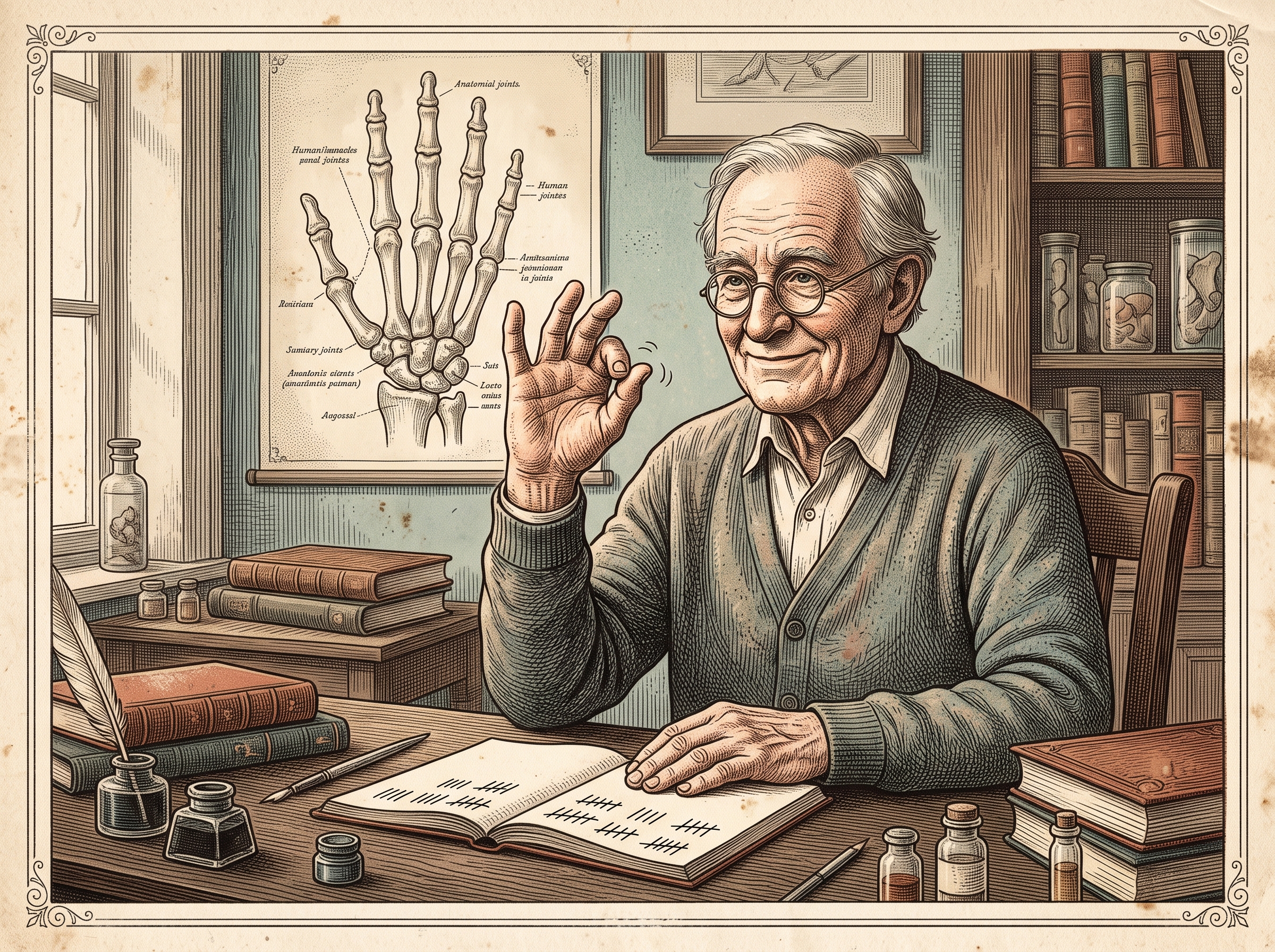
Like a lot of children, Donald Unger was told that cracking his knuckles would give him arthritis. In his telling, the warning came not just from his mother but from several aunts and, later, his mother-in-law. Plenty of kids hear that and either quit or ignore it. Unger, who grew up to become a physician, did something more unusual: he decided to find out.
His method was simple and stubborn. He cracked the knuckles of his left hand at least twice a day, every day. The knuckles of his right hand he cracked only “rarely and spontaneously,” in his words, which made that hand a built-in comparison. Any difference between the two hands after decades of this would be hard to blame on diet, genes, or age, because both hands belonged to the same man.
In 1998, about 50 years in, Unger wrote up the results as a short letter in the journal Arthritis & Rheumatism, under the title “Does Knuckle Cracking Lead to Arthritis of the Fingers?” He estimated that his left hand had been cracked at least 36,500 times, which is roughly what you get from twice a day for 50 years. His right hand had been cracked hardly at all.
The verdict: neither hand had arthritis, and he could see no apparent difference between them. His conclusion was dry but pointed. The finding, he wrote, called into question whether other parental beliefs, such as the importance of eating spinach, might also be flawed. He also admitted the obvious limit of a study with one participant and suggested further investigation was “likely warranted.”
The letter sat quietly in the medical literature for another decade. Then, in October 2009, Unger was awarded the Ig Nobel Prize in Medicine at a ceremony in Harvard University’s Sanders Theatre. The Ig Nobels, run by the science humor magazine Annals of Improbable Research, honor research that “first makes people laugh, and then makes them think.” By then his citation described him as having cracked his left knuckles every day for more than sixty years.
Unger traveled from California to Cambridge to accept the prize in person. Accounts of the night report him addressing his mother directly: “Mother, you were wrong!” In his acceptance speech, he added that after more than 60 years of knuckle cracking, “perhaps I deserve some sort of award.”
Why was it strange?
Most medical myths get tested by large studies, not by one man’s patience. Unger’s experiment ran longer than most careers, and it relied on something researchers usually work hard to avoid: a sample size of one.
That is also why it is charming rather than conclusive. Critics noted the obvious flaws. The study wasn’t blinded, meaning Unger knew which hand was which. One person’s hands can’t speak for everyone’s. And Unger himself treated the result as a well-aimed anecdote, not proof.
But the elegance is real. By using his own two hands as experiment and control, Unger removed many of the variables that make human studies messy. It’s the same logic behind a “split-body” trial, where doctors treat one side of a patient and compare it with the other. He just ran it for six decades and kept count.
Another story that outran the evidence: George Washington’s Wooden Teeth — Which Were Never Made of Wood.
What did scientists learn?
Unger wasn’t the only one asking. In 1990, a study in the Annals of the Rheumatic Diseases examined 300 people aged 45 and older, 74 of whom were habitual knuckle crackers. The crackers didn’t have more hand arthritis, though the study did report they were more likely to have hand swelling and weaker grip, a finding later studies haven’t firmly settled.
In 2011, a team led by Kevin deWeber published a larger look in the Journal of the American Board of Family Medicine. They surveyed 215 adults aged 50 to 89 who had hand X-rays on file. About one in five were knuckle crackers. Hand osteoarthritis, the wear-and-tear form of arthritis, was no more common among crackers (18.1%) than non-crackers (21.5%). Even people who had cracked for many years showed no clear link.
So what is the sound? The joints in your fingers sit inside a capsule filled with synovial fluid, a slippery liquid that keeps them moving smoothly. For decades, researchers argued over the pop. In 1947, British scientists using X-rays tied it to a gas-filled space forming in the joint. In 1971, another team proposed that the noise came from that bubble collapsing instead.
In 2015, University of Alberta researchers led by Greg Kawchuk filmed knuckles cracking inside an MRI machine. Their volunteer, chiropractor and co-author Jerome Fryer, slipped each finger into a tube attached to a cable that was slowly pulled until the joint popped. Kawchuk called it the “pull my finger” study. The video showed a cavity forming at the moment of the crack, supporting the idea that the sound comes from the joint surfaces suddenly separating. A 2018 mathematical model from other researchers argued the sound could come from a bubble partly collapsing, so the exact source of the pop is still debated.
Another claim that stuck harder than the correction: The Night-Fighter Ace Whose Secret Radar Got Blamed on Carrots.
How does it affect us today?
Unger’s letter is now one of the most cited pieces of evidence in popular articles about knuckle cracking, usually alongside the larger studies that agree with him. Doctors still field the question constantly, and the current consensus is reassuring: there’s no good evidence that ordinary knuckle cracking causes arthritis.
His experiment also became a small classic in teaching. It shows how a controlled comparison works, why a control group matters, and why one person’s results, however long-running, still need bigger studies behind them.
A close cousin: The Newspaper Hoax That Put Bat-People on the Moon.
Fun fact
In the same Ig Nobel speech, Unger proposed his own epitaph: “Here lies Donald Unger, who has finally quit cracking his knuckles.”
A quick note: cracking your knuckles appears harmless for most people, but if a joint hurts, swells, or loses movement when you crack it, that’s worth mentioning to a doctor.
Sources
- Unger, D.L. “Does Knuckle Cracking Lead to Arthritis of the Fingers?” Arthritis & Rheumatism (1998): https://pubmed.ncbi.nlm.nih.gov/?term=Does+knuckle+cracking+lead+to+arthritis+of+the+fingers
- Improbable Research, “Ig Nobel acceptance speech: Knuckle-cracking” (2010): https://improbable.com/2010/02/15/ig-nobel-acceptance-speech-knuckle-cracking/
- deWeber, K., Olszewski, M., & Ortolano, R. “Knuckle Cracking and Hand Osteoarthritis.” Journal of the American Board of Family Medicine 24, no. 2 (2011): 169–174: https://www.jabfm.org/content/24/2/169
- Kawchuk, G.N., et al. “Real-Time Visualization of Joint Cavitation.” PLOS ONE (2015): https://journals.plos.org/plosone/article?id=10.1371/journal.pone.0119470
- Castellanos, J., & Axelrod, D. “Effect of habitual knuckle cracking on hand function.” Annals of the Rheumatic Diseases 49, no. 5 (1990): 308–309: https://ard.bmj.com/content/49/5/308