The Misplaced Decimal Point That Made Spinach Famous — and Never Existed
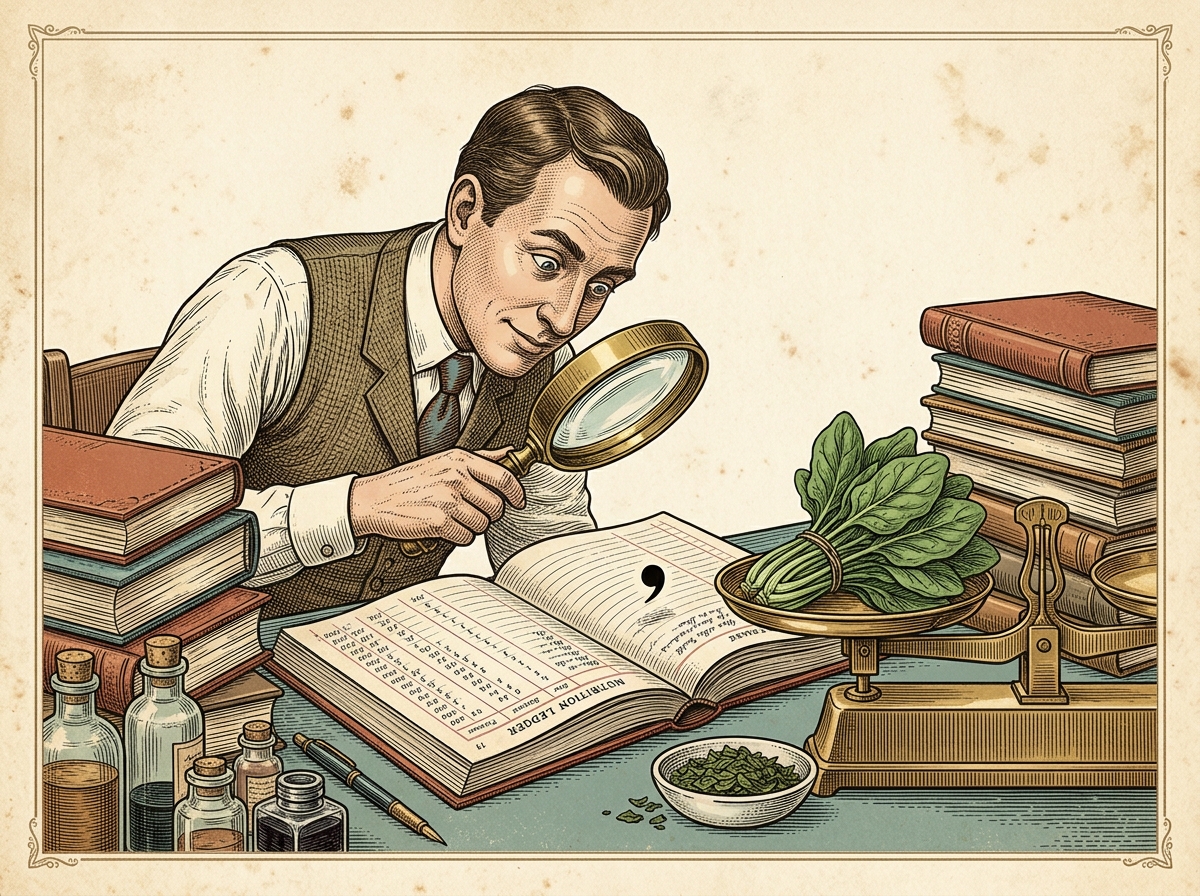
For decades, scientists loved to tell a story about scientists. A careless chemist, the tale went, slipped a decimal point and gave spinach ten times its real iron, Popeye started gulping it by the can, and a whole generation of children was forced to eat their greens for nothing. It was the perfect cautionary tale about sloppy research. There was just one problem: when a criminologist went looking for the misplaced decimal point, he couldn't find it anywhere.
By the Curiosities Desk · · 5 min read · Filed under Medicine · Today’s round
What happened?
Spinach does contain iron, but not an unusual amount. Raw spinach holds roughly 2.7 milligrams per 100 grams, according to USDA figures — respectable for a leafy green, nothing like a superfood. So how did it get its iron-man reputation?
By the 1980s, the scientific world had a crisp answer. In December 1981, Terence Hamblin, a British hematologist (a doctor who specializes in blood), wrote a playful article called “Fake!” for the Christmas issue of the British Medical Journal. Among its examples of bad science, he described how spinach’s iron content had been inflated tenfold by a decimal-point error made in the 1890s and only exposed in the 1930s. Popeye, he joked, “would have been better off chewing the cans.”
The story spread beautifully. Over the following years it was repeated in medical journals, textbooks, popular magazines, and countless lectures. A 1995 paper in the Journal of Internal Medicine even used it as a warning about “the dissemination of false data through inadequate citation” — the habit of passing along a claim without checking where it came from.
Then, in 2010, Mike Sutton, a criminologist at Nottingham Trent University, heard the decimal story at a talk and got curious. He wanted to see the original error with his own eyes. He searched databases, spent weeks in nutrition and biochemistry journals going back to the 1920s, read through bound volumes of the Popeye comic strip, and emailed Hamblin to ask for his source.
Hamblin’s reply was disarmingly honest: he said he “honestly cannot remember.” He explained that he’d been asked to write a light Christmas piece without references and was sure he hadn’t invented the story, but he couldn’t point to where he’d found it.
Sutton reported what he did find, in the Internet Journal of Criminology. He found no evidence of a decimal error in the 19th-century work usually blamed. Instead, he found a more ordinary muddle. Some early-20th-century analyses reported iron figures for dried spinach — and when you remove the water from a leaf, everything left over becomes far more concentrated. Dried-spinach figures in the range of 20 to 45 milligrams per 100 grams appear in the literature Sutton surveyed, and he argued that at least one 1934 American study seems to have presented a dried-weight figure as if it applied to fresh spinach.
And Popeye? Sutton concluded that the comic’s creator, E. C. Segar, wasn’t thinking about iron at all. In a strip from July 3, 1932, Popeye explains that spinach is full of vitamin A, and that’s what makes people strong. Across the hundreds of strips Sutton examined, he found none that tied spinach to iron.
Why was it strange?
Because the myth about a careless error was itself a careless error. The decimal-point tale had been told for years precisely as a lesson in checking your sources — and almost no one had checked its source.
In 2014, the Norwegian anthropologist Ole Bjørn Rekdal traced the legend even further back in a paper titled “Academic Urban Legends.” He found that the British nutrition scientist Arnold Bender had floated the idea in a 1972 lecture, cautiously: spinach’s fame “may well have grown from a misplaced decimal point.” With each retelling, Rekdal showed, the “may well have” quietly disappeared, and later a textbook gave the supposed error a specific date — 1870 — with no citation to back it up. A guess hardened into a “fact” one copy at a time.
To his great credit, Hamblin later said publicly that he had been “right for the wrong reason”: spinach really isn’t an iron powerhouse, but the decimal story wasn’t true either. As he put it, “a good story is not necessarily a true story.”
Another tale that collapsed when someone checked the original: The Bumblebee That Science Supposedly Proved Couldn’t Fly.
What did scientists learn?
Two lessons, one about food and one about knowledge.
On the food side, the amount of iron in a vegetable isn’t the whole story — what matters is how much your body can absorb. Spinach is rich in oxalate (a natural compound that binds to minerals), and plant iron comes in a form the gut absorbs less easily than the iron in meat. Even a 1935 science news report Sutton cites noted that only about a quarter of spinach’s iron was available to the body.
On the knowledge side, the spinach legend became a textbook case of what researchers now call citation errors: quoting a source you haven’t read, copying a claim from someone who also didn’t check, or citing a reference that doesn’t actually support the point. Rekdal argued that these shortcuts let a rumor wear the costume of scholarship.
The same trap — a catchy claim outrunning its evidence — shows up in The Myth That You Only Use 10% of Your Brain.
How does it affect us today?
Spinach is still a genuinely nutritious vegetable, packed with vitamin A, vitamin K, and folate — just not a magic iron tonic. Nutrition guidance now emphasizes pairing plant iron with vitamin C (which helps absorption) rather than leaning on any single “super” food.
The bigger legacy is in how scientists talk about evidence. The spinach story now shows up in discussions of research integrity as a reminder to go back to the original source, even for a “fact” everyone already knows — especially for one everyone already knows.
Another myth with surprising staying power: The Baguette Blamed for Overheating the Large Hadron Collider.
Fun fact
The 1995 journal article warning about false data spreading through careless citation used the spinach decimal-point story as its example — making it one of the more ironic citations in medical publishing.
Sources
- Rekdal, Ole Bjørn (2014). Academic urban legends. Social Studies of Science, 44(4), 638–654.
- Sutton, Mike (2010). Spinach, Iron and Popeye: Ironic lessons from biochemistry and history on the importance of healthy eating, healthy scepticism and adequate citation. Internet Journal of Criminology.
- Hamblin, T. J. (1981). Fake! British Medical Journal, 283(6307), 1671–1674.
- How rumors spread: sloppy citation practices. Inside Higher Ed, August 6, 2014.
- Well, Blow Me Down — A Tale of Spinach, Citations, Nutrition, Epistemology, and Cognitive Ease. The Scholarly Kitchen, September 3, 2014.
If you’re worried about low iron or anemia, a doctor can check your levels with a simple blood test and help you find the right foods or supplements.