Impossible Inventions · Biology
The Seesaw That Was Built to Raise the Dead
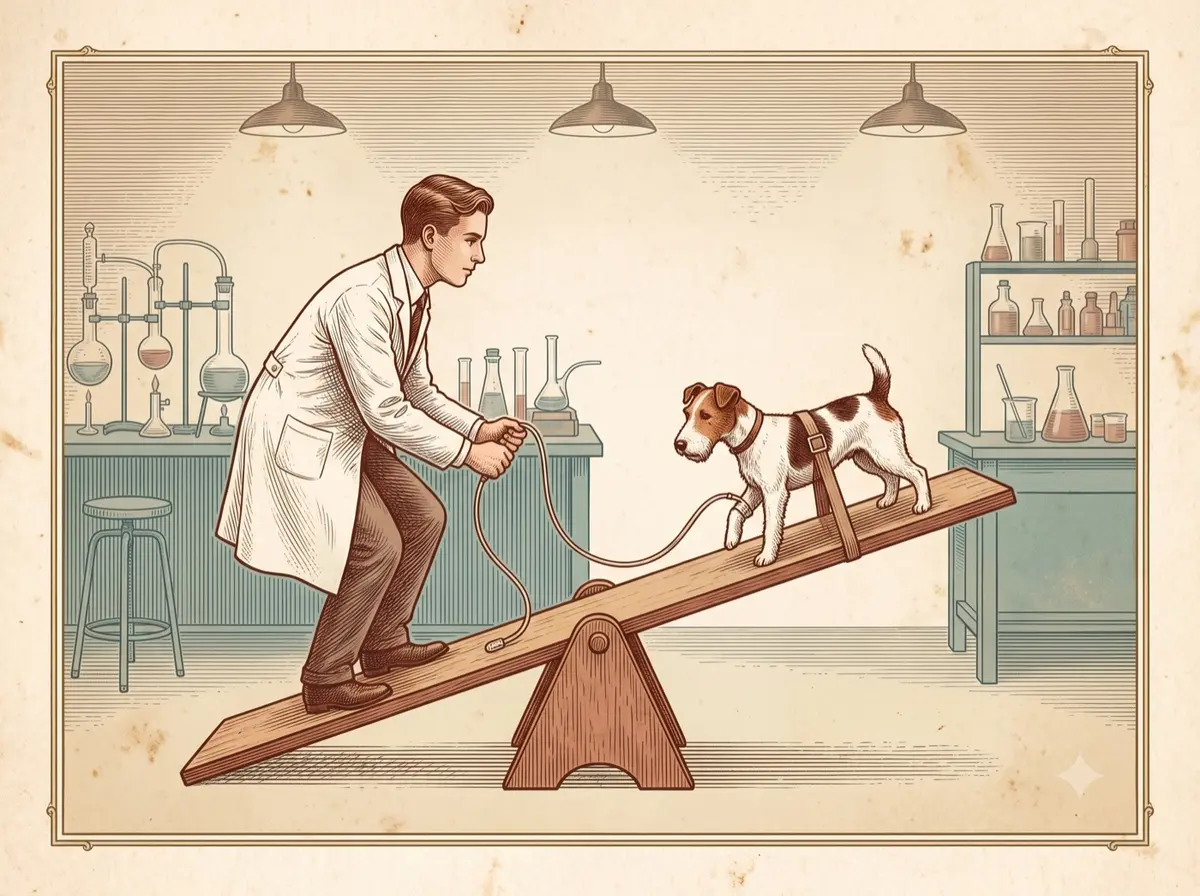
Robert Cornish strapped a dead fox terrier to a wooden seesaw in a University of California lab in March 1934 and started rocking. The dog, asphyxiated with nitrogen gas and ether, had been still for six minutes — dead by every measure the technicians had. Cornish opened a vein. Within minutes the dog gasped. His leg twitched. His heart began to beat again, first feebly, then like a hammer. The lab records listed him as Lazarus II. He was, however briefly, alive again.
By the Curiosities Desk · · 6 min read · Filed under Biology · Today’s round
Part of Built to Do the Impossible
What happened: The Seesaw That Was Built to Raise the Dead
Robert Edwin Cornish was, by most accounts, a genuine prodigy — he graduated from UC Berkeley with honors at 18 and held a doctorate by 22. Around 1932, he became fixated on a single question: if a body had died only minutes earlier, was death actually final, or just a solvable mechanical problem? He reasoned that the biggest obstacle to reviving a freshly dead body wasn’t the heart itself but blood clotting, which choked off circulation before it could restart. His answer was a device that looked almost like a child’s playground toy: a teeterboard, a seesaw-like platform that rocked a body up and down to keep blood moving by gravity while a mixture of adrenaline (to stimulate the heart), heparin (an anticoagulant, to stop clots from forming), and oxygenated saline dripped into a vein.
In 1933, Cornish tried the device on three human corpses — a heart attack victim and two men dead of other causes — with no success. University officials told him to stop experimenting on humans and prove the method on animals first. So he turned to dogs, each one killed with nitrogen gas and — after Cornish and his assistants judged them safely dead — revived on the teeterboard. He named every one of them Lazarus, after the biblical figure raised from the dead.
Time magazine covered the work in a March 1934 article, “Lazarus, Dead & Alive.” Lazarus II survived eight hours and thirteen minutes in an uneasy, whimpering coma before a glucose injection triggered a fatal blood clot. A second terrier, revived the same way, lived five hours before dying again. Cornish kept refining the technique into 1935, and accounts from that period — including a contemporary Modern Mechanix report — describe further dogs, numbered as high as Lazarus V and beyond, that survived for good. Two of them lived, but both were left blind and unsteady, able to eat and bark but never fully themselves again. (Sources disagree on the exact total number of dogs Cornish experimented on — some say five, others describe as many as twenty — a detail lost to inconsistent contemporary press coverage rather than a single documented lab record.)
The stunt-like publicity brought Cornish real trouble: he was let go from his university position amid the controversy. He resurfaced in 1935 playing himself in a Hollywood film, Life Returns, dramatizing the experiments. Then, in 1947, his story took its strangest turn yet. A San Quentin death-row inmate named Thomas McMonigle, awaiting execution for murder, wrote to Cornish offering his body for reanimation after his sentence was carried out. California’s courts refused to allow it — not on the grounds that it wouldn’t work, but because if it did, McMonigle would technically have already served his sentence, and executing a revived man again could violate the constitutional protection against double jeopardy. The petition was denied, and McMonigle was executed in the gas chamber in February 1948. Cornish died in relative obscurity in 1963.
Why it was strange: The Seesaw That Was Built to Raise the Dead
Here was a serious, credentialed scientist pursuing a real hypothesis — that clotting, not the absence of life itself, was resuscitation’s biggest obstacle — using an apparatus that looked like something built for a county fair. National press covered it earnestly rather than as a sideshow. And the story escalated to a genuine constitutional question in a state supreme court: if science could reverse a death sentence, which parts of the law would even still apply? Few stories from the history of biology manage to connect a rocking wooden board to that.
Another invention that refused to stay on paper: The Rose-Colored Glasses Farmers Bought by the Million — for Their Chickens.
What scientists learned: The Seesaw That Was Built to Raise the Dead
Cornish’s central insight — that clot formation, not simply the stopped heart, prevents recovery after clinical death — was scientifically reasonable, and his use of an anticoagulant to address it anticipated real practice. But the teeterboard itself did nothing that a modern reader would recognize as effective circulation support; the dogs that survived did so despite the crude mechanics, not because of them. More importantly, the surviving-but-blind Lazarus dogs delivered a sobering, foundational lesson that resuscitation science still grapples with: restarting a heart does not undo the damage that oxygen-starved brain tissue suffers in the meantime. Reviving the body and recovering the mind turned out to be two very different problems.
Another machine that should not have worked: The Scientist Who Faced a Charging Bull With a Cape in One Hand and a Radio Transmitter in the Other.
How it reaches us today: The Seesaw That Was Built to Raise the Dead
Modern cardiopulmonary resuscitation — chest compressions, rescue breathing, and epinephrine, standardized in the 1960s by researchers including Peter Safar, William Kouwenhoven, and James Jude — replaced the teeterboard with techniques grounded in circulatory physiology rather than showmanship. Anticoagulants like heparin, the same class of drug Cornish used, are now routine in heart surgery and stroke treatment. And the brain-injury problem Cornish stumbled into remains central to emergency medicine’s “time is brain” principle, which drives how quickly hospitals must act after cardiac arrest — as well as ongoing debates in transplant medicine over how, exactly, to define the moment a person has died.
A close cousin: The Giant Space Mirror Russia Built to Turn Night Into Day — and the Antenna That Snagged the Sequel.
FAQ
Who was Robert Cornish?
Robert Edwin Cornish was a University of California scientist who, in the early 1930s, tried to revive the newly dead on a teeterboard. In March 1934 he strapped fox terriers he had asphyxiated — he named them Lazarus — to a wooden seesaw, rocked them, and injected adrenaline and an anticoagulant. Some hearts restarted. The dogs that lived longer were left blind.
What was the seesaw built to raise the dead?
It was Cornish’s teeterboard, a rocking platform meant to keep blood moving by gravity in a body whose heart had just stopped. He tried it on human corpses in 1933 without success, then on dogs. The university let him go amid the publicity. He died in 1963.
Fun fact: The Seesaw That Was Built to Raise the Dead
Cornish wasn’t only in the reanimation business — he also patented special waterproof reading lenses so people could read newspapers while swimming underwater, a considerably less controversial invention.
Sources: The Seesaw That Was Built to Raise the Dead
- “Science: Lazarus, Dead & Alive,” Time, March 26, 1934 — https://time.com/archive/6894500/science-lazarus-dead-alive/
- “Robert E. Cornish,” Wikipedia — https://en.wikipedia.org/wiki/Robert_E._Cornish
- In re McMonigle, 31 Cal.2d 246 (1947), Stanford Law School, Robert Crown Law Library — https://scocal.stanford.edu/opinion/re-mcmonigle-23882
- “History of CPR,” American Heart Association — https://cpr.heart.org/en/resources/history-of-cpr
This article discusses historical animal experimentation and a real capital execution. If any of this is heavy going, it’s worth remembering it primarily as a story about the long, halting road to real emergency medicine.
Related stories: The Seesaw That Was Built to Raise the Dead
- The Rescue Kits That Tried to Revive the Drowning by Blowing Smoke Up Their Backsides — Rescue kits that revived drowning victims with tobacco smoke enemas
- The Chicken That Lived 18 Months After Losing His Head — A rooster that lived 18 months after losing his head
- The Two Vacuum Cleaners That Learned to Breathe — Two vacuum cleaners became the first iron lung