Impossible Inventions · Biology
The Scientist Who Faced a Charging Bull With a Cape in One Hand and a Radio Transmitter in the Other
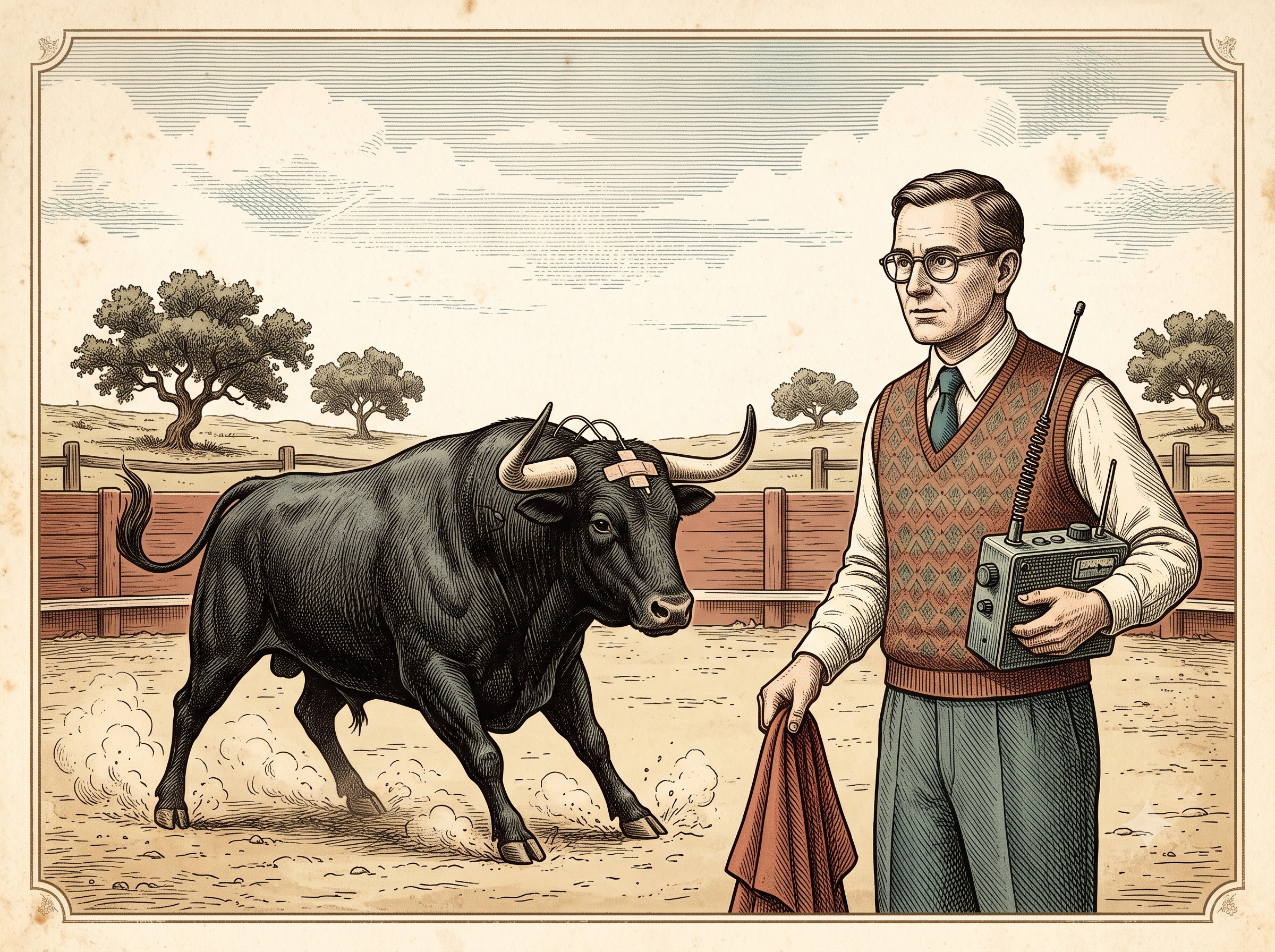
The bull came out at a run, and the man waiting for it was not a matador. He was a Yale physiologist in a sweater and tie, holding a cape in one hand and a metal box the size of a paperback in the other. When the horns were three meters away, he pressed a button — and the bull skidded to a halt in a cloud of dust, lifted its head, and simply stood there.
By the Curiosities Desk · · 5 min read · Filed under Biology · Today’s round
What happened?
The man was José Manuel Rodríguez Delgado, born in Ronda in 1915 and by the 1960s a professor of physiology at Yale. He had spent two decades building small radio devices he called “stimoceivers”: electrodes implanted in a brain, wired to a miniature receiver that could record activity and deliver tiny electrical pulses on command, with no cable trailing out of the animal’s head. In an era of vacuum tubes, that was startling hardware.
Delgado wanted to know where aggression lives in the brain. After cats, rhesus monkeys, gibbons and chimpanzees, he went looking for the most aggressive animal he could find, and found it in his own country: the Spanish fighting bull, bred for centuries to be fast, strong, and willing to charge.
In 1964, on a ranch called La Alamirilla outside Córdoba, he ran the experiment. (Many retellings date it to 1963; Delgado’s own later account says 1964.) Ranch hands assisted, and so, in at least one surviving photograph, did the celebrity bullfighter El Cordobés.
Each bull was darted with a compressed-air tranquilizer gun loaded with Sernylan — phencyclidine, better known now as PCP — and within about fifteen minutes was calm enough to approach. The team opened a two-centimeter hole in each side of the skull with a hand trepanning tool, clamped the head into a frame that let them aim instruments at precise coordinates inside it, and lowered in bundles of hair-thin stainless steel wire. Some animals ended up with 28 electrodes in their heads. There was, at the time, no published atlas of the bull brain to aim at. They were working, Delgado wrote, “below the Andalusian sky accompanied with cowboys and foremen, moreover with songs of birds and distant mooing.”
Trials began days later. Current into the left caudate nucleus — a deep brain structure involved in movement and motivation — made a bull named Cayetano turn his head left, then walk in slow circles; stimulate the right side and he circled right. He seemed, Delgado wrote, “surprised in its own conduct, but not irritated.”
The second bull, Lucero, made the newspapers. He still charged with enthusiasm after surgery, and when Delgado pressed the button mid-charge, Lucero stopped — not staggering, not falling, just stopping, blinking and breathing normally. Delgado would back behind a wooden barrier, release the button, and Lucero would charge again and ram it.
Delgado took the cape himself, on purpose. His ability with it, he wrote, “had been tested sometimes in the rural festivals of my youth and is limited, but an investigator must accept the responsibility of his own methodology.” His heart, he admitted, beat “with greater violence than I desired.” Once the transmitter failed and the bull reached him — “fortunately without more consequence than a good scare.”
On May 17, 1965, The New York Times put it on the front page: “‘Matador’ With a Radio Stops Wired Bull.”
Why was it strange?
The strangest part is what Delgado never did next: publish it. For an experiment shown in neuroscience lecture halls for sixty years, there is no formal paper — no count of how many bulls were implanted, no circuit diagrams, no post-mortem check of where the electrodes ended up. The fullest account he ever wrote appeared in 1981, in Spanish, as an invited chapter in a nine-volume encyclopedia of bullfighting — so obscure that curious neuroscientists had to hunt it down through rare-book dealers. It was translated into English only in 2017.
The most famous demonstration in the history of brain stimulation survives in the scientific record mostly as a photograph.
Another machine that should not have worked: The Rose-Colored Glasses Farmers Bought by the Million — for Their Chickens.
What did scientists learn?
Something real happened in that ring. Current delivered to the caudate nucleus and thalamus reliably changed what a large, motivated animal did with its body. That much isn’t disputed.
What it meant is. Delgado’s own careful phrasing was that the stop came from “a combination of motor effect, forcing the bull to stop and turn to one side, plus behavioral inhibition of the aggressive drive.” The headlines dropped the first half and reported that he had switched off aggression.
Critics pushed back. The psychologist Elliot Valenstein argued that stimulating the caudate would most likely interrupt movement in general rather than aggression specifically — the bull might have been just as furious and simply unable to run. Cayetano, stimulated in the same region, hadn’t turned peaceful; he had walked in circles. In 2005 a group of physicians reviewing the history of psychosurgery dismissed the demonstration as “a famous publicity stunt.”
Underneath sits a problem neuroscientists still wrestle with: if you interrupt a punch, have you removed the anger or only the punch? Telling the two apart needs measurements Delgado never took — heart rate, blood pressure, other signs of arousal — from a freely moving bull. He conceded the effect varied from animal to animal.
Another invention that refused to stay on paper: The Seesaw That Was Built to Raise the Dead.
How does it affect us today?
The core idea outlived the controversy. It became deep brain stimulation: implanted electrodes delivering steady pulses to targets like the subthalamic nucleus to calm the tremor and rigidity of Parkinson’s disease. It is standard neurosurgical practice now, also used for essential tremor, dystonia and some epilepsy, with recent reviews estimating well over 200,000 people implanted worldwide. Cochlear implants, spinal cord stimulators and today’s brain–computer interfaces rest on the same bet Delgado made: that the nervous system speaks electricity, and can be spoken to.
His reputation went the other way. His 1969 book Physical Control of the Mind: Toward a Psychocivilized Society — written by a man who had lived through the Spanish Civil War, spent months in a Franco prison camp, and hoped brain science might reduce human violence — landed in an America growing suspicious of government mind control. He insisted stimulation could never implant a thought. It didn’t help. He returned to Spain in the 1970s and died in San Diego in 2011, at 96.
A close cousin: The Rocket-Powered Wheel That Chased Britain’s Admirals Into Barbed Wire.
Fun fact
The loudest objection came not from neuroscientists but from bullfighting purists, who accused Delgado of “placing a bomb at the fundamental pillars of bullfighting” — worried that matadors might secretly implant bulls to guarantee a good afternoon. He patiently explained why the cheat was impossible: it took a team of specialists, the effect was unreliable from bull to bull, and, decisively, you could not hide the electronics, which sat in a bandage taped to the animal’s horns.
Sources
- Timothy C. Marzullo, “The Missing Manuscript of Dr. Jose Delgado’s Radio Controlled Bulls,” Journal of Undergraduate Neuroscience Education 15(2): R29–R35 (2017) — translates and analyzes Delgado’s own 1981 Spanish account, the fullest primary description of the experiment.
- José M. R. Delgado, “Toros Radiodirigidos: Una experiencia científica con el toro de lidia,” in José María de Cossío, Los toros: tratado técnico e histórico, vol. 7 (Madrid: Espasa-Calpe, 1981) — the primary source, reproduced as supplementary material to Marzullo (2017).
- John A. Osmundsen, “‘Matador’ With a Radio Stops Wired Bull,” The New York Times, May 17, 1965, pp. 1, 20 (archived).
- Stephan Schleim, “Neurorights in History: A Contemporary Review of José M. R. Delgado’s ‘Physical Control of the Mind’ (1969) and Elliot S. Valenstein’s ‘Brain Control’ (1973),” Frontiers in Human Neuroscience 15 (2021).
- Jack El-Hai, “The Man Who Fought a Bull With Mind Control,” Discover, March 21, 2016.