Impossible Inventions · Biology
The Rose-Colored Glasses Farmers Bought by the Million — for Their Chickens
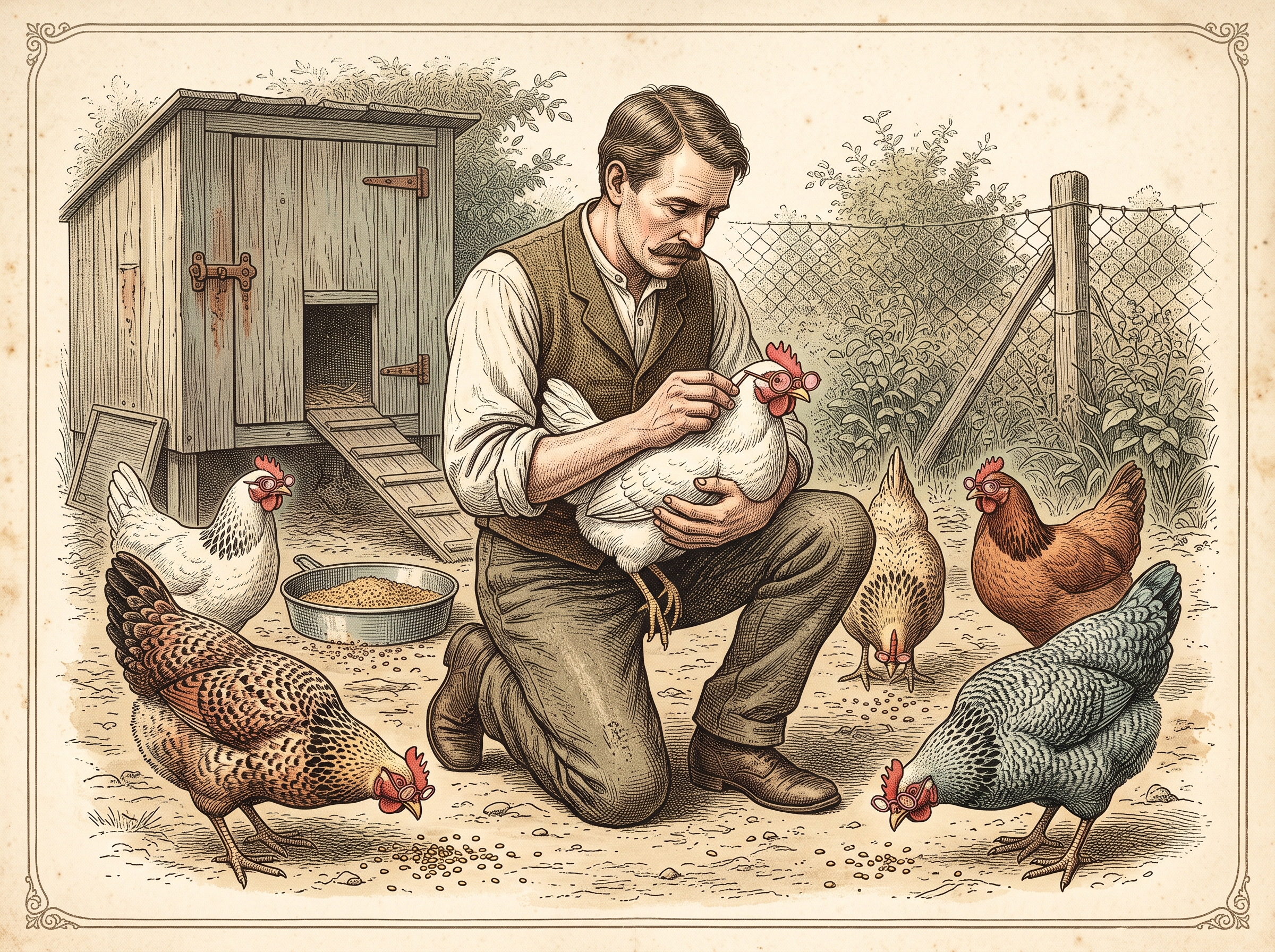
On January 16, 1955, a businessman named Sam Nadler sat down on the CBS game show *What's My Line?* and stumped a celebrity panel trying to guess his job. The answer: he sold eyeglasses for chickens. Tiny ones, often with rose-tinted lenses, perched on the beak. And according to Nadler, his company was moving two to three million pairs a year.
By the Curiosities Desk · · 5 min read · Filed under Biology · Today’s round
What happened?
The story starts with a problem every poultry keeper knew too well. Hens kept close together peck at one another, and the pecking can escalate from feathers to skin to outright cannibalism. Once a bird is bleeding, the others tend to pile on. For farmers, that meant injured birds, dead birds, and lost eggs.
In 1902, Andrew Jackson Jr. of Munich, Tennessee, filed a patent for a solution. U.S. Patent 730,918, granted on June 16, 1903, describes an “eye-protector for chickens”: two small frames holding curved, transparent lenses of glass or mica, joined by a band and kept in place with a strap. The goal, in the patent’s words, was that a fowl “may be protected from other fowls that might attempt to peck them.” The National Archives later picked it as the very first entry in its “Patent of the Month” feature.
Jackson’s version guarded the eyes, but the idea quickly evolved. By the early 1900s, chicken “specs” were being mass-produced and sold through farm-supply stores and catalogs for a few cents each. Many designs were really blinders: opaque panels that blocked a hen’s forward view, so she couldn’t take careful aim at her neighbor. They were often held on by a pin pushed through the nostril openings on the top of the beak.
Then came the color. In 1939, the National Band & Tag Company — a Newport, Kentucky, firm that Joseph Haas started in 1902 by stamping identification leg bands for chickens — introduced glasses with red lenses, reportedly sold under the name “Anti-Pix.” The logic: if hens couldn’t see blood, they wouldn’t be drawn to peck at wounds. The lenses were hinged, so they swung up when a hen lowered her head to eat and dropped back into place when she looked up.
The idea had a surprisingly long life. A 1953 newspaper story described “sunglasses for chicken” bought at a local store. In 1973, an Illinois farmer reportedly fitted 8,000 hens with rose-colored glasses. And in the 1960s, a Seattle poultry-supply salesman named Don Van der Giessen took the concept one step further: red contact lenses for chickens. He later told The Seattle Times that about 1.25 million pairs sold before trouble set in. As the hens grew, the lenses popped out, and farmers found them scattered through the manure.
Van der Giessen wasn’t the last to try. In 1990, a Massachusetts company called Animalens received a patent for a redesigned, red-tinted hen contact lens meant to curb pecking and stay put better than earlier versions.
Why was it strange?
Start with the image itself: rows of hens wearing tiny spectacles, like a flock of librarians. It sounds like a cartoon, yet it was a real product line, patented, catalogued, and sold by the million.
The deeper strangeness is that the rose-colored version rested on a guess about how chickens see. It assumed that a red filter would make blood disappear. Even the industry wasn’t sure. Elmer Haas of National Band & Tag later called the blood-hiding effect a myth, telling a reporter in 1980 that the firm added rose lenses because it “indulged the chicken owners.” In other words, the color may have been chosen partly to reassure the humans.
Another machine that should not have worked: The Scientist Who Faced a Charging Bull With a Cape in One Hand and a Radio Transmitter in the Other.
What did scientists learn?
Chickens, it turns out, see color very well, possibly better than we do. A 1999 study in the Journal of Experimental Biology tested how domestic chicks tell colors apart. Birds have four types of color-sensing cone cells, compared with our three, and the extra type is tuned to ultraviolet light. A tinted lens doesn’t simply delete red from a hen’s world. It changes the picture in ways no 1930s farmer could have predicted.
The pecking itself turned out to be a richer subject than it first appeared. In the early 1920s, the Norwegian zoologist Thorleif Schjelderup-Ebbe watched hens closely and described what he called the “pecking order”: a social ranking in which each bird knows whom it may peck and whom it must avoid. Later research on feather pecking found that much of it isn’t aggression at all. It’s often foraging behavior gone astray — hens with nothing to scratch at may redirect that urge onto their neighbors’ feathers. Crowding, boredom, and diet all play a role.
That reframes the glasses. They treated the symptom, a hen’s line of sight, rather than the conditions that made her peck in the first place.
Another invention that refused to stay on paper: The Seesaw That Was Built to Raise the Dead.
How does it affect us today?
The problem chicken glasses tried to solve hasn’t gone away. Today the most common answer in commercial egg farming is beak trimming, which removes the sharp tip of a young chick’s beak and is itself debated on welfare grounds. Researchers and farmers also use dimmer lighting, more space, perches, and loose material for scratching to reduce pecking at its source.
As for the glasses, several countries have moved against them. The United Kingdom restricts devices fitted by piercing the nasal septum, and Switzerland has banned glasses and contact lenses for poultry outright since 2008. National Band & Tag stopped making its tinted sunglasses long ago, though it still sells pinless plastic “peepers” that clip onto the beak.
What survives most vividly is the idea itself: a reminder that the path to understanding animal behavior sometimes ran straight through the farm-supply catalog.
A close cousin: The Head-Bump Machine That Printed Your Personality on Ticker Tape.
Fun fact
When the director of What’s My Line? was asked in 1958 to name the most unusual occupation in the show’s eight seasons, his pick was the man who sold eyeglasses for chickens.
Sources
- U.S. Patent 730,918, Andrew Jackson Jr., “Eye-Protector for Chickens” (1903): https://patents.google.com/patent/US730918A/en
- National Archives, “Patent of the Month” (AOTUS blog, 2013): https://aotus.blogs.archives.gov/2013/10/24/patent-of-the-month/
- National Band & Tag Company, company history: https://www.nationalband.com/?p=18697
- Don Hannula, “You Kidding? Contact Lens for Chickens?” The Seattle Times (1990): https://archive.seattletimes.com/archive/19900801/1085513/you-kidding-contact-lens-for-chickens
- Osorio, Vorobyev & Jones, “Colour vision of domestic chicks,” Journal of Experimental Biology 202 (1999): https://doi.org/10.1242/jeb.202.21.2951