Impossible Inventions · Biology
The Pigeons a Pharmacist Fitted With Tiny Cameras — and the Patent Office Said It Was Impossible
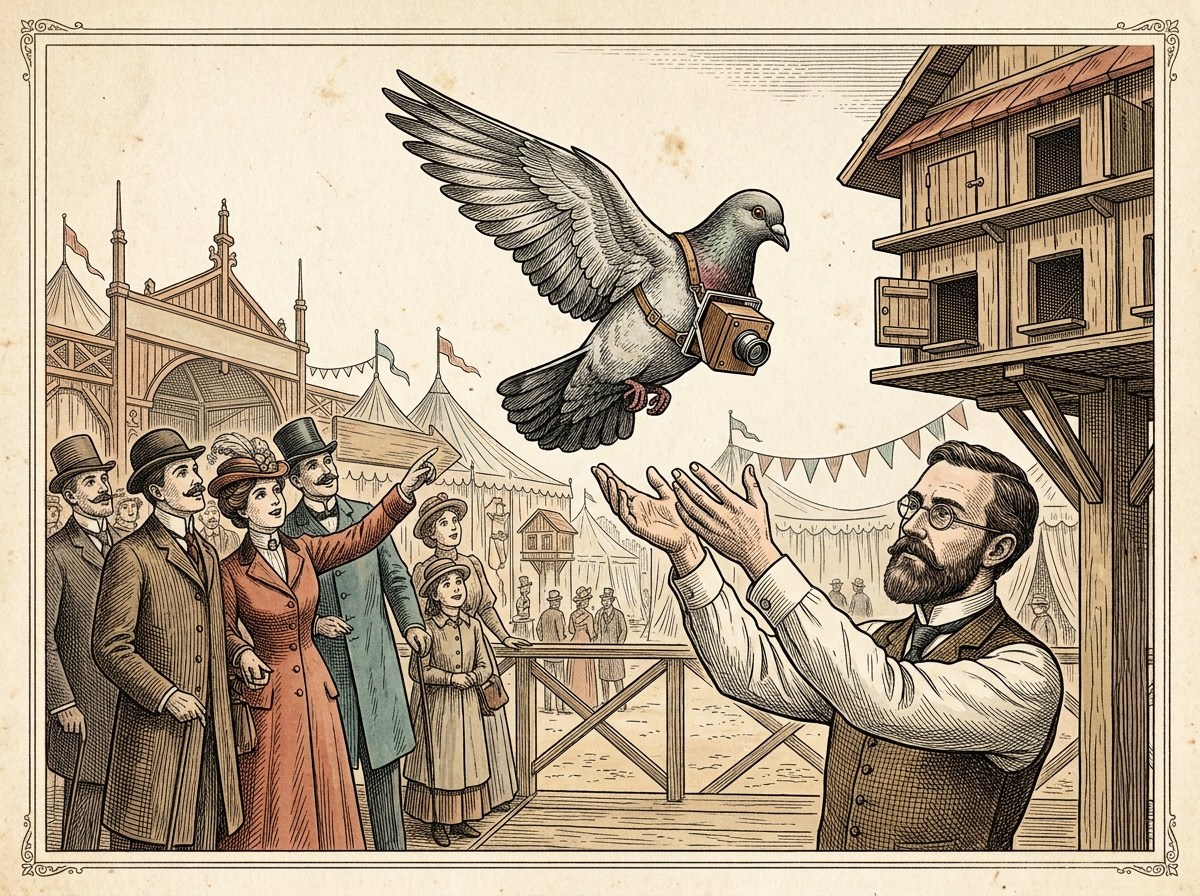
Dresden, 1909. A crowd at a photography exhibition watches the sky, waiting for the photographers to come home. When they arrive, they land on a dovecote. Each one is a homing pigeon wearing a tiny wooden camera strapped to its chest, and minutes later the pictures they took over the city are being developed and sold as postcards. The man behind the birds wasn't a soldier or an aviator. He was a small-town pharmacist named Julius Neubronner.
By the Curiosities Desk · · 5 min read · Filed under Biology · Today’s round
What happened?
Julius Neubronner was born on February 8, 1852, in Kronberg im Taunus, a town in the hills outside Frankfurt, Germany. Pharmacy ran in the family: his grandfather took over the local apothecary in 1808, his father Wilhelm ran it after him, and Julius inherited it in 1886. So did a habit. Decades earlier, Wilhelm had used carrier pigeons to receive prescriptions, a practice he dropped once neighboring villages got their own pharmacies.
Around 1903, Julius revived the idea. His pigeons flew prescriptions and urgent medicines between his shop and a tuberculosis sanatorium in nearby Falkenstein, and fetched rush orders of chemicals, up to about 75 grams at a time, from his wholesaler in Frankfurt. Homing pigeons don’t deliver to an address. They fly home, carrying whatever you’ve tied to them.
Then one pigeon got lost in the fog. It turned up four weeks late, healthy and well-fed. According to the account usually told, it had spent the missing month with a restaurant chef in Wiesbaden. Neubronner, who had been an amateur photographer since he was a teenager, started wondering where his birds actually went. The obvious way to find out, at least to him, was to give them a camera.
After testing a small “Ticka” watch camera on a train and a sled, he built his own. His cameras were made of wood and weighed roughly 30 to 75 grams. Each one sat in an aluminum frame shaped to the pigeon’s body and was held on by a light harness. The clever part was the timer. A small rubber ball was pumped up with air, and as the air slowly leaked out, it released the shutter. Neubronner worked out how long the flight home would take, let out some of the air to set the delay, and released the bird. If his math was right, the camera fired somewhere over the target.
In June 1907 he applied for a German patent. The patent office turned him down. Its reason, roughly: a pigeon can’t carry that much weight, so the invention couldn’t work. Neubronner answered the way any photographer would. He sent in photographs that his pigeons had taken, with proof of how they’d been made. The patent, DE 204721, was granted in December 1908, and he later obtained patents in France, Britain, and Austria too.
Then came the showmanship. At the 1909 Dresden International Photographic Exhibition, visitors watched the camera pigeons land and bought their photos as postcards. That same year, at an aviation exhibition in Frankfurt, he showed a horse-drawn carriage that combined a dovecote with a darkroom. His pigeon pictures won prizes at the Paris air shows in 1910 and 1911.
Why was it strange?
Here was an official body declaring an invention impossible on the basis of a fact about biology, and being wrong about the biology. A trained homing pigeon could carry the camera. The patent office was rejecting a working device, and it took pictures from the device itself to change its mind.
The photos were odd in their own way, too. Pilots of the era photographed from a fixed seat, at least in theory under control. A pigeon chose its own route, height, and angle. Some of Neubronner’s pictures are tilted. A few show the tips of the bird’s own wings at the edges of the frame. They’re among the earliest photos ever taken from the air, and the photographer had no idea it was taking them. For another bird recruited into a job it never applied for, see The Bomb Three Pigeons Were Trained to Steer.
What did scientists learn?
The experiment worked because of a skill biologists still don’t fully understand: homing. Homing pigeons can find their way back to their loft from distances of dozens of miles or more, apparently using a mix of cues that may include the sun’s position, Earth’s magnetic field, familiar landmarks, and possibly smells. Neubronner didn’t need to explain it, only to rely on it.
He also learned the practical limits of a pigeon as a camera platform. The bird had to be released from somewhere specific so it would cross the target on the way home. That turned out to matter to the military. The Prussian War Ministry was interested but skeptical, so Neubronner trained young pigeons to return to a mobile dovecote that could be moved behind the lines. In 1912 he passed a test the ministry had set him: photographing the Tegel waterworks near Berlin using only the mobile loft. A deal was reportedly close when World War I began in 1914. His pigeons were tested at the front, but airplanes were improving fast, and after the war the ministry concluded the method had no real military value. For another flock that proved more useful than expected, see The Pigeons Trained to Spot Breast Cancer — and the Flock That Got It Right 99% of the Time.
How does it affect us today?
The idea outlived its inventor. Decades later, the CIA’s Office of Research and Development built its own pigeon camera, a battery-powered model under five centimeters long that snapped a series of photos at set intervals. According to the CIA Museum, it ran into the same problem Neubronner faced: getting the birds to fly over exactly the right spot.
A more peaceful descendant lives in biology. Researchers now attach small cameras to animals, from seals to seabirds, to see what they see. In a 2009 study, a camera on a black-browed albatross caught it foraging in the company of a killer whale. The core trick is Neubronner’s: let the animal go where it wants and let the camera record the trip. Neubronner’s story belongs with the others in The Animals Hired for a Job.
Fun fact
The most famous accident was a photo of the Schlosshotel Kronberg with the pigeon’s wingtips poking into the frame. In 1929 it turned up in German cinema newsreels, used without Neubronner’s permission. The pigeon got no credit either.
Sources
- Julius Neubronner, German patent DE 204721, “Verfahren und Vorrichtung zum Photographieren von Geländeabschnitten aus der Vogelperspektive” (filed June 20, 1907) — the original patent, describing the aluminum body frame and the slow-leaking rubber-ball timer.
- The Public Domain Review, “Dr Julius Neubronner’s Miniature Pigeon Camera” — the lost pigeon, the patent office’s objection, the Dresden postcards, and a gallery of the original photos.
- CIA Museum, “Pigeon Camera” — the agency’s later pigeon camera and why it fell short.
- Sakamoto et al., “From the Eye of the Albatrosses: A Bird-Borne Camera Shows an Association between Albatrosses and a Killer Whale in the Southern Ocean”, PLOS ONE (2009) — modern animal-borne camera research.
- “Pigeon photography” and “Julius Neubronner”, Wikipedia — used as guides to dates and the military trials, following their citations to Neubronner’s own 55 Jahre Liebhaberphotograph (1920) and Franziska Brons, “Bilder im Fluge,” Fotogeschichte (2006).