Accidental Discoveries · Medicine
The Farmer Who Drove Through a Blizzard With a Dead Cow and a Milk Can of Blood
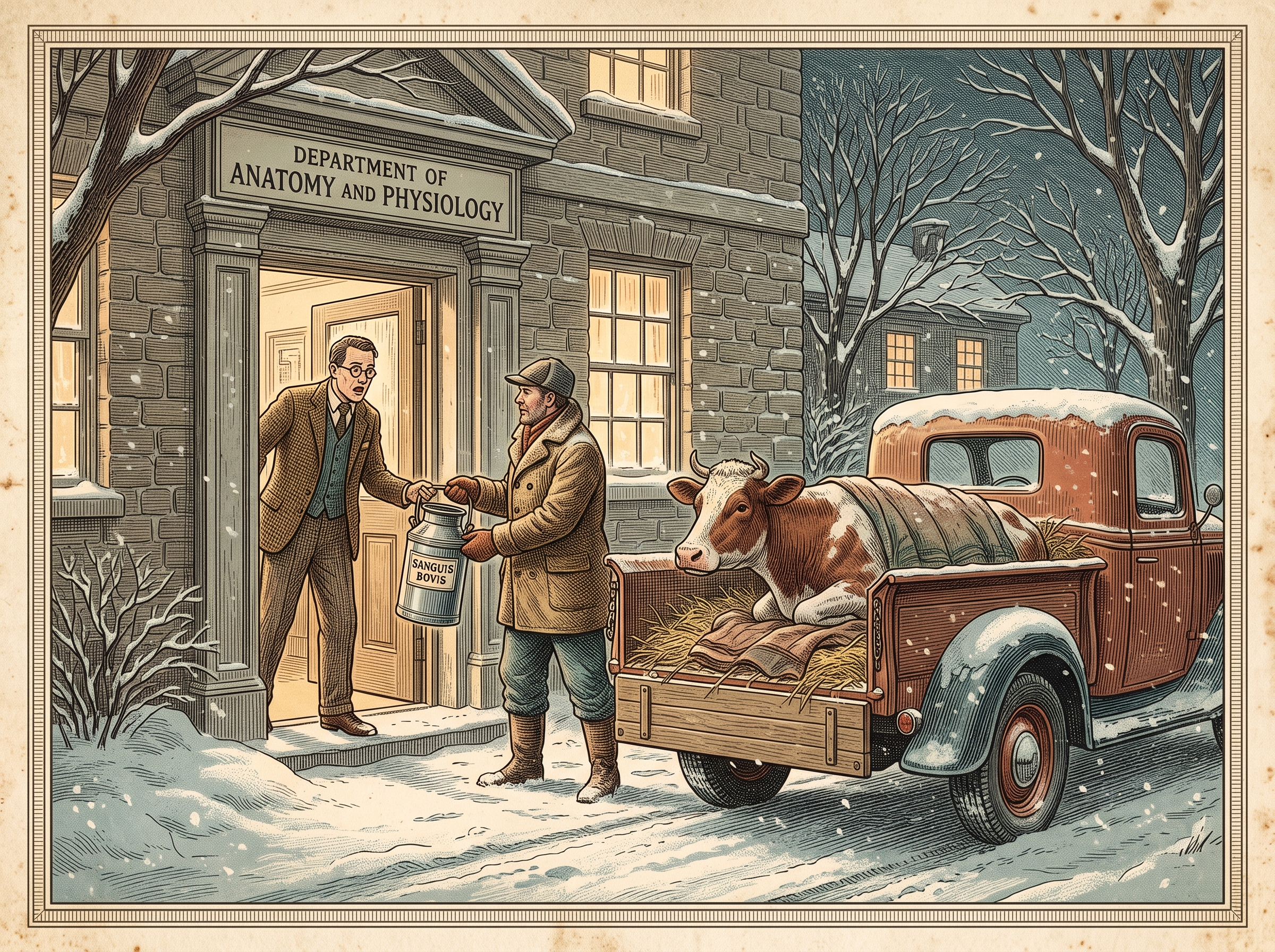
On a Saturday afternoon in February 1933, with the temperature near zero and a blizzard coming down over Wisconsin, a farmer named Ed Carlson pulled up outside a university building in Madison. In the back of his truck was a dead heifer, about a hundred pounds of spoiled hay, and a milk can full of his cow's blood — blood that, hours after leaving the animal, still would not clot. He had driven roughly 190 miles to show someone. He was in the wrong building.
By the Curiosities Desk · · 5 min read · Filed under Medicine · Today’s round
What happened?
Carlson farmed near Deer Park, in St. Croix County, and his herd was bleeding to death. Two young heifers had died in late December. In January, one of his favorite older cows developed a huge swelling on her thigh and bled out fast after her skin was punctured. On the Friday before his drive, two more young cows died and the bull started oozing blood from his nose. A veterinarian blamed the sweet clover hay. Carlson didn’t buy it — he had fed sweet clover for years without trouble — so he was told to take his case to the state Agricultural Experiment Station.
By the time he reached Madison, the state veterinarian’s office had closed for the weekend. Pure chance walked him into the Biochemistry Building instead, and into the lab of Karl Paul Link, a carbohydrate chemist with a taste for flannel shirts, capes, and picking fights with university administrators.
Link had to send him home nearly empty-handed. All he could offer was the existing advice: stop feeding the spoiled hay, and try transfusing the sick animals. Two veterinarians — Frank Schofield in Ontario and L. M. Roderick in North Dakota — had worked out in the early 1920s that “hemorrhagic sweet clover disease” struck cattle fed moldy hay. Nobody knew what the poison actually was. And in the depths of the Depression, telling a farmer to throw away the only hay he had was not really advice at all.
Link recalled that after Carlson left, his senior student Eugen Wilhelm Schoeffel paced the lab in fury, dipping his hands into the milk can and shouting that there was no clot in that blood. That scene deserves a caveat. Link told it publicly in 1959, twenty-six years after the fact, and his colleague Robert Burris later noted that “the distance the farmer traveled has increased with the years.” Other students in the lab said they never heard the dramatic version at all. The trip itself, and its effect on Link, are not in doubt.
Link turned his lab loose on the hay. Five years of extraction, concentration, and rabbit bioassays followed. On the night of June 28, 1939, graduate student Harold Campbell isolated six milligrams of a pure crystalline anticoagulant. Mark Stahmann and Charles Huebner — working with oak barrels and spoiled hay stored in the campus horse barn — produced enough to determine the structure, and on April Fools’ Day 1940 they set out to build it from scratch. Three days later they had it. The compound, later named dicumarol, was 3,3′-methylenebis(4-hydroxycoumarin). Molds had been converting the coumarin in sweet clover into something that quietly switched off an animal’s ability to clot.
Link’s lab went on to make more than a hundred variations. One of them, analog number 42, killed rats with unusual efficiency. Link thought it was too toxic to be worth patenting. Stahmann disagreed, and pushed the paperwork through the Wisconsin Alumni Research Foundation with 23 days to spare before the patent window closed. Analog 42 went on sale as rat poison in 1948.
Why was it strange?
The strange part is the direction of travel. This is not a story about a lab that set out to design a drug. It is a story about a broke dairy farmer hauling a corpse through a snowstorm to a chemistry building he wasn’t looking for, and a chemist who happened to be working late.
Then it gets stranger. The compound was so good at making mammals bleed that it became the world’s leading rodenticide — and that reputation is exactly what kept doctors from testing it. In 1950 Link urged hematologists to try analog 42 in patients. They refused. It was rat poison.
What changed their minds was a case nobody planned. In April 1951, a 22-year-old U.S. Navy inductee was admitted to a naval hospital in Philadelphia after swallowing repeated doses of the rodenticide in an attempt to end his life. Transfusions and vitamin K brought him through, and he recovered fully. His survival proved what no animal study had: the effect was reversible, and the antidote already sat in every hospital. Trials followed. The FDA approved the drug for human use in 1954, and when President Eisenhower had a heart attack in 1955 he was put on an anticoagulant from Link’s lab — accounts differ on whether it was dicumarol or its more potent cousin.
Another accident worth keeping: The Failed Heart Pill That Trial Volunteers Wouldn’t Give Back.
What did scientists learn?
The mechanism took decades longer to pin down. Blood clotting runs on a cascade of about thirty proteins, several of which can’t be switched on without vitamin K. The vitamin gets chemically used up doing that job, then recycled by an enzyme now called VKORC1 (vitamin K epoxide reductase complex subunit 1). Warfarin blocks the recycling. The vitamin K is still there; the body just can’t restore it to working form fast enough, so the clotting factors go out of service one by one.
That explains the rest of the drug’s behavior: why the effect takes days to appear, why a dose of vitamin K reverses it, and why a plate of spinach can undo a carefully tuned prescription.
Another time the mistake was the invention: The Moldy Petri Dish That Almost Got Thrown Away.
How does it affect us today?
Analog 42 is warfarin, and it is still one of the most prescribed medicines in the world, given to prevent strokes and clots in people with atrial fibrillation, mechanical heart valves, and deep vein thrombosis. It also remains a common rat poison — same molecule, same mechanism, wildly different intent. Rats have been fighting back: populations across Europe and North America now carry VKORC1 mutations that blunt warfarin’s effect, a textbook case of evolution on human timescales.
Warfarin has never been an easy drug. The right dose varies enormously between people, and too much causes serious bleeding, so newer anticoagulants have taken over much of its market. But most of them act on the same clotting cascade Link’s students mapped while trying to work out why a Wisconsin farmer’s cows were dying.
A close cousin: The Wrong Resistor That Grabbed a Heartbeat Out of Thin Air.
Fun fact
Warfarin is named after a patent office. Link’s research was funded by the Wisconsin Alumni Research Foundation, so analog 42 became WARF plus -arin, from coumarin. One of the most widely prescribed drugs on Earth is, essentially, a university licensing department with a chemical suffix stapled on.
This article mentions a suicide attempt. If you’re struggling, talking to a doctor or a crisis line can help — and I’m happy to point you toward resources if you’d like them.
Sources
- Karl Paul Link, “The Discovery of Dicumarol and Its Sequels,” Circulation 19, no. 1 (1959): 97–107. Link’s own first-person account, including the Carlson visit.
- Robert H. Burris, “Karl Paul Link, 1901–1978,” Biographical Memoirs, National Academy of Sciences (1994). Includes Link’s April 1940 letter to the dean documenting the isolation and synthesis, and a skeptical read of Link’s later retellings.
- “Hemorrhagic Sweet Clover Disease, Dicumarol, and Warfarin: the Work of Karl Paul Link,” JBC Classics, Journal of Biological Chemistry.
- Ramya Rajagopalan, “A Study in Scarlet,” Distillations, Science History Institute (2018).
- “The Winding Story of Warfarin: Saint Croix County Impact,” Wisconsin Alumni Association (2017).