Strange Animals Scientists Studied · Biology
The Stork That Came Home With an African Spear Through Its Neck
In the summer of 1822, on an estate near the little Baltic town of Klütz, someone looked up at a white stork and saw something that should not have been there. A wooden spear roughly two and a half feet long was driven clean through the bird's neck — entering low on one side, the shaft jutting out the other like a badly aimed skewer. The stork was alive. It was standing there, apparently getting on with its day. And the spear was not German.
By the Curiosities Desk · · 5 min read · Filed under Biology · Today’s round
Part of Creatures That Changed Science
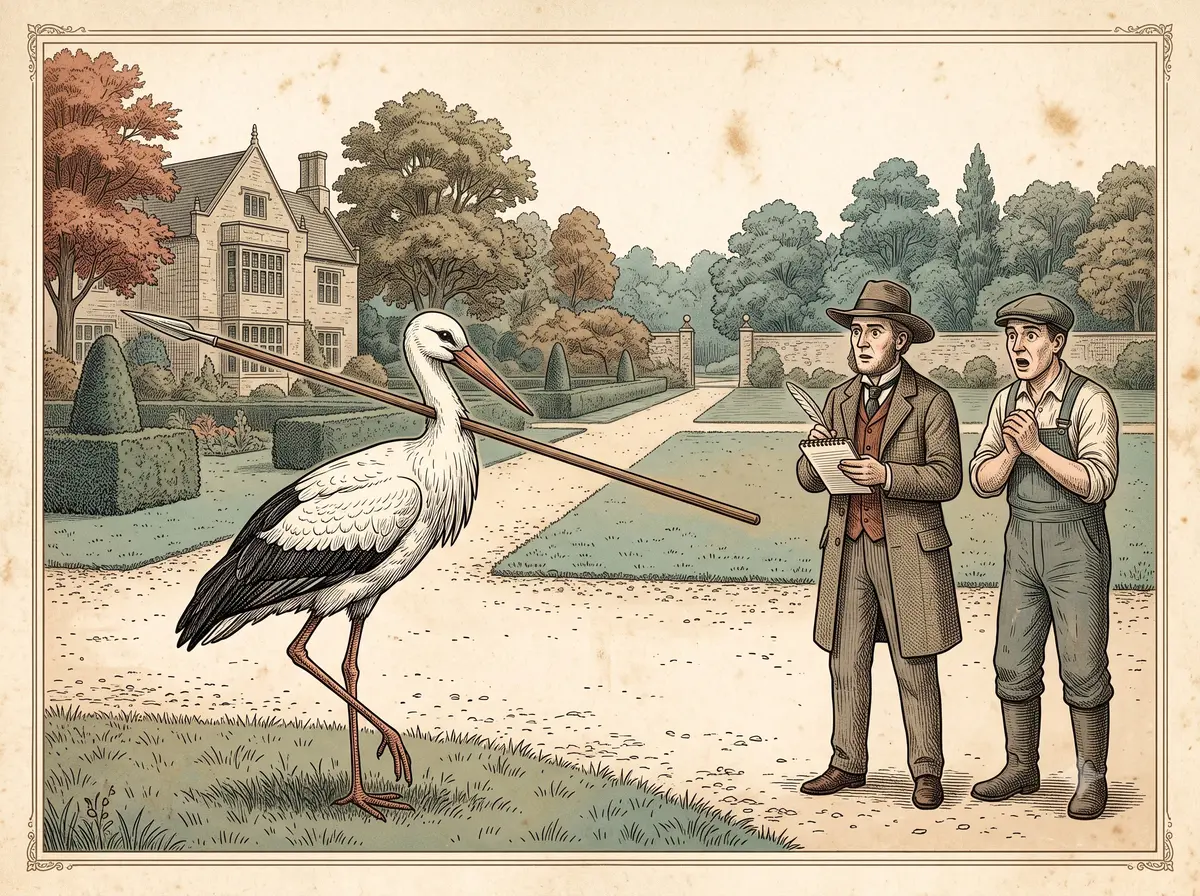
What happened: A Pfeilstorch
The bird was shot down and examined, and the examination is where the story turns from grisly to extraordinary. The shaft was made of a fine-grained tropical hardwood that grew nowhere in northern Europe. The tip was iron, lashed to the wood with animal sinew in a style that matched hunting weapons from Africa — later assessments pointed toward central Africa and the upper Nile region, in what is now Sudan. Nobody in Mecklenburg made spears like that. Nobody in Mecklenburg had ever seen one.
Which left exactly one explanation. Some hunter, thousands of miles away, had thrown that spear at a large white bird, hit it, and watched it fly off. The wound had healed around the shaft. Then, months later, the same bird had crossed a desert, a sea, and most of a continent to land back in the same north German countryside it had left the previous autumn — still carrying the evidence.
The specimen was stuffed and kept. It is still there: the Rostocker Pfeilstorch — German for “arrow stork” — in the zoological collection of the University of Rostock, a collection founded in 1775 and now among the oldest in Germany. The stork stands in a case with the spear exactly where it was, which remains one of the more arresting things you can encounter in a university hallway.
To understand why this mattered so much, you have to appreciate how genuinely baffling autumn was to European naturalists. Every year the storks and the swallows vanished. Every spring they came back. Where they went in between was an open question that had been open for two thousand years, and the answers on the table were remarkable.
Aristotle, writing in the fourth century BCE, noticed that redstarts disappeared from Greece right as robins appeared, and recorded the idea that the birds were transmuting — one species physically becoming another for the winter. He also reported that some swallows hid in hollow trees. (In fairness to Aristotle, he often flagged these accounts as things people said, and sometimes listed the arguments against them; later readers were less careful.) In 1555 the Swedish bishop Olaus Magnus wrote that swallows spent the winter balled up in the mud at the bottom of lakes and rivers, and fishermen occasionally hauled them up in nets. That idea had staying power. In the 1680s the English minister Charles Morton rejected underwater hibernation on the sensible grounds that birds need to breathe — and proposed instead that they flew to the Moon, a journey he estimated at about sixty days.
None of these people were fools. They were reasoning carefully from the evidence they had, which was: the birds are here, then they are not, then they are here again. The one thing nobody could produce was proof that an individual bird had gone somewhere specific and come back.
The spear was proof.
Why it was strange: A Pfeilstorch
The strangeness runs in two directions.
The first is the sheer improbability of the object. For this evidence to exist, a spear had to be thrown hard enough to pass through a stork’s neck without severing anything the bird needed, the wound had to heal around a foreign body the length of your forearm, and the bird then had to complete a migration of several thousand miles carrying it. Storks flying that route cross the Sahara. This one did it wearing a spear.
The second is what it says about how science actually gets its answers. Bird migration was not solved by a clever experiment or a brilliant theorist. It was solved by an accident of ballistics — a hunter’s miss, in a place no European naturalist had ever connected to a German rooftop, arriving as a physical message that could not be argued with. Two millennia of speculation ended because one bird was unlucky, and then very lucky.
Another creature that ended up in the notes: The Chicken That Lived 18 Months After Losing His Head.
What scientists learned: A Pfeilstorch
Direct evidence that individual birds travel enormous distances between continents and return to the same breeding grounds. That sounds modest. It was not. It replaced transmutation, hibernation, and lunar travel with a single testable idea — long-distance migration — and gave naturalists a reason to start asking where, specifically, rather than whether.
The 1822 stork also demonstrated a method: mark an individual bird, recover it somewhere else, and you have a data point no amount of theorizing can match. That logic became bird ringing (called banding in North America). On 5 June 1899, the Danish schoolteacher Hans Christian Cornelius Mortensen fitted a starling with a tiny aluminum ring stamped VIBORG 1 — he had tried zinc rings in 1890 and found them too heavy — and by the end of that year he had ringed 165 birds. It was the first systematic use of the technique, and it is the same basic idea as the spear, minus the spear.
Another animal the lab could not ignore: The Jellyfish That Can Reverse Its Own Aging.
How it reaches us today: A Pfeilstorch
Every migration map you have ever seen descends from this line of evidence. Ringing gave way to radio transmitters, then satellite tags, then solar-powered trackers light enough for a songbird, and the routes are now mapped in detail that would have astonished anyone in 1822. White storks are known to funnel through narrow crossings at Gibraltar and the Bosporus, riding thermals to save energy over land.
That mapping is not trivia. Knowing exactly where migratory birds go, and when, is the foundation of protecting them — you cannot conserve a species by protecting only half of the world it lives in. Stopover wetlands, flyway treaties, and the timing of wind-farm shutdowns all rest on knowing where the birds actually are.
A close cousin: The Parrot That Asked What Color Am I.
Fun fact: A Pfeilstorch
The Rostock stork was not a one-off. By 2003, roughly 25 arrow storks had been documented in Germany — white storks arriving home with African arrows or arrow fragments still in them. The ornithologist Ernst Schüz catalogued arrow-carrying birds more broadly, including a short-toed eagle in Hungary, a honey buzzard in Finland, and swans and eiders carrying Inuit arrows. In 1969 he noted, with what reads as genuine scientific regret, that such sightings had become rare because bows and arrows were being replaced by firearms.
Sources: A Pfeilstorch
- Ragnar K. Kinzelbach, Das Buch vom Pfeilstorch (Basilisken-Presse, 2005) — the scholarly monograph on the Rostock specimen and its documented successors.
- Zoologische Sammlung, University of Rostock — the collection that holds the 1822 Pfeilstorch.
- E. Schüz, “Storks and Other Birds Carrying Arrowheads,” Ostrich 40(1), 1969 — the peer-reviewed catalogue of arrow-carrying birds.
- Audubon, “A Brief History of How Scientists Have Learned About Bird Migration” — on pre-migration theories and the rise of ringing.
- J. Bønløkke et al., “Hans Christian Cornelius Mortensen: Aspects of His Life and of the History of Bird Ringing” — the VIBORG 1 ringing record.
Related stories: A Pfeilstorch
- The Fish Extinct for 66 Million Years That Rode to the Museum in a Taxi — A fish extinct for 66 million years turned up on a trawler
- The Lemmings That Never Jumped Off the Cliff — Disney pushed the lemmings off the cliff, not the lemmings
- The Blind Bats That Flew Perfectly in the Dark — Blindfolded bats flew fine; deafened ones crashed