Strange Animals Scientists Studied · Space
The Skylab Minnows That Swam in Loops While Their Astronauts Were Space-Sick
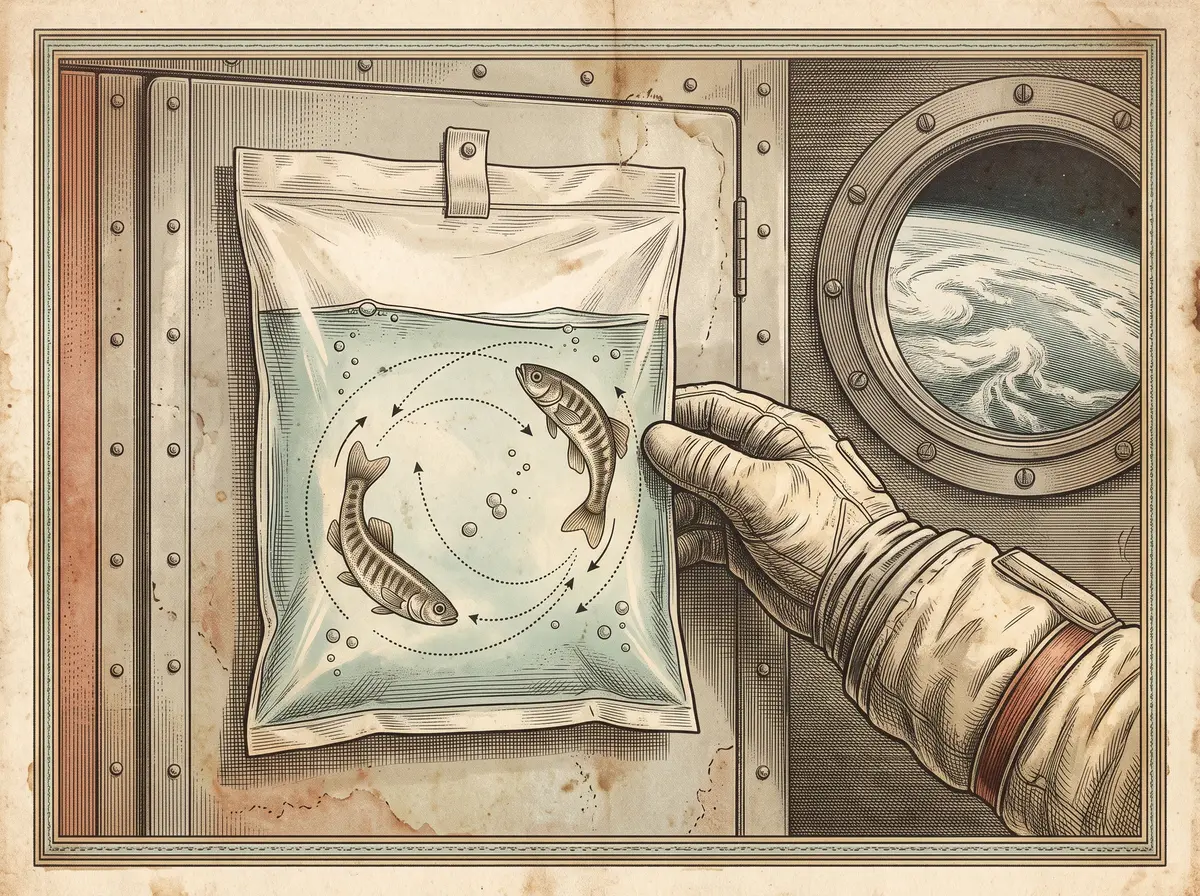
In the summer of 1973, two mummichog minnows in a plastic bag of seawater were floating aboard Skylab, America's first space station. Instead of swimming in straight lines, they kept turning forward somersaults, around and around, like they'd lost track of which way was up. A few feet away, the three astronauts who had carried them up were nauseated and having a rough first few days of their own.
By the Curiosities Desk · · 5 min read · Filed under Space · Today’s round
Part of Creatures That Changed Science
What happened: The Skylab Minnows
The fish were mummichogs (Fundulus heteroclitus), a drab, finger-length minnow, sometimes called a killifish, that lives in the salt marshes of North America’s Atlantic coast. They aren’t prized as aquarium fish or bait, which is partly why almost no one has heard of them.
NASA picked them on purpose. It needed a fish that could survive the shaking of a rocket launch and weeks of life in orbit with very little care. Mummichogs fit. In their home marshes they put up with water that swings from fresh to salty, warm to cold, and full to nearly drained with every tide.
On July 28, 1973, a Saturn IB rocket lifted off from Kennedy Space Center carrying Alan Bean, Owen Garriott, and Jack Lousma to the Skylab space station. Their mission, known as Skylab 3, was the second crew to live aboard. According to NASA, the crew’s science passengers included “two minnows, 50 minnow fish eggs, six pocket mice, 720 fruit fly pupae and two spiders.” (The spiders, Arabella and Anita, became famous. The minnows mostly did not.)
The mission got off to a queasy start. Lousma reported nausea within an hour of launch, and by that evening all three men had motion sickness, according to NASA’s official history of Skylab. The illness peaked around the second and third days.
The minnows were struggling in a similar way. Kept in a bag of seawater fixed to a locker door, they swam in loops and circles instead of moving forward. The behavior was odd enough to make the news: on August 1, 1973, The New York Times ran the headline “Space Making Skylab Minnows Swim as if They’re Confused.”
Then, like the crew, the fish began to settle down. NASA’s later educational account says that after about three days the minnows started treating the dark locker door as “down,” swimming mostly with their bellies facing it. The formal scientific write-up, published in 1975 by researchers at NASA’s Ames Research Center with Garriott himself as a co-author, describes looping as most pronounced around the third day of weightlessness, then becoming less frequent. By the 21st day, the authors reported, the fish had fully adapted and swam with their backs toward the light.
Meanwhile, the eggs were hatching. A popular account by a salt-marsh ecologist in Scientific American reports that 48 of the 50 eggs hatched during the flight, and that the newborn fish, who had never known gravity at all, didn’t loop like their elders. That detail isn’t in the published Skylab paper, so treat it as a reported observation.
Why it was strange: The Skylab Minnows
A fish seems like the last animal that should get confused by weightlessness. Water already holds it up, so in a sense it spends its whole life “floating.”
But fish don’t rely only on buoyancy to know which way is up. Like us, they have an inner ear containing otoliths, tiny stones of calcium carbonate that rest on beds of sensory hairs. Gravity pulls the stones downward and bends the hairs, sending a steady signal: that way is down. In orbit, the stones stop pressing. The fish’s balance system goes quiet, or worse, sends confusing signals.
That is very close to what researchers think causes space motion sickness in astronauts. The minnows and the crew were, in a way, having the same problem at the same time, a few feet apart.
For another tiny passenger whose gravity sensors went haywire in orbit, see The 2,478 Baby Jellyfish NASA Sent to Space — and the Ones That Came Home Dizzy.
What scientists learned: The Skylab Minnows
The 1975 paper offered two possible explanations for the loops. One: without gravity bending their sensory hairs, the fish tilt forward to try to get some kind of signal, and in total weightlessness that tilt keeps going until it becomes a full somersault. Supporting that idea, fish flown on aircraft that produced only partial weightlessness tilted but didn’t loop. Two: by spinning, the fish may create their own centrifugal force, flinging their otoliths outward to fake the feeling of gravity.
The bigger lesson was that the fish could switch senses. When gravity stopped giving useful information, they learned to orient by light instead, keeping their backs toward the brightest direction, the way sunlight comes from above in a marsh.
NASA followed up in 1975 on the Apollo-Soyuz Test Project, the joint U.S.-Soviet flight. Experiment MA-161 carried hundreds of killifish eggs at different stages of development, plus juvenile fish. The juveniles looped early in the flight and mostly adapted within five or six days. After nine days in orbit, the fish’s otoliths, eyes, and bones looked the same as those of ground controls. The one notable difference: some batches of space eggs hatched sooner.
The spiders that shared the Skylab 3 mission have a story of their own in The Teenager Who Sent Two Spiders to Spin Webs in Space.
How it reaches us today: The Skylab Minnows
The Skylab minnows were an early piece of a question space agencies still study: how does a body rebuild its sense of “up” when gravity disappears, and how fast can it switch back? Space motion sickness remains common among new astronauts, and the fish showed that learning to lean on other senses, especially vision, is part of the cure.
The humble mummichog, meanwhile, became one of biology’s quiet celebrities. The same toughness that made it a good astronaut also makes it a good test subject on Earth. In 2016, a team writing in Science compared killifish populations living in heavily polluted U.S. estuaries with populations from cleaner water. Some of the polluted-water fish had become up to 8,000 times more resistant to certain industrial toxins, and the researchers traced much of that resistance to changes in a single chemical-sensing pathway.
The minnows join the other animals on the shelf Creatures That Changed Science.
Fun fact: The Skylab Minnows
One of the scientists who wrote up the Skylab fish study had watched the minnows in person from inside the station: astronaut Owen Garriott is listed as a co-author.
Sources: The Skylab Minnows
- R. J. von Baumgarten, R. C. Simmonds, J. F. Boyd, and O. K. Garriott, “Effects of prolonged weightlessness on the swimming pattern of fish aboard Skylab 3” — Aviation, Space, and Environmental Medicine (1975), NASA Technical Reports Server (primary source)
- “Apollo-Soyuz Pamphlet No. 7: Biology in Zero-G” — NASA EP-139 (1977), including Experiment MA-161 results
- “Skylab 3: Return to Skylab” — NASA
- W. David Compton and Charles D. Benson, “Living and Working in Space: A History of Skylab,” Chapter 16: The Second Mission — NASA SP-4208 (1983)
- “The First Fish in Orbit” — Scientific American guest blog