Strange Animals Scientists Studied · Engineering
The Black Widows a California Farmhouse Raised to Spin Crosshairs for the War
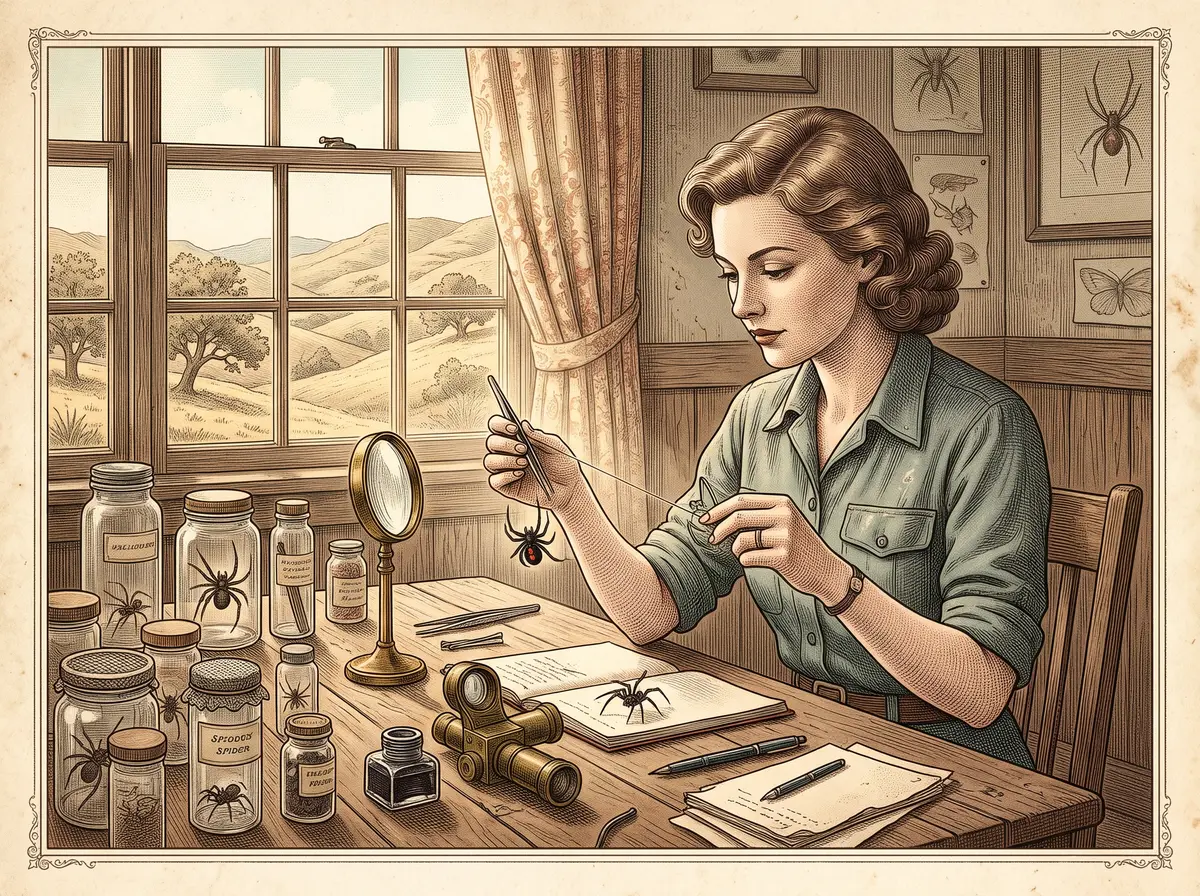
In the early 1940s, in the front room of Nan Songer's farmhouse in Yucaipa, California, a black widow lies pinned on its back while she gently strokes its belly with a thin strip of yucca. A thread too fine to see well with the naked eye begins to come out, and she winds it onto a little frame. The customer waiting for that thread was the United States government. It needed something thinner than a human hair to put in the crosshairs of its wartime optics, and it had found nothing better than a spider.
By the Curiosities Desk · · 5 min read · Filed under Engineering · Today’s round
Part of The Animals Hired for a Job
What happened: Spider Silk Crosshairs
Nannie “Nan” Songer was born in Tennessee in 1892 and spent her childhood turning over leaves in the family garden to watch insects and spiders. She never finished a degree, but she kept studying on her own, and by the 1930s she was living on a small ranch in Yucaipa, in the foothills east of Los Angeles, with spiders as her favourite neighbours.
In 1939, according to the Smithsonian historian Silvio Bedini, Songer heard from a staff member at the American Museum of Natural History that the U.S. National Bureau of Standards was looking for spider silk. The reason was precision optics. Telescopes, surveying instruments, and gunsights all need fine lines in the eyepiece, called crosshairs or a reticle, so the user knows exactly where the instrument is pointing. The lines have to be thin enough not to hide the target, strong enough not to snap, and steady enough not to sag. The Bureau’s first order called for silk of “one ten thousandth of an inch” in diameter or less. That is roughly a tenth the width of a human hair.
Songer set out to meet it, and it took her almost two years. She gathered black widows and other local spiders from the hills around Yucaipa, collected their egg sacs, and raised the spiderlings on crickets and gnats. She tested more than 50 species. To harvest the silk, she “silked” each spider: she held it belly-up and coaxed out the dragline, the safety line a spider trails behind it, then reeled it onto a frame. The hardest step was splitting that line into two or three separate strands with fine forceps, because a black widow’s dragline is made of several strands bundled together. One finished, single strand was what the instrument makers wanted.
Supplying the spiders had its own adventures. When a local newspaper reported that Songer was looking for black widows, well-meaning people began posting spiders to the Yucaipa post office, apparently unaware that federal law barred mailing poisonous creatures. Her stock was later topped up by about 250 spiders shipped from Mexico, which arrived with a warning that the shipment “is not to be removed from the immediate premises.”
Bedini records that her silk sold for “twenty dollars per hundred feet,” and that a single healthy spider might produce about 1,000 feet over its life. During the war the government used her silk in military optics, including bombsights. According to the Yucaipa Historical Society, her address was kept out of the local phone book for the duration, and couriers arrived with briefcases handcuffed to their wrists. Those details come from local memory rather than official records, so they’re best treated as part of the town’s lore.
Why it was strange: Spider Silk Crosshairs
At the height of the most technological war yet fought, one supply line for precision weapons ran through a woman’s front room and a collection of jars full of venomous spiders. Black widows have a fearsome reputation, yet here they were treated as delicate, valuable workers whose silk had to be teased out a strand at a time.
Songer was not alone, which makes it stranger still. Bedini found a whole cottage industry. At the Vickers factory in York, England, apprentices collected garden spiders every late summer. A wartime BBC broadcast described workers there getting spiders to drop off a frame, spinning silk as they fell, simply by breathing on them. In Ohio, two brothers ran what a 1942 magazine called a “spider ranch,” selling reels of golden garden spider silk through a Chicago scientific supply company.
Other animals have been handed surprisingly technical jobs too, as in The $35 Ferret Hired to Clean a Particle Accelerator.
What scientists learned: Spider Silk Crosshairs
Using spider silk in instruments was an old idea. Bedini traces it to the Italian naturalist Felice Fontana, who is recorded as fitting spider silk crosshairs to a levelling instrument in 1755, and to the American astronomer David Rittenhouse, who described doing the same in 1786 and wrote that the silk “has a beautiful effect.” Earlier makers had tried human hair, silk thread from silkworms, and fine silver or platinum wire. Each was either too thick, too stretchy, or too touchy about heat and damp.
Dragline silk solved most of that. It is extremely thin, round in cross-section, and holds tension without kinking, so it stays as a crisp, straight line across the view. Songer believed black widow silk was especially good because it showed up clearly against a background. She later called her silk, at its finest, “possibly one of the strongest materials made by a living creature.” Modern research supports the general point: some spider dragline silks are remarkably tough for their weight, though “strongest” depends on how you measure it.
For more creatures put to unusual work, see The Animals Hired for a Job.
How it reaches us today: Spider Silk Crosshairs
Spider silk crosshairs faded out after the war, as instrument makers switched to lines etched or deposited onto glass and, later, to fine wires and electronic displays. Songer kept supplying silk for telescopes, microscopes, and other instruments for years, until synthetic alternatives took over. She died in 1956.
The scientific interest in spider silk never went away, though. Engineers still study dragline silk as a model for strong, light, flexible fibres, and researchers have spent decades trying to produce it without spiders. The idea that a spider’s thread can be a precision engineering material, which Songer proved one strand at a time, now drives a whole field of materials research.
Spider silk has also been spun for music, as in The 300 Spiders a Chemist Raised to String a Violin.
Fun fact: Spider Silk Crosshairs
To get garden spiders to spin a fresh line for instrument makers, workers at one English factory didn’t poke or prod them. They just breathed on them, and the startled spiders dropped away on a thread.
Sources: Spider Silk Crosshairs
- Silvio A. Bedini, “Along Came a Spider — Spinning Silk for Cross-Hairs, Part 1”, The American Surveyor, March/April 2005.
- Silvio A. Bedini, “Along Came a Spider — Spinning Silk for Cross-Hairs, Part 2”, The American Surveyor, May 2005.
- Natalia Mesa, “The Spider Lady, Circa 1939”, The Scientist, 2022 (draws on Songer’s 1955 Natural History article and the Yucaipa Historical Society).
- Amanda Frye, “Nan Songer”, San Bernardino County Sentinel, 2017.