Strange Animals Scientists Studied · Physics
The 300 Spiders a Chemist Raised to String a Violin
In 2012, a chemist in Japan tightened a new set of strings onto a violin, drew the bow, and listened. The strings looked ordinary. They were not. Each one had been twisted by hand from thousands of threads of silk, drawn from roughly 300 golden orb-weaver spiders he kept in his lab. Musicians who played them described the sound with a phrase that ended up in the title of a physics paper: "soft and profound."
By the Curiosities Desk · · 5 min read · Filed under Physics · Today’s round
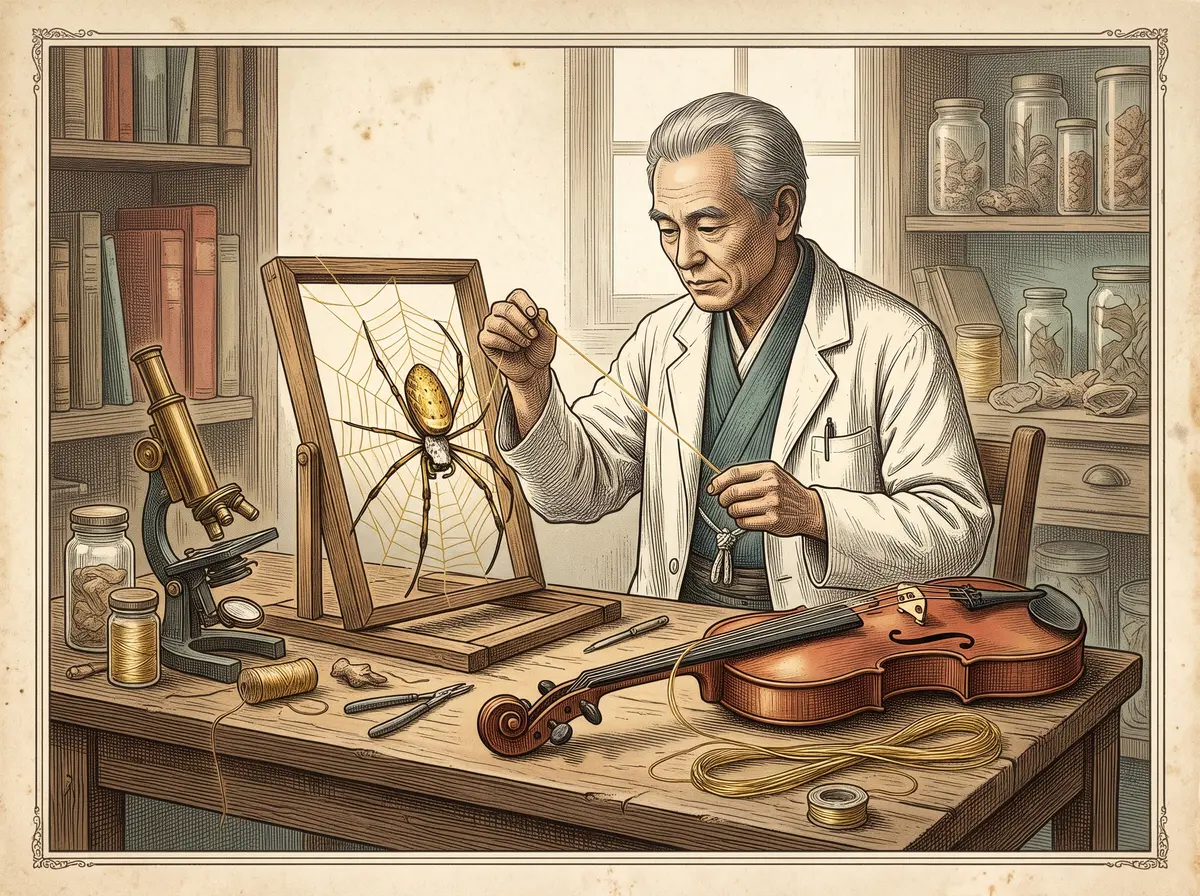
What happened: The 300 Spiders a Chemist Raised to String a Violin
Shigeyoshi Osaki, a professor of polymer chemistry at Nara Medical University, had been studying spider silk for about 35 years by the time his violin made the news, according to an AFP report from March 2012. Polymer chemistry is the study of long, chain-like molecules, and spider silk is one of nature’s most impressive examples: a protein fiber that, pound for pound, can rival steel. Osaki had earlier explored it for medical sutures and protective materials. Then he turned to music.
His raw material came from female golden orb-weavers, large spiders then classified as Nephila maculata. He didn’t use their webs. He used their dragline silk, the tough safety line a spider trails behind it and hangs from when it drops. According to Popular Science, Osaki collected dragline silk from about 300 spiders.
Turning that silk into a violin string took patience. Each string, Popular Science reported, was made of three bundles of dragline silk, each bundle containing 3,000 to 5,000 individual strands. Osaki twisted each bundle in one direction, then twisted the three bundles together in the opposite direction, the same principle that keeps a rope from unraveling. Science News reported that the bundles were also treated with a gelatin solution. Strand counts vary a little between accounts, but all agree on the scale: thousands of threads, finer than a human hair, combined by hand into a single string.
Osaki then put the strings on violins and asked professional violinists to play them. According to Science News, the players rated the sound favorably compared with traditional strings made of gut or steel. He published his results in Physical Review Letters, one of the most prestigious physics journals, on April 11, 2012, under the title “Spider Silk Violin Strings with a Unique Packing Structure Generate a Soft and Profound Timbre.” The journal flagged it as an Editors’ Suggestion.
Osaki was not the first person to try to make something useful out of spider silk. In 1709, a French magistrate named François Xavier Bon de Saint Hilaire made gloves and stockings from silk he combed out of boiled spider egg sacs, and sent pairs to scientific societies in London and Paris. His attempt to farm spiders in crates didn’t go well: when he returned after a long absence, only a few were left. Spiders, it turns out, tend to eat each other.
Why it was strange: The 300 Spiders a Chemist Raised to String a Violin
Violin strings have been made from the same short list of materials for centuries: sheep gut first, then steel and, later, synthetic cores like nylon. String makers tweak recipes in tiny increments, and violinists argue passionately about the differences. A chemist walking into that world with strings made from spiders sounds like the setup to a joke.
The deeper surprise was in what the microscope showed. Silk strands are round, and round things don’t stack neatly; pack a box with pencils and you still get gaps between them. But when Osaki looked at his twisted strings under an electron microscope, the strands had changed shape. Twisting had pressed them from circles into polygons with flat sides, which fit together with essentially no gaps at all. Randy Lewis, a spider silk researcher at Utah State University, told Science News that this shape change was “the most interesting aspect” of the paper.
For another time an animal ended up at the center of a physics paper, see The Cat Who Co-Authored a Physics Paper Because His Owner Used the Word ‘We’.
What scientists learned: The 300 Spiders a Chemist Raised to String a Violin
A vibrating string doesn’t produce just one pitch. It sings a main note, called the fundamental, plus a stack of fainter, higher notes called overtones. The balance of those overtones is what physicists call timbre, the quality that lets you tell a violin from a flute even when both play the same note.
When Osaki analyzed the sound of his strings, he found that their overtones were relatively strong at high frequencies. In his paper, he connected that pattern to the “soft and profound” timbre the violinists described, and he linked both to the tightly packed, gap-free polygonal structure inside the string. The idea is that how a string is built on the inside, not just what it’s made of, shapes how it sounds.
The strings also had limits, and the coverage was candid about them. Popular Science reported that in Osaki’s tests, the silk strings were about as strong as the aluminum-wrapped nylon strings commonly used today, but a traditional gut string outlasted them. Science News noted that the silk didn’t rebound from stretching as well as steel, which made it harder to keep in tune. And the biggest hurdle was supply. “Natural spider silk is a very scarce material,” bioengineer Nikola Kojic of Tufts University told the magazine.
Sound under water has its own strange animal story; see The Inch-Long Shrimp That Drowned Out the Navy’s Underwater Microphones — With a Bubble.
How it reaches us today: The 300 Spiders a Chemist Raised to String a Violin
You can’t buy a set of spider silk violin strings at your local music store, and the scarcity problem Kojic described is a big part of why. Spiders can’t be farmed like silkworms, as Bon de Saint Hilaire discovered three centuries earlier. For a sense of the scale, a golden spider silk cape displayed at London’s Victoria and Albert Museum in 2012 took about eight years and about a million golden orb-weavers collected in Madagascar to make.
That’s why researchers have spent decades trying to make spider silk proteins without spiders, using engineered bacteria, yeast, and even goats that produce silk proteins in their milk. As of Osaki’s paper, none of those artificial silks matched the real thing. His experiment adds a useful lesson for that work: the way fibers are twisted and packed can matter as much as the protein itself.
Spider silk isn’t the only animal fiber that has caught materials scientists’ attention; see The 7,500 Pounds of Hagfish That Slimed Five Cars and Closed a Highway.
Fun fact: The 300 Spiders a Chemist Raised to String a Violin
The spiders didn’t spin webs for Osaki’s violin. Every string came from dragline silk, the lifeline a spider hangs from when it drops off a ledge.
Sources: The 300 Spiders a Chemist Raised to String a Violin
- Shigeyoshi Osaki, “Spider Silk Violin Strings with a Unique Packing Structure Generate a Soft and Profound Timbre” — Physical Review Letters 108, 154301 (2012) (primary source)
- Devin Powell, “Scientist fiddles with spider silk” — Science News (2012)
- Japanese researcher crafts violin strings from 300 spiders’ silk — Popular Science (2012)
- Japan scientist makes violin strings from spider silk — AFP via Phys.org (2012)
- “The Tangled History of Weaving with Spider Silk” — JSTOR Daily (2018)