Strange Animals Scientists Studied · Physics
The Physicist Who Asked, With Equations, Whether Cats Are Liquid
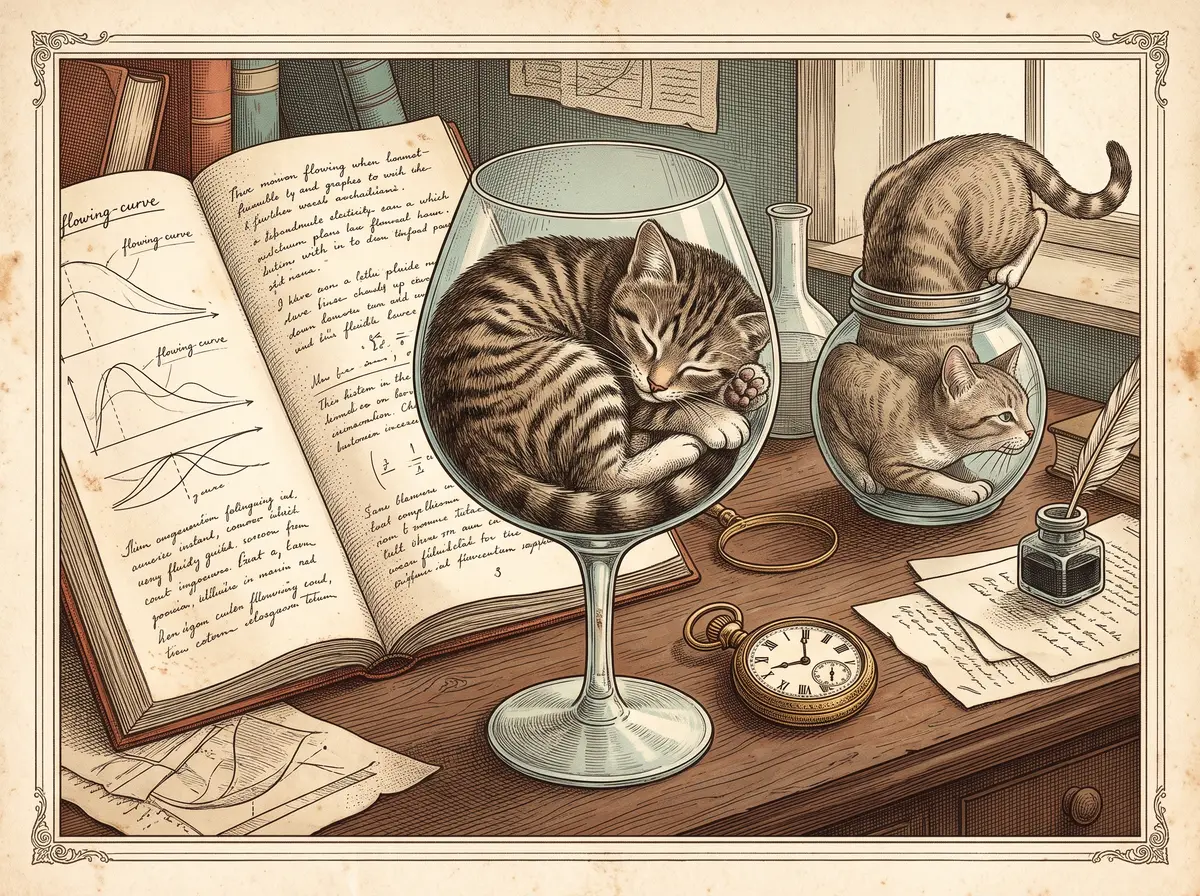
In July 2014, a French physicist named Marc-Antoine Fardin published a paper whose figures included a kitten poured into a wine glass, a cat filling a jar like soup, and another cat spread across a floor in what the caption treated as a puddle. The question behind it came from an internet joke: are cats liquid? Fardin's answer, worked out with the real tools of his field, was that it depends on how long you're willing to watch.
By the Curiosities Desk · · 5 min read · Filed under Physics · Today’s round
Part of Creatures That Changed Science
What happened: The Physicist Who Asked, With Equations, Whether Cats Are Liquid
By 2014, a running gag had spread across the internet. People were posting photos of cats wedged into salad bowls, flower pots, sinks, and cardboard boxes far too small for them, each cat taking on the exact shape of its container. One popular collection on the site Bored Panda summed it up in its title: “Cats are liquids.”
Fardin, then a physicist at the physics laboratory of the École Normale Supérieure de Lyon, studies rheology, the science of how materials flow and deform. Rheologists spend their days on substances that don’t behave neatly as solids or liquids: toothpaste, bread dough, blood, wet sand. When he saw the meme, he later wrote, it made him laugh and then think. He began working on it that spring, and he has cheerfully admitted it was a way of avoiding his main research. “This procrastination actually led to some success,” he told Scientific American.
The result was “On the Rheology of Cats,” published in the Rheology Bulletin, the newsletter of the Society of Rheology, in July 2014. Fardin didn’t run lab experiments on cats. Instead, he took the internet’s photos and videos seriously as observations and asked what a rheologist would make of them. He described the meme collection, with a straight face, as a “meta-study.”
The paper reads like a normal physics article, which is much of the joke. A cat bouncing off a surface is analyzed as a solid. A kitten in a wine glass is a liquid filling its container. A cat that refuses to slide out of a tilted jar shows “yield stress,” the minimum push a material needs before it starts to flow, like ketchup sitting in a bottle until you shake it. A cat that keeps clear of a wet floor is said to be resting on a “superfelidaphobic” surface, a pun on the superhydrophobic surfaces (like a lotus leaf) that water beads up on.
Three years later, the work found its natural home. On September 14, 2017, at Harvard’s Sanders Theatre, Fardin received the Ig Nobel Prize in Physics, an award given each year by the magazine Annals of Improbable Research for science that first makes people laugh and then makes them think. The official citation honored him for using fluid dynamics to answer the question “Can a Cat Be Both a Solid and a Liquid?”
Why it was strange: The Physicist Who Asked, With Equations, Whether Cats Are Liquid
We learn that solid and liquid are fixed categories. A cat, surely, is a solid with fur on it.
Rheology says that tidy split is partly an illusion. Whether a material looks solid or liquid depends on the time scale. Smack the surface of a pool and it feels hard; lower your hand slowly and it parts like nothing. Glaciers are solid ice, yet over years they flow downhill like very slow rivers.
So the cat question, silly as it sounds, lands on a real idea: being a liquid isn’t only about what something is made of. It’s also about how long you watch it.
Another animal that turned out to be a physics problem in disguise: The Falling Cat That Seemed to Break the Laws of Physics. More stories like this live in Creatures That Changed Science.
What scientists learned: The Physicist Who Asked, With Equations, Whether Cats Are Liquid
Fardin’s main tool was the Deborah number, a measure rheologists use to decide whether something is acting like a solid or a liquid. It compares two times: the material’s “relaxation time,” roughly how long it takes to settle into a new shape, and the observation time, how long you’re watching. If the relaxation time is much longer than your observation, the material behaves like a solid. If it’s much shorter, the material flows like a liquid.
The name comes from the Israeli rheologist Markus Reiner, who, with the American chemist Eugene Bingham, had coined the word “rheology” in 1928. In an after-dinner speech at an international rheology congress in Providence, Rhode Island, in 1963, later reprinted in Physics Today, Reiner borrowed a line from the biblical Song of Deborah, in which the mountains flow before the Lord. Even mountains flow, Reiner argued, if you observe them on a time scale of divine length.
Applied to cats, Fardin estimated that a typical young adult cat has a relaxation time somewhere between about one second and one minute. Watch a cat for a moment as it leaps and it’s a solid. Give it a few minutes with a bowl and it becomes, in rheological terms, a liquid. He suggested that agitated kittens might take hours to “relax,” while older cats might settle faster.
He also flagged a real complication: cats are “active” materials. Unlike honey, they have their own motive power and their own opinions, which puts them in the same awkward category as flocks of birds and swarms of bacteria, materials that physicists still struggle to describe. Fardin closed by noting that cats were proving to be a rich model system for rheology, with much work left to do.
It’s worth being clear about what the paper is. It’s a playful piece built on internet photos, not a measured study. Its value is as a teaching device: it puts real concepts in an unforgettable package.
How it reaches us today: The Physicist Who Asked, With Equations, Whether Cats Are Liquid
The same Deborah-number thinking matters well beyond cats. Engineers use it to predict how plastics behave when molded at speed, why silly putty bounces but slowly puddles, and how glacier ice and rock in Earth’s mantle creep over long spans.
Fardin has since used the cat paper in talks and essays to explain rheology to the public, and the liquid cat has become a popular classroom example of how “solid” and “liquid” depend on time.
The most patient demonstration of the same principle is The Experiment So Slow Its Keeper Watched for 52 Years and Never Saw a Single Drop Fall, whose pitch also won an Ig Nobel Prize in physics.
Fun fact: The Physicist Who Asked, With Equations, Whether Cats Are Liquid
Fardin’s paper doesn’t stop at liquid. One figure shows an older cat in a “gaseous” state, apparently expanding, the way a gas does, to fill whatever space is available.
Sources: The Physicist Who Asked, With Equations, Whether Cats Are Liquid
- Fardin, M.-A. (2014). “On the rheology of cats.” Rheology Bulletin 83(2): 16–17, 30. Fermat’s Library annotated copy
- Day, C. (2011). “The Deborah number.” Physics Today (recounting Markus Reiner’s 1963 speech, reprinted in Physics Today, January 1964). physicstoday.aip.org
- Fardin, M.-A. “Answering the question that won me the Ig Nobel Prize: Are cats liquid?” PBS NewsHour / The Conversation. pbs.org
- École Normale Supérieure de Lyon. “Marc-Antoine Fardin, recipient of the 2017 Ig Nobel prize in physics” (September 19, 2017). ens-lyon.fr
- “Are Cats Actually Liquid?” Scientific American. scientificamerican.com