Strange Animals Scientists Studied · Medicine
The Giant Rats That Sniff Spit for Tuberculosis — and Get Paid in Banana
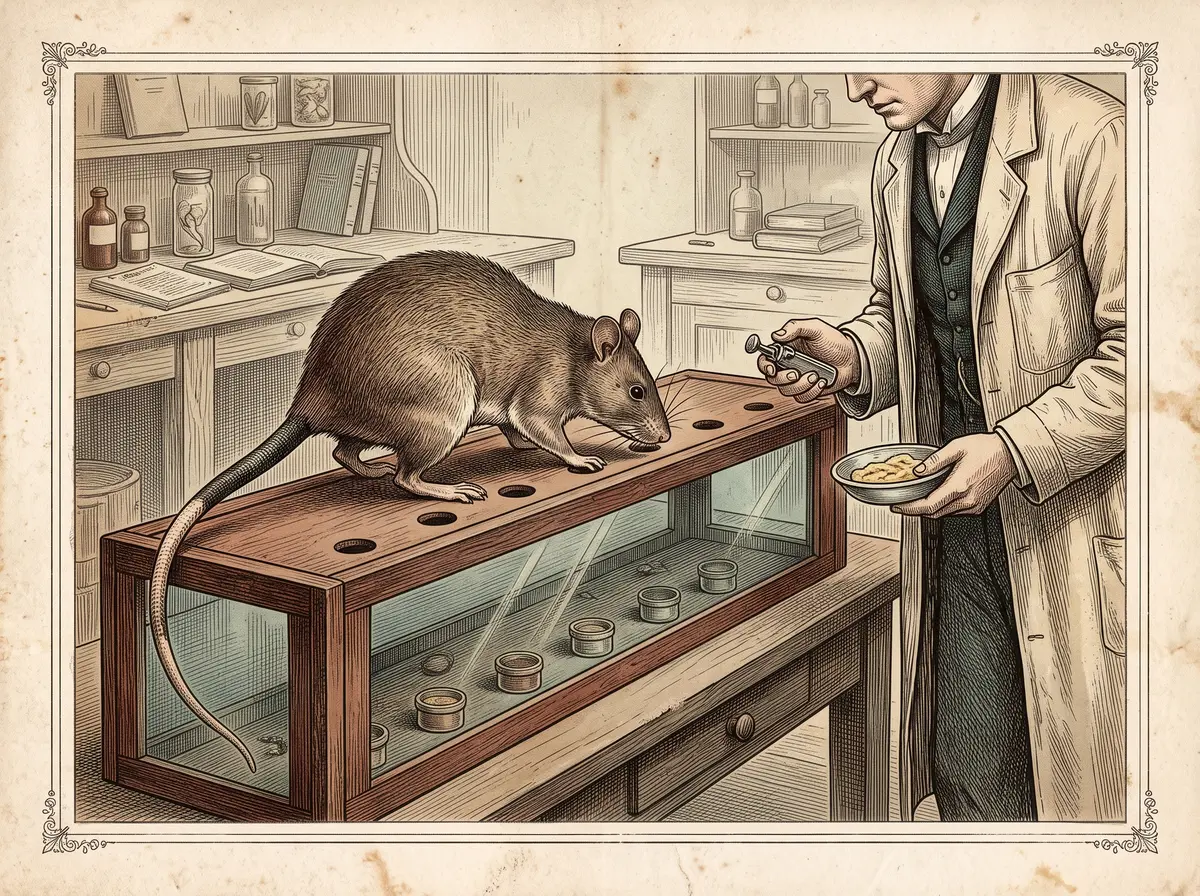
In a lab in Tanzania, a rat the size of a small cat trots along a long glass-sided cage, poking its nose into a row of holes in the floor. Under each hole sits a pot of human spit. At one hole it stops, holds its nose perfectly still, and waits. A click sounds, and a dollop of mashed banana appears. The rat has just told a doctor something a microscope missed: the person who coughed up that sample probably has tuberculosis.
By the Curiosities Desk · · 5 min read · Filed under Medicine · Today’s round
Part of The Animals Hired for a Job
What happened: The Giant Rats That Sniff Spit for Tuberculosis — and Get Paid in Banana
The story starts with landmines, not lungs. In 1997, Belgian product designer Bart Weetjens and his former schoolmate Christophe Cox launched a small nonprofit called APOPO (a Dutch acronym for “Anti-Personnel Landmines Removal Product Development”). Weetjens was a pet owner himself, and after reading about gerbils being tested as scent detectors, he wondered whether a bigger, tougher African rodent could do the job better.
The animal they picked was the African giant pouched rat, Cricetomys. These rats can grow to nearly a meter long counting the tail and have an excellent sense of smell. Trained with a clicker and food rewards, they turned out to be very good at sniffing out explosives in minefields.
If a rat could smell TNT, could it smell a disease? Tuberculosis (TB) is caused by the bacterium Mycobacterium tuberculosis, and bacteria often give off their own chemical scents. With the help of a 2003 World Bank grant, APOPO began TB research at Sokoine University of Agriculture in Morogoro, Tanzania. When Weetjens presented the idea at a tuberculosis symposium in Tanzania in October 2005, “We got a big applause, lots of questions,” he told South Africa’s Mail & Guardian.
The method that grew out of that work is surprisingly low-tech. Clinics in Tanzania already tested patients’ sputum (the thick mucus coughed up from the lungs) using smear microscopy, in which a technician stains a sample on a glass slide and looks for the bacteria. APOPO couriers collect those same samples, positives and negatives, and bring them to a central lab. There the samples are heated for 30 minutes at 90°C, which makes them safe for the rats and their handlers to work around.
Then the pots go under the holes in the cage floor. A rat walks the line and sniffs. When it lingers over a sample for a few seconds, it is “indicating.” If that sample is one the clinic already confirmed as positive, the rat gets its reward: banana mixed with crushed rat chow. If the rat indicates on a sample the clinic called negative, no treat comes, but the lab flags that sample and retests it with a standard diagnostic method. Confirmed cases go back to the clinic, so the patient can be called in for treatment.
The speed is what made people sit up. APOPO reports that one rat can check 100 samples in under 20 minutes, a job it says would take a lab technician at least four days. In a 2010 study in the Pan African Medical Journal, rats screening clinic samples raised the number of new TB cases detected by about 43%, finding 716 patients the clinics’ first tests had missed. By 2022, a study in BMC Infectious Diseases reported that rats in Tanzania screened 46,048 samples and helped identify 2,029 TB cases that had first tested negative.
Why it was strange: The Giant Rats That Sniff Spit for Tuberculosis — and Get Paid in Banana
Diagnosing a disease from someone’s spit sounds like a job for a machine with a lot of buttons. Instead, part of the work went to a rodent most people would chase out of a kitchen, one paid in fruit rather than salary. Each rat costs about €6,000 to train over roughly nine months, but once working it can stay on the job for four or five years.
The other surprise is that the rats are not replacing doctors or lab tests. They are a second set of noses. Their value comes from re-checking the samples the first test called clean.
Another animal that learned to read medical samples: The Pigeons Trained to Spot Breast Cancer — and the Flock That Got It Right 99% of the Time.
What scientists learned: The Giant Rats That Sniff Spit for Tuberculosis — and Get Paid in Banana
The rats are almost certainly smelling chemistry. In a 2012 study in the journal Tuberculosis, researchers including Georgies Mgode identified volatile compounds (chemicals that easily evaporate into the air) given off by M. tuberculosis cultures. Thirteen were specific to the TB bacterium, and the rats could tell a blend of those compounds apart from compounds that other microbes also produce.
The careful answer to “how accurate are they?” is: useful, but not perfect. A 2021 meta-analysis in Scientific Reports pooled seven studies and found the rats had good-to-excellent accuracy at sorting samples. But all seven studies came from the same group and the same country. A smaller 2015 study in Bagamoyo, Tanzania, compared rats against bacterial culture, the gold-standard test, and found they caught about 57% of cases, with performance dropping when patients carried fewer bacteria. Its authors concluded that the rats did not yet meet World Health Organization standards for a stand-alone rapid TB test.
That is why the rats work as a screen rather than a final verdict. Anything they flag gets confirmed by a standard lab test before anyone is told they have TB.
Another lab that put a trained animal’s senses to work: The Bomb Detector That Watched Bees Stick Out Their Tongues.
How it reaches us today: The Giant Rats That Sniff Spit for Tuberculosis — and Get Paid in Banana
TB remains one of the world’s deadliest infectious diseases, and smear microscopy can miss many cases, especially when a patient carries few bacteria. Each missed case is a person who goes home untreated and may infect others. APOPO now runs TB detection programs in Tanzania, Mozambique, and Ethiopia, and reports that its rats have increased the number of TB-positive patients found at partner clinics by about 40%.
The work also feeds a bigger idea: if diseases have a smell, an electronic “nose” might one day detect them cheaply.
An older animal-based test from a hospital basement: The Frog in the Hospital Basement That Told You If You Were Pregnant.
Rats hired to sniff sputum, and paid in banana, sit with the other animals given a job in The Animals Hired for a Job.
Fun fact: The Giant Rats That Sniff Spit for Tuberculosis — and Get Paid in Banana
The TB rats have a famous coworker. Magawa, an APOPO pouched rat who sniffed out landmines and unexploded bombs in Cambodia, received the PDSA Gold Medal for animal bravery in 2020. He was the first rat to win it.
If you’re worried about a persistent cough or possible TB exposure, a local clinic can test you, and TB is treatable and curable with the right medicines.
Sources: The Giant Rats That Sniff Spit for Tuberculosis — and Get Paid in Banana
- Agizew et al., “Increased tuberculosis case detection in Tanzanian children and adults using African giant pouched rats,” BMC Infectious Diseases (2024)
- Mahoney et al., “Using giant African pouched rats to detect tuberculosis in human sputum samples: 2010 findings,” Pan African Medical Journal (2011)
- Reither et al., “Evaluation of Giant African Pouched Rats for Detection of Pulmonary Tuberculosis in Patients from a High-Endemic Setting,” PLOS ONE (2015)
- Kanaan et al., “Rats sniff out pulmonary tuberculosis from sputum: a diagnostic accuracy meta-analysis,” Scientific Reports (2021)
- APOPO, “TB detection process”