Strange Animals Scientists Studied · Archaeology
The Cadaver Dogs That Found Graves 2,700 Years Cold
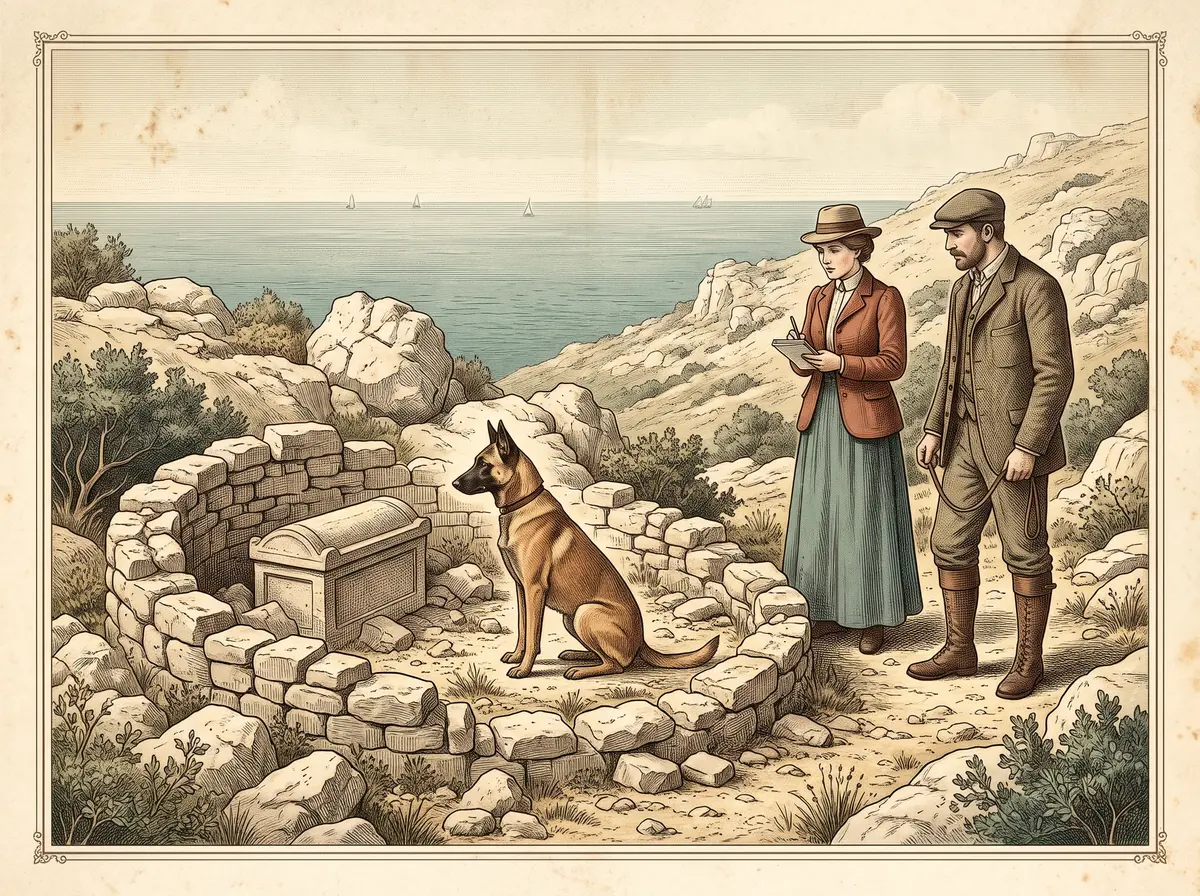
In September 2015, on a rocky ridge above Croatia's Adriatic coast, a Belgian Malinois named Panda stopped dead and pointed her nose at a ring of stones. Dogs like her are trained to find people who went missing last month. The person she had just found had been buried roughly 2,700 years ago.
By the Curiosities Desk · · 5 min read · Filed under Archaeology · Today’s round
Part of The Animals Hired for a Job
What happened: The Drvisica Graves
In 2014, archaeologist Vedrana Glavaš of the University of Zadar began excavating an Iron Age necropolis (a cemetery, literally a “city of the dead”) at Drvišica, a hillfort on the seaward slope of the Velebit mountains. The people buried there lived between roughly the eighth and first centuries B.C. Their graves were small stone burial chests, each ringed by a low circle of stones, holding fragments of bone and a few artifacts.
The trouble was finding them. Drvišica is mostly limestone, and over the centuries the stone circles have slumped and blended into the rubble of the hillside. Ground-penetrating radar, which sends radio pulses into the earth and reads the echoes, struggles in terrain this rocky. The usual alternative, digging test trenches, is slow and damages the very thing you are looking for. Looters had already found, and probably robbed, three of the tombs.
So in 2015 Glavaš contacted Andrea Pintar, who trains human remains detection dogs, better known as cadaver dogs, with her husband, Christian Nikolić. These dogs are normally used by police and rescue teams to find bodies. No one was sure they could detect anything this old.
The first test, in September 2015, used two of Pintar’s Belgian Malinois, Panda and Mali. The team brought them to the three tombs the archaeologists had already excavated and emptied, places where nothing obvious remained to see. The dogs alerted on them anyway. A dog “alerts” with a trained signal; here, the dogs sat or lay down inside the flattened stone circles with their noses aimed at the burial chests. Some hopped right into the little chests first. Pintar, who had doubted the plan, later described being startled when Panda froze on her first ancient grave.
A year later the team came back for a harder test. This time the searches were blinded and double-blinded: in some, the handler didn’t know where graves were, and in others, nobody on site did. A third Malinois and a German shepherd joined in. Every spot where a dog alerted was inspected and then excavated.
The results were published in the Journal of Archaeological Method and Theory in 2019. Across the searches, four dogs led the team to five previously unknown prehistoric tombs, along with the ones already dug. Press accounts have given slightly different counts of the new graves, so the published paper’s number of five is the one to trust.
Why it was strange: The Drvisica Graves
Cadaver dogs are built, by training, for fresh tragedies. The whole field assumes the scent of a body fades as it decays. A grave nearly three thousand years old should have been, in scent terms, long gone.
Instead, dogs walked over a jumbled hillside and picked out burials that trained archaeologists had walked past. They did it without a shovel, without equipment, and without disturbing a single stone. The idea of archaeologists taking their best tip from a dog’s nose sounds like a joke, but it was a controlled experiment, and the dogs passed.
Putting a nose to work it was not trained for is the same bargain as The Giant Rats That Sniff Spit for Tuberculosis — and Get Paid in Banana.
What scientists learned: The Drvisica Graves
The dogs are not hunting for bones. As Glavaš put it, “They are searching for the molecules of human decomposition.” A decaying body releases hundreds of volatile organic compounds, chemicals that drift into the air as vapor, and a trained dog learns the particular blend that marks a human.
Why would any of that survive for 27 centuries? Pintar’s view is that environment matters more than age. Moisture, sunlight, and temperature all change how scent breaks down. At Drvišica, the bodies had lain on limestone slabs, and she believes the compounds soaked into the porous rock and stayed trapped there. That is a hypothesis, not a proven mechanism, but it fits what the dogs did.
The study also has honest limits. Outside scent experts have praised its controls while noting that dogs are excellent “anomaly detectors”: freshly disturbed soil or other odd smells can draw a false alert. Cadaver dogs also take about 18 months to two years to train, and they can react to pig bones used in practice. The authors themselves framed the work as a proof of concept, showing the method can work, not that it always will.
Another find that began while someone was busy with a different chore is The Lost Hammer That Led to 14,865 Roman Coins — and Got Its Own Museum Number.
How it reaches us today: The Drvisica Graves
Drvišica wasn’t the first case, but it was one of the most carefully tested. In 2012, an Australian rescue dog named Migaloo, trained only on the scent of human bone, found a roughly 600-year-old Aboriginal grave in South Australia within about two minutes of searching. In Sweden, a German shepherd named Fabel, working with archaeologist Sophie Vallulv, correctly told human remains from animal remains in more than 94 percent of jar tests. In Georgia, dogs flagged more than two dozen suspected graves at the Kettle Creek Revolutionary War battlefield, which radar then backed up.
Dogs will not replace radar, magnetometers, or trowels. But on rocky ground, at sites where digging is unwelcome, or at burial grounds that descendant communities would rather not disturb, a dog can narrow down where to look before anyone breaks the soil.
The dogs, hired to find graves no person could see, belong with The Animals Hired for a Job.
Fun fact: The Drvisica Graves
Migaloo, often called the first dog trained specifically for archaeology, was a black Lab mix rescued from western Queensland. Her reward for finding a grave was simply her ball.
A note on the subject: this story involves death and burial. If you’re grieving or the topic weighs on you, talking with someone you trust can help.
Sources: The Drvisica Graves
- Glavaš, V., & Pintar, A. “Human Remains Detection Dogs as a New Prospecting Method in Archaeology.” Journal of Archaeological Method and Theory 26 (2019): 1106–1124: the original study, with four dogs, blinded and double-blinded searches, and five new tombs
- Warren, C. “When Cadaver Dogs Pick Up a Scent, Archaeologists Find Where to Dig.” The New York Times, May 19, 2020: the 2015–2016 field tests, Panda and Mali, and how the dogs alerted
- Daley, J. “Canine Archaeologists Sniff Out 3,000-Year-Old Graves in Croatia.” Smithsonian Magazine, October 25, 2019: the limestone hypothesis, training time, and other archaeology-dog cases
- Neimark, J. “Archaeology Dogs Can Help Scholars Sniff Out the Past.” SAPIENS, 2020: Fabel’s accuracy tests and the chemistry of decomposition scent
- National Geographic, “Archaeology Dogs” (December 2012): Migaloo’s training and the 600-year-old grave