The Scientist Behind It · Archaeology
The Surgeon Who Unrolled Mummies for Sold-Out Crowds — and the Duke Who Hired Him to Make One More
In August 1852, a London surgeon famous for taking Egyptian mummies apart was asked to put one together. His client was the Duke of Hamilton, an 84-year-old collector who had just died and who wanted to be embalmed in the ancient Egyptian style and laid inside a real Egyptian stone coffin. The surgeon was Thomas Pettigrew, better known around town as "Mummy" Pettigrew. There was just one problem: the Duke was over six feet tall, and the coffin had been made for someone smaller.
By the Curiosities Desk · · 5 min read · Filed under Archaeology · Today’s round
What happened: The Surgeon Who Unrolled Mummies for Sold-Out Crowds — and the Duke Who
Thomas Joseph Pettigrew was born in London in 1791, the son of a naval surgeon. He became a surgeon himself, rose to be surgeon to the Duke of Sussex and to the Duchess of Kent, and, as part of that job, vaccinated the young princess who would become Queen Victoria. In 1822 he became the first surgeon at the hospital that grew into Charing Cross Hospital, and around the same time he became interested in embalming.
Britain was in the grip of Egyptomania, a craze for all things ancient Egyptian, fed by Napoleon’s expedition to Egypt and the decipherment of hieroglyphs in 1822. Mummies were arriving in London as souvenirs and auction lots. Pettigrew saw them as something else: bodies that could be examined like any other patient, just a few thousand years late.
In spring 1833, he bought a mummy at Sotheby’s for £23 and unrolled it in the lecture theater at Charing Cross Hospital. “Unrolling” meant exactly what it sounds like: unwinding layer after layer of linen bandages, then examining the body underneath. The invited audience included a prince, lords, doctors, and hospital governors. He held three unrollings that year, and he used what he found to write History of Egyptian Mummies (1834), illustrated with plates by the satirical artist George Cruikshank. Yale’s Peabody Museum describes it as the first scientific study of ancient Egyptian funeral practices written in English.
His January 1834 unrolling at the Royal College of Surgeons, of a mummy from its own Hunterian Museum collection, was so oversubscribed that the museum posted a notice reassuring people without tickets that they could view the unrolled body afterward. Scraps of its bandages were handed out as keepsakes; one survives today in the Cuming Museum’s collection in south London.
Not every show went smoothly. Mummies were sometimes coated in bitumen or resin, a tar-like sealant that set hard. At a ticketed lecture series at Exeter Hall in the late 1830s, Pettigrew ran out of time partway through, and a newspaper described the job as “a work of absolute labour” of cutting, hammering, and chopping. Other unrollings turned up surprises such as a skull packed with sand, or a supposed princess who turned out to be a man.
Among Pettigrew’s admirers was Alexander, the 10th Duke of Hamilton, a lavish collector whom one contemporary called the grandest “magnifico” of his age. In Paris in 1836 he had bought two Egyptian stone sarcophagi, coffins carved in human shape. One, from the Ptolemaic period (the last dynasty of Greek-speaking kings that ruled Egypt), he kept for himself. He also arranged for Pettigrew to embalm him when the time came.
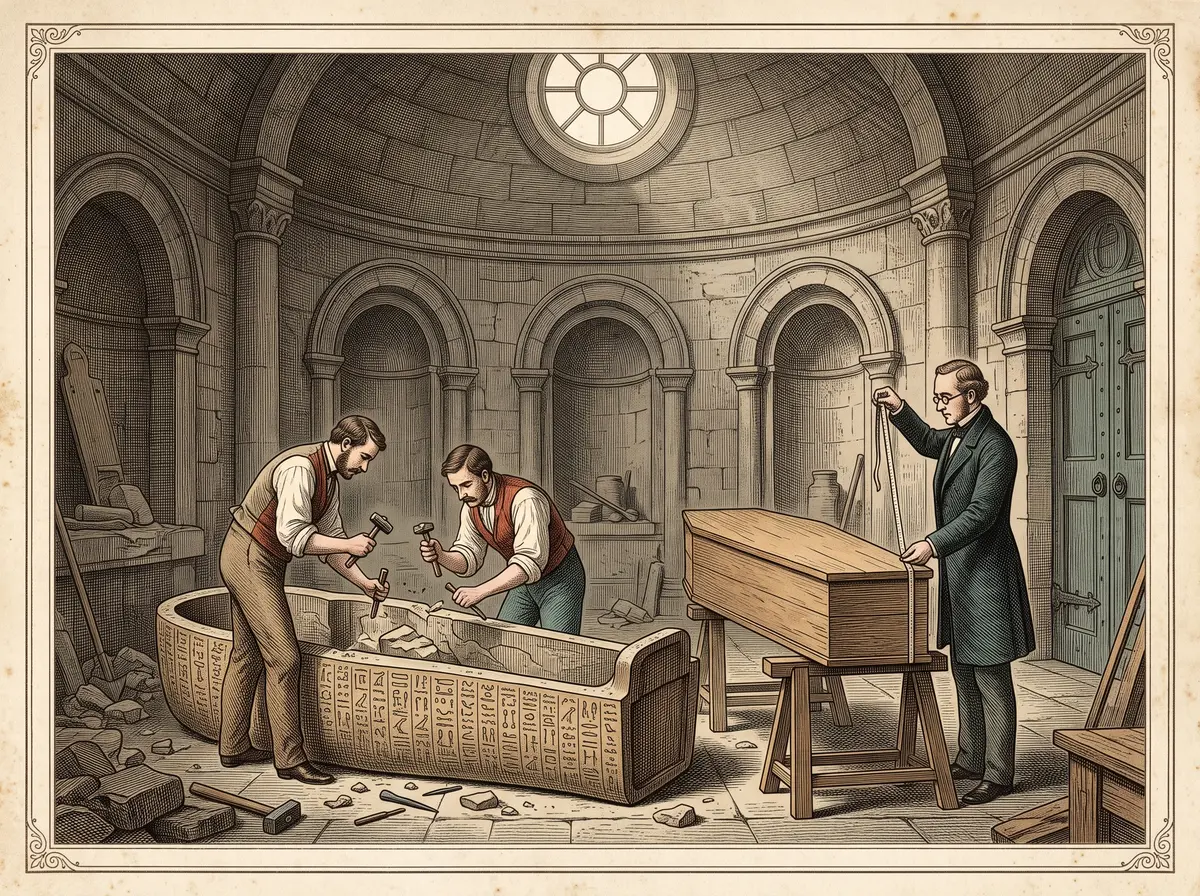
The Duke died in London on 18 August 1852. Pettigrew embalmed him, the body went north by train, and he was buried at Hamilton Palace on 4 September. According to South Lanarkshire’s account of the site, the Duke’s coffin would not fit inside the sarcophagus, so workers chipped stone away from the inside to make room. (Retellings sometimes make this part grislier; the version from the people who run the site involves chisels, not the Duke’s feet.)
Why it was strange: The Surgeon Who Unrolled Mummies for Sold-Out Crowds — and the Duke Who
Pettigrew spent decades treating mummies as specimens to be opened, measured, and analyzed. His friend Michael Faraday even tested materials Pettigrew pulled from inside them. Then one of his own fans asked him to do the reverse and turn a modern British aristocrat into a new mummy.
It also shows how blurry the line between science and showmanship was. The same unrolling could be an anatomy lesson, a society party, and a ticketed performance. Pettigrew kept an already unwrapped mummy on hand in case a new one crumbled, which is good stagecraft and an honest admission of how destructive the method was. The site has another story of ancient Egyptians getting unusual medical attention: The 3,000-Year-Old Pharaoh Who Flew to Paris for a Fungus Treatment — Without a Passport.
What scientists learned: The Surgeon Who Unrolled Mummies for Sold-Out Crowds — and the Duke Who
Pettigrew’s unrollings produced some of the first careful descriptions in English of how mummies were made: the resins, the layering of linen, the removal of organs, and how classical writers’ accounts compared with what was actually inside. Historian Gabriel Moshenska calls him the best-known mummy unroller of his era, and his book became a standard reference.
But every unrolling destroyed the thing it studied. Wrappings were cut away, amulets removed, and bodies often damaged or lost. Some of the era’s measurements also served racial theories that modern scholars reject. Today’s researchers learn far more by leaving mummies intact. A very different fate for Egyptian mummies is told in The 180,000 Mummified Cats That Were Sold by the Ton as Fertilizer.
How it reaches us today: The Surgeon Who Unrolled Mummies for Sold-Out Crowds — and the Duke Who
Modern Egyptology looks inside mummies with CT scanners instead of scissors, producing 3D images of bones, packing, and even hidden amulets without unwinding a single bandage. Museums also now think hard about displaying human remains at all, a debate Pettigrew’s audiences rarely had.
Pettigrew’s other legacy is institutional. In 1843 he helped found the British Archaeological Association, and at its first meeting, in Canterbury in 1844, he unrolled a mummy as a crowd-pleaser. Archaeology as an organized profession partly grew out of gatherings like that. For the legends that grew up around mummies themselves, see The Mummy’s Curse That Missed Its Main Target.
Fun fact: The Surgeon Who Unrolled Mummies for Sold-Out Crowds — and the Duke Who
The Duke’s resting place, the Hamilton Mausoleum, was built as a chapel but never used as one. Its stone dome has what is often described as the longest echo of any building in Britain: a slammed door can take about 15 seconds to fade, which made services impossible. The Duke and his sarcophagus were moved to Hamilton’s Bent Cemetery in 1921, after subsidence made the ground unsafe.
Sources: The Surgeon Who Unrolled Mummies for Sold-Out Crowds — and the Duke Who
- Thomas Joseph Pettigrew, A History of Egyptian Mummies (1834), via the Internet Archive — the primary source for his methods and early unrollings.
- Gabriel Moshenska, “Unrolling Egyptian mummies in nineteenth-century Britain,” British Journal for the History of Science 47, no. 3 (2014) — the main scholarly study of Pettigrew’s unrollings, venues, and audiences.
- Yale Peabody Museum, “A history of Egyptian mummies…” — the 1833 unrollings, the book’s significance, and the Cruikshank plates.
- Royal College of Surgeons, Plarr’s Lives of the Fellows: Pettigrew, Thomas Joseph — his career at Charing Cross, his interest in embalming from 1822, and vaccinating Queen Victoria.
- South Lanarkshire Leisure and Culture, “Hamilton Mausoleum: Did you know?” — the Duke’s height, the chipped-out sarcophagus, the train journey, the echo, and the 1921 reburial; with “Alexander Hamilton, 10th Duke of Hamilton,” Wikipedia, as a guide to his dates and the 1836 purchase.
The people in this story were real, and so were the bodies. If thinking about death or loss stirs up something difficult, it’s okay to step away and talk with someone you trust.