The Worms That Were Supposed to Learn by Eating Their Teachers
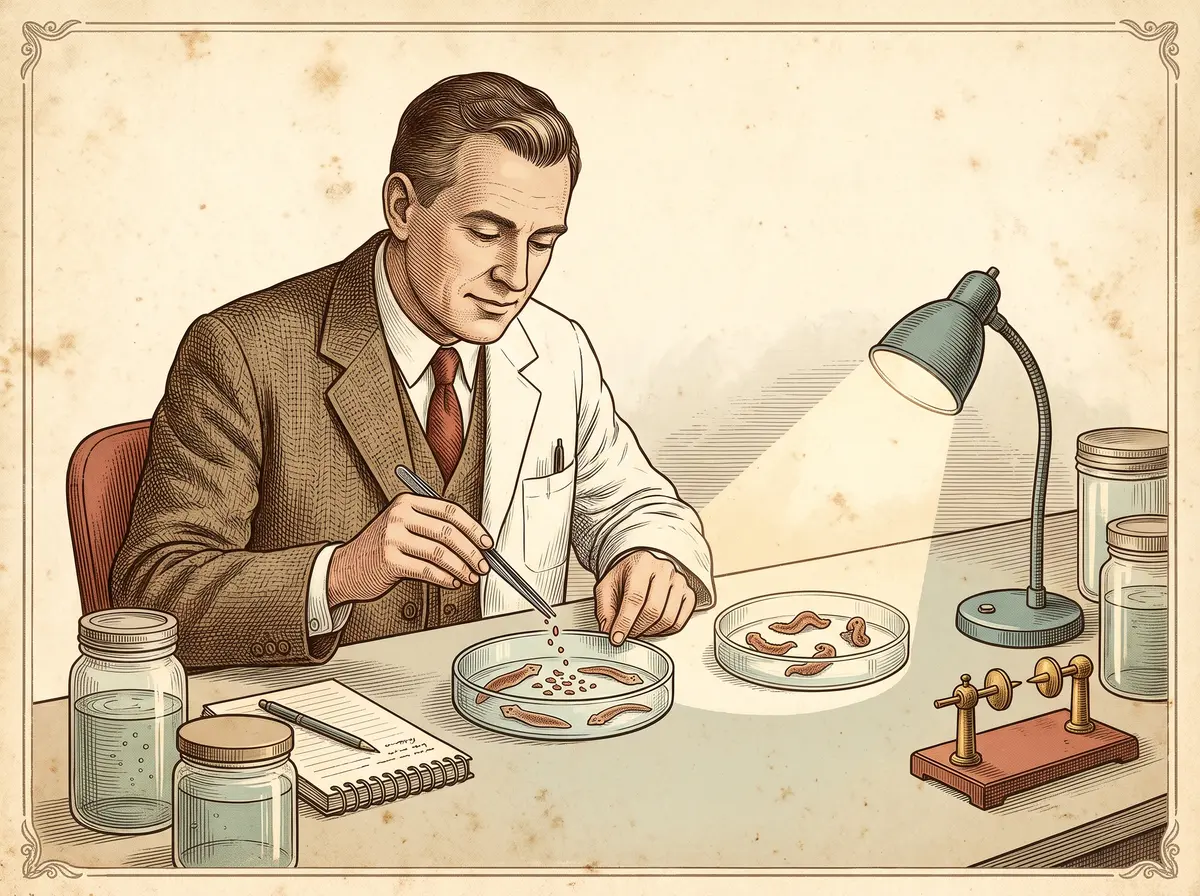
In a University of Michigan lab around 1960, a psychologist chopped up flatworms that had been trained to flinch at a flash of light and fed them to flatworms that had never been trained at all. Then he flashed the light at the diners. His question sounds like the setup to a joke: if you eat someone who knows something, do you get to know it too?
By the Curiosities Desk · · 5 min read · Filed under Biology · Today’s round
What happened: The Worms That Were Supposed to Learn by Eating Their Teachers
The worms were planarians, small freshwater flatworms that glide along pond bottoms and can regrow a whole body from a fragment. In the early 1950s at the University of Texas, James V. McConnell and Robert Thompson showed they could be classically conditioned, the kind of learning made famous by Pavlov’s dogs. The researchers flashed a light and gave a mild electric shock at the same moment. After enough pairings, the worms scrunched their bodies at the light alone.
McConnell carried the worms with him to the University of Michigan, where he joined the psychology department. On September 8, 1959, at the American Psychological Association’s annual convention, he presented a result built on data from an honors student, Reeva Jacobson. They had trained worms, cut them in half, and let each half regrow. The regrown tails, which had to build brand-new heads, remembered the training about as well as the regrown heads did, and sometimes better.
That raised an obvious, odd question: if memory could survive in a tail, was it stored in some chemical spread through the body? McConnell tried to move it from one worm to another. According to a history in the American Psychological Association’s Monitor on Psychology, grafting a trained head onto an untrained worm failed because the head kept falling off. Injecting ground-up trained worms failed too; the needles were too big, and the worms oozed or burst.
Then, in 1960, biologist Jay Boyd Best wrote to McConnell about a planarian species that eats its own kind. Pilot tests that April looked promising. Untrained worms that ate minced trained worms seemed to learn the light-scrunch response faster than worms fed untrained ones. McConnell published the result in 1962 as “Memory Transfer Through Cannibalism in Planarians.”
The press loved it, and McConnell did not discourage them. He had already started a homemade journal called The Worm Runner’s Digest, which mixed real data with parody. He first reported the cannibal results there. Readers complained they couldn’t tell the experiments from the jokes, so starting in October 1964 he moved the humor to the back and printed it upside down.
The trouble came when others tried to repeat the work. Some labs reported success. Others, including a Berkeley team working under Nobel laureate Melvin Calvin, reported failure. The idea spread anyway: by the APA history’s count, roughly 200 teams ran memory-transfer experiments on 23 kinds of animals, from rats and baby chicks to octopuses, kittens, praying mantises, and honeybees. Results kept conflicting. McConnell closed his lab in 1971.
Why it was strange: The Worms That Were Supposed to Learn by Eating Their Teachers
Because it took a metaphor literally. People talk about “absorbing” a lesson or “digesting” an idea. McConnell’s experiment asked whether a memory could be a physical substance, something you could grind, swallow, and inherit.
It was also strange that the claim was never cleanly killed. Sociologists Harry Collins and Trevor Pinch, quoted in Quanta Magazine, put it this way: memory transfer “was never quite disproved; it just ceased to occupy the scientific imagination.” Scientists simply stopped believing it, one shaky replication at a time.
It joins Cold Fusion: The Breakthrough That Wasn’t on the list of exciting results that other labs couldn’t reproduce.
What scientists learned: The Worms That Were Supposed to Learn by Eating Their Teachers
The big lesson was about method. A flatworm’s “scrunch” is a small, judgment-based behavior. A person watching has to decide whether the worm reacted, and if that person knows which worms ate trained meals, expectation can tip the call. Lighting, water chemistry, worm strain, and handling can all shift the outcome. Memory transfer became a lasting example of why experiments need blind scoring and independent replication before a big claim is accepted.
There was a deeper question underneath, though, and it has not gone away: where does memory physically live? Neuroscientists now mostly locate it in changes to connections between nerve cells. But the idea that molecules such as RNA (a cousin of DNA that carries instructions inside cells) might play a role never fully died.
In 2013, Tal Shomrat and Michael Levin at Tufts University used automated, video-tracked training to revisit McConnell’s simpler claim. They decapitated trained planarians, let them regrow their heads, and found that the regrown worms relearned a familiar setting faster than untrained ones did. Their results hinted that some memory survives outside the brain. It did not revive the cannibalism finding.
As with Clever Hans: The Horse That Could ‘Do Math’, part of the real discovery was how easily people read a result into an animal’s behavior.
How it reaches us today: The Worms That Were Supposed to Learn by Eating Their Teachers
McConnell’s worms are still being tested. In 2026, Quanta Magazine reported that a Harvard group led by Sam Gershman tried to rebuild the original light-and-shock training, using a protocol from one of McConnell’s own students and about a dozen strains of planarians from suppliers, streams, and lakes. In a preprint (a study posted publicly before peer review), they reported that they couldn’t get the worms to learn the task at all, let alone pass it on. Two of McConnell’s former lab members told the team they remained convinced their own experiments had worked.
That kind of patient re-checking is now a field of its own, sometimes called replication science. And the question of whether memories can move between bodies has returned in other animals, including sea slugs and the roundworm C. elegans, with more careful methods.
The same pattern of a dazzling claim met by stubborn re-testing runs through Polywater: The New Form of Water That Almost Ate the World.
Worms that were supposed to swallow a lesson sit with the other confident results that had to be taken back in Science’s Most Embarrassing Mistakes.
Fun fact: The Worms That Were Supposed to Learn by Eating Their Teachers
At its peak, The Worm Runner’s Digest had about 2,500 subscribers worldwide, and McConnell explained the jokey name by saying anyone who takes their work too seriously is in “a perilous state of mental health.”
Sources: The Worms That Were Supposed to Learn by Eating Their Teachers
- McConnell, J. V. (1962). “Memory Transfer Through Cannibalism in Planarians.” Journal of Neuropsychiatry, 3 (Suppl. 1), S42–S48. Bibliographic record
- Stern, L. (2010). “The memory-transfer episode.” Monitor on Psychology, 41(6). American Psychological Association. apa.org
- Stern, L. “Looking back: The Worm Runner’s Digest.” The Psychologist, British Psychological Society. bps.org.uk
- Shomrat, T. & Levin, M. (2013). “An automated training paradigm reveals long-term memory in planarians and its persistence through head regeneration.” Journal of Experimental Biology, 216. Summary via Tufts Now: now.tufts.edu
- “Are Memories Transferable or Edible?” Quanta Magazine, June 5, 2026. quantamagazine.org