Failed Experiments · Chemistry
The Seafloor Slime Hailed as the Simplest Life on Earth — That the Specimen Jar Made Itself
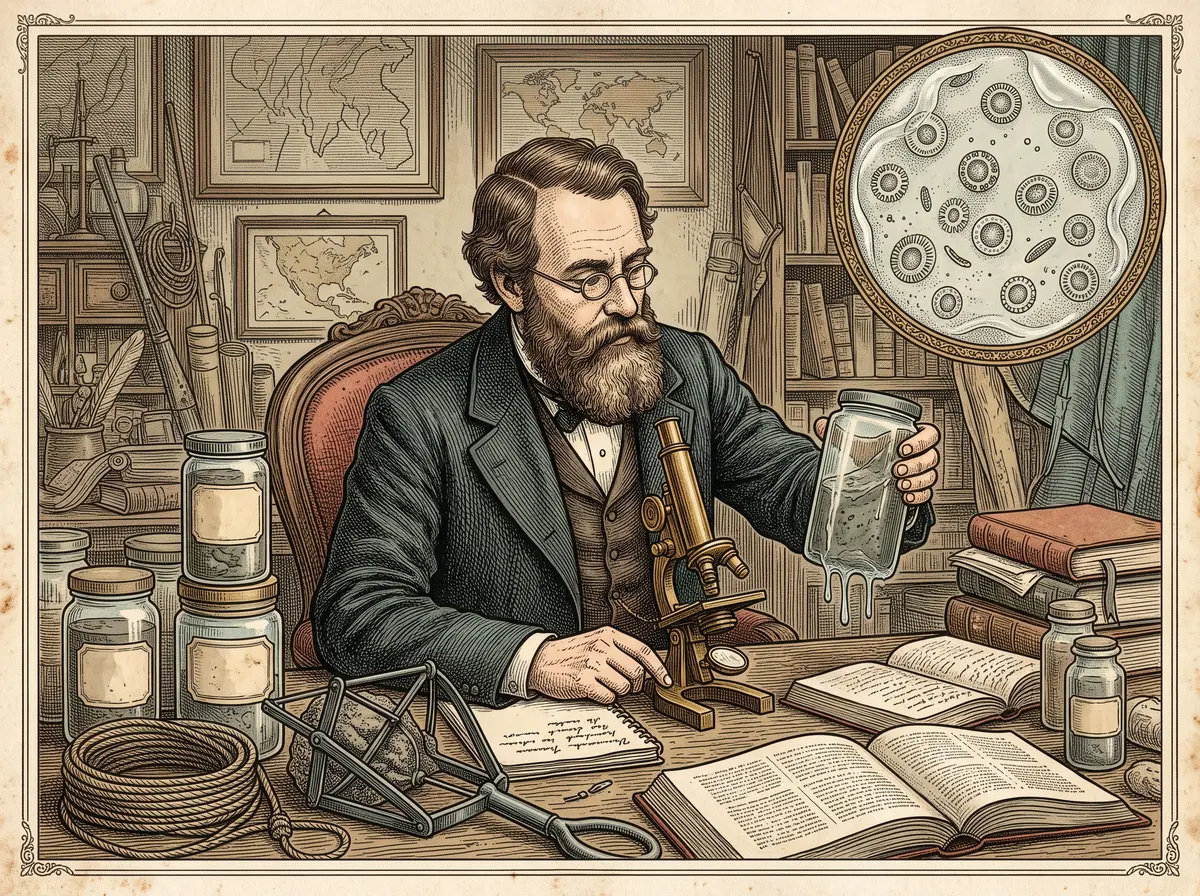
In 1868, Thomas Henry Huxley, one of the most famous biologists in Britain, peered through his microscope at a jar of mud that had been sitting in his collection for ten years. Threaded through it was a clear, jelly-like slime. Huxley decided it was alive: a new organism so simple it had no shape at all, perhaps spread across the bottom of the ocean. Seven years later, a chemist on a ship halfway around the world worked out what it really was. The jar had made it.
By the Curiosities Desk · · 5 min read · Filed under Chemistry · Today’s round
What happened: The Seafloor Slime Hailed as the Simplest Life on Earth — That the
The mud came from the bottom of the North Atlantic. In 1857, the British survey ship HMS Cyclops, commanded by Captain Joseph Dayman, sounded the seafloor along the proposed route for the first transatlantic telegraph cable. Some samples came up from more than 2,000 fathoms, deeper than 3.6 kilometers (about 2.3 miles). Huxley examined them and found the sediment packed with tiny round plates, which he named “coccoliths.” Then the samples, by his own account, “were placed in spirits,” meaning preserving alcohol, and put away.
When Huxley looked again in 1868, he saw something new: “innumerable lumps of a transparent, gelatinous substance” with coccoliths scattered through them. That August he presented it to the British Association for the Advancement of Science, and in October he published it in the Quarterly Journal of Microscopical Science. He called it a new “Moner,” a living blob of protoplasm (the living material inside cells) with no nucleus and no fixed form. He named it Bathybius haeckelii, roughly “Haeckel’s life from the deep,” after the German zoologist Ernst Haeckel.
Haeckel was delighted. He had argued that the earliest life was formless living matter, a kind of Urschleim, or “primordial slime.” Here, it seemed, was a living example. The naturalist Charles Wyville Thomson, who had dredged deep-sea mud aboard HMS Porcupine, described “a diffused formless protoplasm” in his own samples. Haeckel later suggested that Bathybius might be forming on the seabed all the time.
The real test came with HMS Challenger, which left England in December 1872 on a voyage of nearly four years to survey the world’s oceans. Wyville Thomson led its scientific staff. They dredged mud at station after station and kept looking for Bathybius in fresh samples. They never found it.
The ship’s chemist, John Young Buchanan, figured out why. The jelly showed up only after alcohol was added to the seawater in a sample. Buchanan identified it as calcium sulfate (then called “sulfate of lime”), the same compound as the mineral gypsum, forced out of the seawater by the alcohol.
In 1875 Wyville Thomson wrote to Huxley with the news, and Huxley shared it with the readers of Nature. The slime, he wrote, appeared to be “little more than sulphate of lime, precipitated in a flocculent state from the sea-water by the strong alcohol.” He did not pass the blame to anyone else: “I am mainly responsible for the mistake, if it be one.”
Why it was strange: The Seafloor Slime Hailed as the Simplest Life on Earth — That the
Most scientific mistakes involve seeing too little. Bathybius was a case of seeing something that the preservation method had made. The specimen jar wasn’t just storing the evidence. It was producing it.
It also fit what people hoped to see. The 1860s were the first decade after Darwin’s On the Origin of Species, and Huxley was Darwin’s fiercest public defender. A living link between chemistry and life, lying on the seafloor, would have been a spectacular find. With no fixed shape, it was hard to rule out: a blob of jelly looks a lot like a blob of protoplasm.
Haeckel held on longest. He kept Bathybius in his popular book The History of Creation through its seventh edition in 1879 and dropped it only in the eighth, in 1889. Huxley handled it with good humor. At the British Association’s 1879 meeting he admitted, “I am undoubtedly primarily responsible for it,” and said the creature “has not altogether verified the promise of his youth.” Years later, the paleontologist Stephen Jay Gould called Bathybius an “inspired error”: wrong, but the kind of wrong a reasonable scientist could make.
For more episodes like this one, see Science’s Most Embarrassing Mistakes.
What scientists learned: The Seafloor Slime Hailed as the Simplest Life on Earth — That the
The chemistry is simple once you know to look for it. Seawater carries large amounts of dissolved calcium and sulfate. Calcium sulfate dissolves only sparingly in water and far less in alcohol, so pouring strong alcohol into seawater pushes it past its limit. Some of it comes out of solution as a precipitate, a solid that forms inside a liquid. Here it was flocculent: loose, fluffy and gelatinous, not neat crystals. In a sample full of coccoliths, that clear jelly looked like living tissue holding them together.
The biology was more interesting than the mistake. The coccoliths Huxley found in the mud were real, and so were the creatures behind them. They are calcite (calcium carbonate) plates made by single-celled algae called coccolithophores, which live in sunlit surface water. When the algae die, their plates sink and pile up on the seafloor. The deep ocean has no sunlight, so it cannot grow its own food. Most life down there depends on what falls from above.
A similar lesson about water and wishful measurement: Polywater: The New Form of Water That Almost Ate the World.
How it reaches us today: The Seafloor Slime Hailed as the Simplest Life on Earth — That the
Bathybius is an early, clear example of what scientists now call an artifact: a result created by the method rather than found in nature. Microscopists, geologists and biologists still guard against it. A preserving chemical can shrink cells, form crystals or clump proteins. Careful labs run “blank” samples, put the preservative through the same steps without a specimen, to see what the process makes on its own.
The Challenger voyage, where Bathybius finally died, is often called the start of modern oceanography. And the coccolith ooze Huxley first described turned out to matter a great deal. Over millions of years, layers of these plates hardened into chalk, including the White Cliffs of Dover. Today coccolithophores are studied for their part in the ocean’s carbon cycle.
Another case of instruments and expectations leading scientists astray: N-Rays: The Radiation 300 Scientists Saw That Was Never There.
Fun fact: The Seafloor Slime Hailed as the Simplest Life on Earth — That the
Huxley’s slime was a chemistry accident, but his coccoliths still carry his name. One of the most abundant coccolithophores in today’s oceans is called Emiliania huxleyi (some researchers now call it Gephyrocapsa huxleyi), after Huxley and the geologist Cesare Emiliani. Its blooms can turn huge patches of ocean milky turquoise, and they show up clearly in satellite photos.
Sources: The Seafloor Slime Hailed as the Simplest Life on Earth — That the
- T. H. Huxley, “On Some Organisms Living at Great Depths in the North Atlantic Ocean,” Quarterly Journal of Microscopical Science 8 (1868): 203–212. Full text, Clark University Huxley archive: https://mathcs.clarku.edu/huxley/SM3/bathy.html
- T. H. Huxley, “Notes from the Challenger,” Nature 12 (August 1875): 315–316. Selected text: https://mathcs.clarku.edu/huxley/UnColl/Nature/Letters/Notes-Chal.html
- T. H. Huxley, remarks at the British Association for the Advancement of Science, reported in Nature (August 1879): https://mathcs.clarku.edu/huxley/UnColl/Nature/Rep-BAAS.html
- Richard Corfield, The Silent Landscape: The Scientific Voyage of HMS Challenger (Joseph Henry Press, 2003), Epilogue: https://www.nationalacademies.org/read/10725/chapter/14
- “The famous and lesser-known illustrations of Thomas Huxley’s Bathybius,” Ocean Science History (2020): https://oceansciencehistory.com/2020/07/13/the-famous-and-lesser-known-illustrations-of-thomas-huxleys-bathybius/